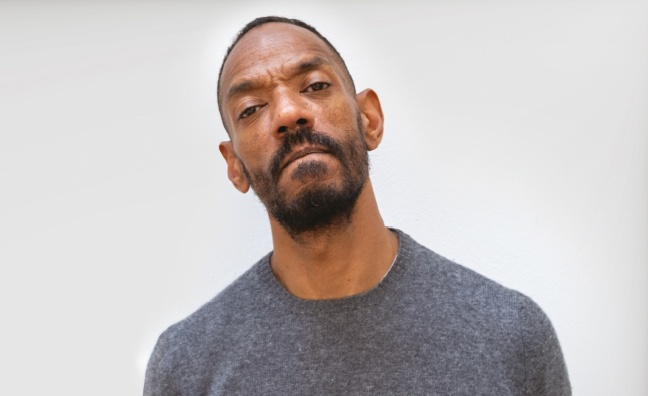
Darcus Beese shared his remarkable industry story with Music Week when he won The Strat in 2019, but this year his journey is set to be illuminated like never before via a new memoir. Rebel With A Cause tracks his path from childhood to the top of the music business, tackling discrimination, industry politics and developing superstar talents in the process. Here, we ask the exec how writing it has changed him and discuss A&R, legacy and beating the odds…
WORDS: YEMI ABIADE PHOTOS: SHANE O’NEILL
There is a passage in Rebel With A Cause, the new memoir by music industry titan Darcus Beese, in which he recounts the first time he was racially abused.
Growing up in Fulham, West London in the 1970s and 1980s, he was never too far from discrimination, but rarely did it pose a threat to his safety.
“I was going to see my brother who lived in the World’s End estate in Chelsea,” he tells Music Week. “I heard monkey noises towards me and when I got far enough, I flipped them off, they started chasing me and I just went. That was the first time I’d been chased.”
While he escaped that day, Beese, the 2019 Music Week Strat Award winner, has been running towards success ever since. His achievements over 30-plus years in the industry speak for themselves. Responsible for steering the careers of a raft of stars including Amy Winehouse, Mumford & Sons and Florence + The Machine, and nurturing those of Drake, Nicki Minaj and The Weeknd, the former president of Island has his fingerprints permanently etched in the DNA of popular music. And the current EVP of Warner Music – which has a JV with his Darco Recordings imprint – intends to find new ways to make his mark.
Right now though, Beese’s focus is firmly on his first book. Instilled with a zeal to make change by his activist parents Darcus Howe and Barbara Beese, he digs into his life story with refreshing sincerity. From his youth discovering his unrelenting passion for music, to a transformative time running Island Records US in New York from 2018-2021, Beese paints every detail with consideration and truth in mind.
Guided in the present day by the principles of his mentors – industry legends such as Chris Blackwell, Jazz Summers and David Joseph to name a few – Beese remains committed to unearthing diamonds in music and breaking stars who will transcend the UK and achieve worldwide acclaim.
“The only thing that really drives me is creation,” he explains. “The journey to having a hit, being in the studio with an artist and hearing something amazing. That has put a Duracell battery in my back since I returned from America. I want to be wherever creation is happening.”
And so, talking to Music Week for the first time since his 2019 Strat Award win, Beese reveals all about Rebel With A Cause, how his ADHD diagnosis impacted the process and the state of A&R in the UK today...
Let’s start at the beginning. Why did you want to write Rebel With A Cause?
“I never sat down and said I wanted to mythologise my story in this way. When I came back from America in 2021, I was approached to write an autobiography, which I wasn’t keen on. Then the idea of a memoir came about. I was a bit emotional after coming back, but I also thought, ‘I’m not a writer, I don’t have the attention span for that.’ I met [co-author] David Matthews, a contrarian just like my dad. We met up every week and had hours and hours of conversation over nearly three years to the point where I found myself in the process [of putting a book together]. It was quite cathartic – almost like therapy. David read out a snippet of a chapter to me and we’d figured out the book’s voice and the rhythm. I became more engaged and once we started laying everything out, I started to think, ‘I’ve been on quite a journey’.”
What did you learn about yourself in the process?
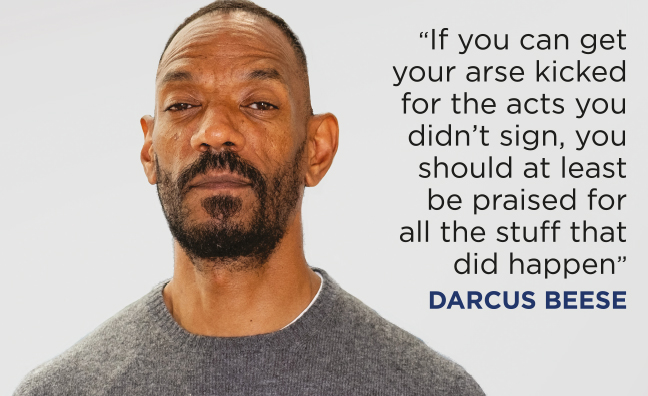
“If I was one of the first to do what I did, and I can lay out that journey and people can take it all at face value and resonate with it, then it becomes more of a resource. I think the music is what makes it an interesting and engaging backdrop, but it’s deeper than that, especially if you’re a person of colour or anyone who sees themselves as the ‘other’. It was never going to be a behind-the-scenes, myth-confirming tell-all. But this process has given me a sense of ownership and pride in what I’ve done in the industry. I learned that I’m really good at what I do. I went through life and all my successes and still didn’t think I was worthy. But if you can get your arse kicked for stuff you missed and acts you didn’t sign, you should at least be praised for all the stuff that did happen.”
In terms of challenges, what was the hardest part of writing it?
“Halfway through, I was diagnosed with ADHD. I always knew I was wired differently and that was the lightning bolt that confirmed it. I had to rewrite the book from this new perspective, thinking back not just to work but to times with family and in school, where I was given all these labels and was very misunderstood, as many young Black men are. Reading the book back was a challenge. Dealing with my mum reading it, my family. I needed to make sure it was framed in the right way and was truthful.”
As you looked back on your career, did you see any choices or decisions in a different light?
“It made me reassess my presence within my family. I thought I was present, but I really wasn’t, and that’s through the ADHD lens, being ultra-focused and able to shut everything out. I realised I had no patience at work, could go from zero to 100 very quickly and push the nuclear button before counting to 10. I could always move with such intensity and I would question those who couldn’t. I had no issue having a roster where eight acts are making records at the same time. I could jump from room to room, from genre to genre, jump on the plane, have a meeting in LA and come back on the same day. Not everyone runs at that speed. Once I got diagnosed, I was almost apologetic to people. Now that I understand this about myself and have calmed down in a sense, I’d say I’ve completely changed.”
The title of the book is Rebel With A Cause, but what makes you a rebel? And how would you sum up the cause you’re fighting for?
“My form of rebellion was to be successful as a Black man and to go left when everyone went right. The cause is just the ongoing perception of me, of us, music, and our place in it. And how I move it forward. That was formed in the fire of resilience – of my background and that of my parents, going to Black civil rights demonstrations in London and further afield places like Bradford. I wanted to become indispensable to the point where I could run a company while instilling that understanding of what it’s like to be ‘othered’. So, you run it differently, through the lens of empathy and patience.”
You talk extensively about your childhood and parents, who were members of the Mangrove Nine. Did you have any reservations about being as open as you were on this topic?
“No, because I think anybody in my generation that is Black knew the stuff we would go through because they went through it too. Mum, working all hours. Dad getting pulled over, arrested and criminalised. Us having to go to school in that backdrop like everything is normal. I wanted to give people a taste of what it is to be young and Black, stuff that doesn’t start with you but your parents and then trickles down to you. It’s just an ongoing battle.”
What was your first experience of racism or discrimination in the music industry?
“I was in a meeting, it was about a soundtrack, and this very posh dude said, ‘Well, the only n-word in the woodpile is…’ I was like, ‘What did you say?’ The dude repeated it and he caught himself and I just stood up, opened the door and said, ‘If you don’t get out of the office now, I’m going to kick you out physically.’ There are other micro incidents but that was the first overt one for me. And there’s a lot of baggage that comes with it.”
In 2019 you reflected on the issues of representation and discrimination in the industry in Music Week. How do you see the picture now?
“I think five years on, if you look at the mix of people that are running the frontlines, you can say that there’s been change. Direction of travel has been good but we are not there yet. We must be very careful not to revert back to old ways. For me it’s never been just about numbers. There is a genuine benefit in bringing all these different voices, perspectives and experiences into an organisation and making it way more about communities. That way you have a team that properly reflects society and has a greater understanding of what’s moving in the culture. But as much as I made that point five years ago, the music industry, or the model that I knew, was all born from breaking acts here and around the world. When you’re on this journey behind an act and going from 100-person capacity venues to 300, to 500, to 1,000, that’s where people used to draw their influence, their power, their passion, their excitement, and that’s what the music industry was. So, in the absence of that, if no acts are breaking, then where does the excitement come from?”
Looking back on your time at Island, what was the one secret to your success?
“I think people like me and that always helps. I always knew that it was going to be a long play, and that it was about a skillset I had to develop. Music is art so if you’re going to curate art, then you have to take that seriously. I was a loner as a kid, and all I had was my mum and dad’s record collection and a cassette recorder. So, music made me feel a certain way. I always work from that position. How does the first line or first verse make you feel? How does the chord progression pull on the frequency of your emotion? None of my career happened by accident. When I got to a point where records needed to be made, I spent those 10,000 hours doing it, and I was able to go on and repeat with different artists and different levels of success. I never really thought it was just about me. I worked with amazing people on the way. It’s the same as a football team; you’ve got to have the balance.”
You’re known as a music man, but do you think you’re an all-rounder and good at the music business in general?
“Not at all [laughs]. I’m a people person. I’ve probably got the mind of an artist, without being as talented. That’s why I’m always in the studio, in the process with artists; that’s where I’m at my happiest. I love the cut and thrust of trying to win a deal, and then you just leave it to your head of legal. It’s better that other people are in the financial meetings, because if you leave that with me, I’ll take the company down [laughs].”
What made you a successful A&R?
“I had some mentors growing up that taught me about A&R and how to make records. Jazz Summers and Tim Parry taught me about songs, layers, lyrics. Julian Palmer gave me a Stevie Wonder Original Musiquarium box set and told me, ‘This is Black music.’ Lucian Grainge gave me that level of seriousness and accountability and responsibility. David Joseph taught me about the refinement of leadership. Lincoln Elias, who was the only other Black A&R when I was coming up, was a reference point with the acts he signed, people like Jamiroquai and Des’ree. Chris Blackwell helped me understand that we live an incredible life because we work with so many incredible artists and people. If you have so many amazing people around you, you’re not going to be bad. You never stop learning.”
Do you stay in touch with all the artists you signed?
“Some, but not really. Me and Jessie J still message each other, Marcus Mumford sent me a track the other day. But through diagnosis, I’ve realised that I find it very hard to manage relationships and friends.”
One of your most successful acts, Amy Winehouse, has been in the spotlight this year following the release of the Back To Black film. What have you made of the debate around it?
“Everybody’s got their opinion. It’s harder for me because I was front row for some of it, in the record-making process. But I thought Marisa Abela was fantastic as Amy, she got her nuances down. All I know is that the Amy I knew would never be intimidated by a room full of men, if that was insinuated. She was very strong willed, super smart, even funnier and more empathetic than in the film.”
How do you remember her personally?
“I remember going to the studio as her and Mark Ronson were starting to make Back To Black. I went to sit down, and the first record that Mark pulled up was Rehab. I told him to rewind it a few times! It was amazing. And Amy is sitting there going, ‘Do you think this is good?’ And I’m like, ‘Yeah!’ She says, ‘Do you think people will think I’m trying too hard?’ I’m like, ‘No!’ She was just one of those people who knew what she wanted and what she was going to do.”
You also worked with Drake, who was in the news with the Kendrick Lamar beef. What was your take on it all?
“Drake’s my guy. We put out all his records from day one, and I loved when they were going at it in the very first instance, and then Not Like Us dropped. And what do I say? I love Kendrick as well, that track on every level is amazing. [The beef] was a burst of excitement that we don’t have enough of, it just woke people up. I love that it became this water-cooler moment. When people ask if there are still ‘moments’ in music, you point to things like this.”
How do you see the quality of A&R in the UK now?
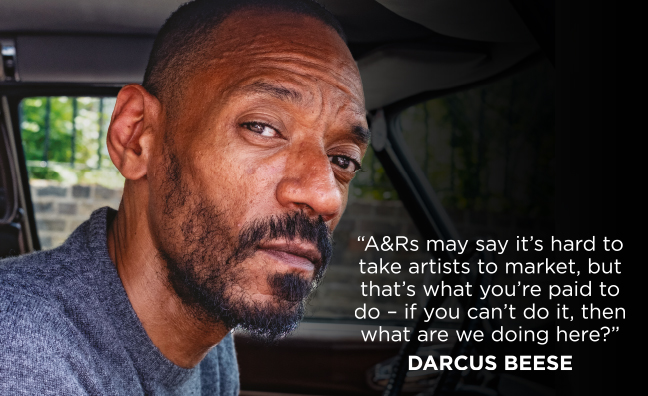
“When you’re in an A&R meeting and people say there’s no artists to sign and use data to back it up, I love the fact that someone went out and put FLO together. Whether you like the music or not is irrelevant; they put something together and took it to market, and now people are talking about it. Then there’s The Last Dinner Party who got signed, made a whole album and toured it. A&Rs may say it’s hard to take artists to market, but that’s what you’re paid to do. If you can’t do it, then what are we doing here? I know it’s not impossible to make records and get some kind of upside. Raye showed you can do it independently, so there is proof of concept everywhere. But in A&R culture, are there mavericks? There are A&Rs that give you culture, that give you amazing records. People that are going to change the dynamic of a room and care about something that 99% of the business doesn’t care about, like finding a young garage girl that turns out to be PinkPantheress, for example. There needs to be more of that, I’d say.”
How are you finding life at Warner?
“Warner has been a great partner and has been patient with Darco Recordings, considering how difficult the landscape is now. The backing they’ve given me, the label and its artists has been great, second to none.”
You told Music Week in 2019 that you were jaded by the end of your time in the UK, and the book outlines a tough time in the US. What happened exactly?
“It felt like I’d reached my limit in terms of success, nothing was going to top what I was doing at the time and if that was the case, then there had to be a changing of the guard. The opportunity of America came at the right time, but it kicked in another 10 gears of what being an executive is and how my diary just blew up to the point of unsustainability. I loved my first year in America but as soon as Covid hit, and we were amid the last election, America just got too toxic. Being a CEO, Black and separated from my daughter who was still in the UK… The cops are still killing Black people with impunity even after George Floyd. There were a couple of instances that let me know that despite my success, I’m still Black in America. It became hard and tiring, my ADHD was exacerbated, and I was unknowingly depressed. Since I’ve come back, been diagnosed and started therapy, I’ve become less of an obstacle to myself. It’s given me a lot more understanding of my story.”
Do you regret leaving the UK?
“Yes, only for the effect it had on my family. Whether it was me being selfish saying we’re going over there, or me being selfish saying we were coming back. I didn’t realise the emotional toll it would take. I both would and wouldn’t go again, but I’d have a better understanding of myself if I did.”
Where do you feel you fit into the UK industry today?
“Being in the studio, with artists. Making records that can hopefully travel. The delivery system changes with technology, but my tastes don’t, so you’ve just got to find communities of people that feel the same. At Island, we were just a small label amongst all the others, that curated what we knew, and that’s all I can do. Through my actions, I’m still talking to people and listeners who have a profound relationship with music.”
What do you make of AI and its changing role in the industry?
“I think once legislation and best practice comes into effect, a lot of goodness can come from it. But in the meantime, what do you do? You experiment with it. Right now, we’re probably in beta mode with AI. I completely get the threat of infringing on people’s image and music and that needs to be protected. But if you can keep the human in the room, if you can keep the soul in the room, then it should be an added tool.”
How would you sum up the state of music in the UK now?
“The UK has lost its way in terms of what our offering is on the world stage. We were very good at bringing different cultures and sounds together and we were very good at genre-bending club music that would somehow find its way up into a pop zeitgeist moment. This came from a hybrid world of garage, drum & bass, grime, four to the floor, hip-hop. We used to be able to bottle that and send it around the world. Everything feels homogenised now. Everybody’s making records for the algorithm rather than for communities. There needs to be room for more new and exciting music to show the world what we’re about. I’d also like to see more belief and investment in career artists and their communities. Investment in the pipeline that brings developing artists to the fore, especially live shows, is important too, as is the belief that everybody involved in the journey should have a fair and equitable slice.”
Where are you going next?
“I want to be in partnership with artists and not just in the record business. In the record business, we try to get other bits of the industry, like a percentage of live rights. But what if an artist puts everything in the pot – brand money, live money, publishing, records – and we just invest? I remember with Tinchy Stryder, we invested in his Star In The Hood brand, but it was driven by the records and made a lot of money. It wasn’t a record deal but an investment deal. I just want to be more entrepreneurial and across all of the different verticals.”
Finally, what do you want your legacy to be?
“The book. And for me to have been an open book. Being so open gives real people insight, so I hope it encourages people not to miss opportunities for themselves.”
 FOLLOW