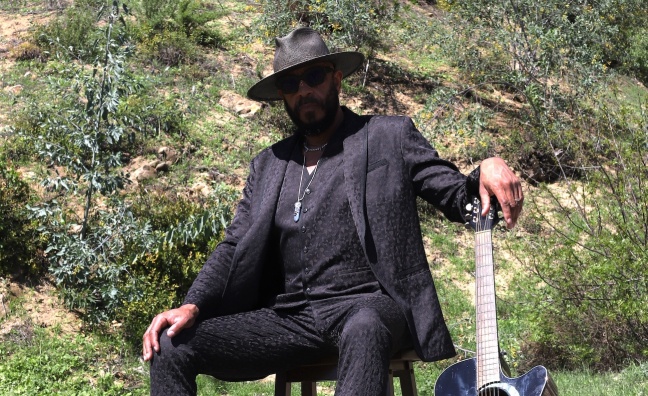
US singer, songwriter and producer Peter Lord – a founding member of The Family Stand – recently released his Songs From The 8th Dimension EP.
He is also an established songwriter with hundreds of tracks including credits on songs by Paul Abdul, Nicki Minaj, D’Angelo, Macy Gray, Common, Hall & Oates, Patti LaBelle, Lalah Hathaway, Heather Headley, Will Downing, Idina Menzel, Catherine Zeta-Jones, and more.
In recent years, Lord has worked increasingly in film and television, as a screenwriter and filmmaker.
Here, he opens up about returning to recording with the new solo project and his catalogue of hits.
What inspired Songs From The 8th Dimension and how does it reflect your evolution as a songwriter over the years?
“In recent years, I've been focused on film and television projects, as a screenwriter. So a lot of the songs originated as part of this project called Love Junkies, which is a TV musical. When I say TV musical, don't think Glee or anything like that, but Tarantino, Scorsese and David Lynch-meets some alternative rock, pop, hip-hop, etc. That project is still in the works. There are a couple of songs that were inherently written to be duets and so I worked with some great singers and actresses – on Boom is Didi Dionne, who's a great singer-actress, and there’s And The Sun Is A Dying Star that Terra Naomi sang on. So it was just part of the organic process.”
Did you experiment with new sounds and collaborators?
“Yes, somewhat. I mean, on a certain level I consider myself a neo-classicist. I knew on this album, I wasn't trying to bring back the ’90s or early 2000s and I didn't have any intentions of wearing a G-string and doing the running man on stage or anything like that. People will ask, ‘Well, what makes a hit?’ What makes a hit is marketing, past a certain point, but it starts with a great song. I can't try to predict or think, ‘this is what people (or the record companies) will like’. But just to write a sincere song that comes from a sincere place for me emotionally, and that's how the songs generate. I think Quincy Jones said this once: the top line can stay the same, but the sonics and the beats and the rhythms is what makes something current and doesn’t sound stuck.”
The lead single Boom is this big, catchy radio-friendly track, but it also hints at something deeper. What were you hoping to get across with it?
“The story of that song, which is also related to the original seed of the Love Junkies project, has to do with people dealing with their addiction triggers and using music therapy to deal with these addiction triggers. There’s a line in the song that says, ‘I forgot the lessons learned, and everything went boom’. So I felt that that's something that people could identify [with] in general, personally, when they get to a point that maybe went too far, and they had to start all over or regroup themselves spiritually or emotionally or mentally. But also going on in the world right now, particularly in America and this President, is that this country forgot the lessons that were learned. So it can be taken on that personal level, but also on a world level, socially, politically.
What makes a hit is marketing, past a certain point, but it starts with a great song
Peter Lord
When you're writing for another artist, how different is your approach compared to when you're writing for yourself?
“Not much other than just try to think in a broad concept of writing for somebody else, but I write from titles most of the time. I might go to the piano, the guitar, and start having some stream of consciousness, and might be singing ‘yabba, dabba do’. You know, eeny beanie, chili beanie, whatever, but then you go into a state. That's why I don't believe in writer's block, because if you see yourself as just a vessel for something that's coming through you, I'm not thinking of it – it's coming through me, and it's my experience with that day. Once I have a vague idea of a feeling, then I want to know what my title is, because when you know what your title is for a song, it's easy to get where you're going.
“To me, I see the analogy as a bunch of gas, and that's the energy of it. But until you form that gas into something solid, then it becomes a planet or a sun, then it becomes a galaxy, and then a universe. So instead of looking at [song] structure as a restraint, structure is freedom, because then you can build something from it. Now, formula isn't freedom. Formula is some other stuff, but structure is freedom.”
You’ve had some huge global hits including Ghetto Heaven with The Family Stand in the ’90s. When you look back at that now, did you expect it to have the staying power that it's had?
“Well, no, we don't really think about those things when writing a song, we just wanted to tell a story that resonates with people. There’s always a story in different layers to the things that I write, maybe that's why I thought Songs From The 8th Dimension as a title for the album would kind of fit. But with Ghetto Heaven, I was just thankful that it ended up being what it was. I was telling different stories that could be taken from a personal level, but then also to a social level, without being preachy. Some people misunderstood what Ghetto Heaven was about; it was about how do you find relief or release in the context of a world that's pressurised or is not always a haven for nurturing you. And for some people, that heaven might have been a drug, it could be religion, or could be the best drug, the beauty of a real love.”
You also won Billboard Pop Songwriter of the Year for your work with Paula Abdul. Have any of your previous hits taken on new meaning for you now?
“Yes, in some ways. Some of the biggest like Rush, Rush [by Paula Abdul] and Ghetto Heaven, which are very different songs, very different worlds, in time I've come to appreciate. Even though there might have been songs I loved more – Blowing Kisses In The Wind – that musically or lyrically I might like better. But the power of Rush, Rush is kind of a perfect song – the simplicity of it and structure, even though I'm like, ‘that's not the best thing I ever wrote’. Even with Ghetto Heaven, which is also a very simple song, but to take something that's simple, and you're fortunate enough to create something that has a profound meaning but beyond your initial intent – that's what I've come to appreciate in those songs even more.”