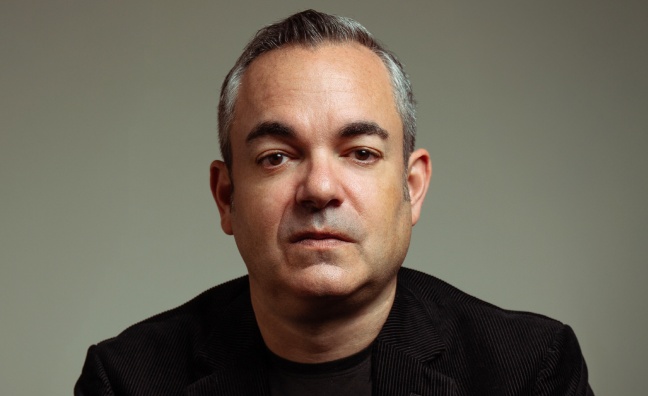
Already one of the most famous live execs in the game, Kirk M Sommer will receive another feather in his cap when he gets the International Music Person Of The Year award at Musexpo (March 24). To celebrate that – not to mention his recent birthday – Music Week finds a space in WME’s global head of contemporary music's schedule to trace his path from the postroom to the very top of the business. Here, he talks working with Adele, Amy Winehouse, The Killers and more, plus the importance of data and his office almost catching fire…
WORDS: KAREN BLISS
PHOTOS: ANDREW LIPOVSKY
Kirk M Sommer has had quite the week. In the build up to celebrating his “almost big birthday”, his 49th, WME’s senior partner and global head of contemporary music went to see Nine Inch Nails at the Prudential Center in Newark, New Jersey, got home at midnight, then set his alarm for 3.30am to fly to The Killers’ drummer Ronnie Vannucci’s 50th birthday in Carmel-by-the-Sea, California. On Sommer’s actual birthday, his WME colleague Sam Dolen decorated the front of his office door with red velvet ropes and inflatable unicorns and dinosaurs.
“I made sure nobody could get in and do anything crazy or create a mess that would drive me nuts, that I would have to clean up,” Sommer reveals. “Then I confiscated [Dolen’s] industrial-strength confetti blowers, turned them around on him and made a mess of his office.”
WME’s co-chair Christian Muirhead ordered pizza and sandwiches from Sommer’s childhood friend’s pizza shop, only for the box to catch fire on his desk.
“It happened to be the day after we had someone in the office telling us what to do in the event of a fire, so I picked up one of these cans of green tea and I put the fire out,” he laughs, pointing to a stack of drinks behind him.
Thankfully, things are much calmer as Music Week encounters Sommer in his New York office. He spent 22 years in WME’s Los Angeles outpost, but is now back home in the Big Apple where in his university days he booked acts at NYU.
His trajectory is textbook, starting in the postroom (yes, really) in May 2000 and working his way up the esteemed agency, building a roster that includes some of the world’s most sought-after acts. His client base includes (deep breath): Adele, Andrea Bocelli, Arctic Monkeys, Billie Eilish, Benson Boone, Lewis Capaldi, Lola Young, Hozier, The Killers, Nine Inch Nails, Sam Smith, Sam Fender, Teddy Swims, Carín León, Weezer, Sienna Spiro, Paolo Nutini, Pet Shop Boys, Morrissey, Olivia Rodrigo and more. He also represented Amy Winehouse.
In recognition of his achievements, A&R Worldwide will honour Sommer as International Music Person Of The Year at Musexpo this month. Last year, Pollstar named him Agent Of The Year and in 2024 NYU inducted him into its Hall Of Fame.
Sommer is clearly feeling elated about the upcoming award, but with characteristic humility, he takes an industry and company-wide view.
“I would say the timing of this award is important to me because I don’t think there’s ever been a bigger opportunity in live music and that opportunity is globalisation,” he tells Music Week. “We book 40,000 shows a year and 2,000 festivals in over 120 countries, and every year the number of countries grows. There are more artists touring than ever before, and non-English-speaking artists are selling more tickets in more places than ever before. This is an opportunity to shape the future of this agency – that’s what is most important to me.”
Sommer’s varied roster reflects his upbringing, listening to everything from his uncle’s Grateful Dead records to reggae, jam bands, rap, hard rock, zydeco and “even some opera”, he says. He tried playing drums, guitar, trombone and bass, but he had friends far more gifted and no shortage of other interests. He was also captain of the football team, pole-vaulted, played on a competitive baseball team and loved cooking.
But it was music that had the most pull. At NYU, he started organising events, including bookings for Run-DMC, Biz Markie and Tricky.
“I was doing quite well promoting these different events, tube socks full of cash,” he recalls.
After graduation, he landed an internship at Delsener/Slater, run by legendary live execs Ron Delsener and Mitch Slater.
“It was for no money,” he says. “I showed up there maybe two hours a day, two days a week for a few weeks, and I quickly learned I didn’t want to be like an air traffic controller, placing holds and not really influencing anything.”
Instead, he took a chance and went to Los Angeles, interviewing everywhere he could, including WME.
“I met a guy named Peter Grosslight [former global head of music at WME] in a beautiful, art deco-y office with pictures of The Eagles and the Pope, and I felt like I could relate to more people there than anyone I’d encountered anywhere else,” Sommer says. “But I accepted multiple jobs on that trip, then I flew home and packed up my apartment on Mulberry Street and the [removals] trucker came with a Rottweiler who marked his territory all over the carpet! I hadn’t unplugged the answering machine and a guy named Benjamin Scales [former global director of operations at WME] had called to offer me the job. So thank God I didn’t unplug that machine. I thought, ‘That was meant to be.’”
He landed in the mail room as a trainee, making $300 a week and, 26 years later, he’s senior partner and has mentored dozens of aspiring agents.
Before settling in for a riveting Q&A with an exec who clearly enjoys spinning a good yarn, Music Week jokingly tells Sommer that if he needs to pause at any time to grab a coffee or, say, take a call from Adele, he can just tell us. Without skipping a beat, he grabs a bedazzled ‘Hello’ phone receiver and holds it up.
“A little prop,” he laughs. “I cleaned a bunch of stuff out and was like, ‘I’m going to hang on to this.’ That was from her dressing room at Caesars Palace.”
He adds that he could, if we wanted, do the interview wearing Marshmello’s famous white headgear. And while it is tempting to ask Sommer to trawl further through his archive of memorabilia, it’s time to get into the serious stuff…
Being presented with an award at Musexpo represents another landmark. Does it give you cause to reflect on your story so far?
“We came up in a system where we’re not necessarily directly rewarded for any levers we pull or buttons we push. In other words, there’s no direct correlation between a show I confirm and my bank account. We came up trying to do the right thing. And oftentimes that means saying no to a lot of money because there can be attachments to that money, or it’s not the right thing to do, it’s too much, too soon, or it’s not on brand. I feel extremely lucky and I’m beyond grateful to work with the artists I work with and have the platform and support that I do. I got very lucky in signing what some people say is the biggest British band from America: an unsigned band called The Killers. I was able to learn in real time, touching all the spokes on the wheel – whether it was lawyer, business manager, publicist, label or tour manager – how to build a long, sustainable career. From there, that took me to the UK and I signed Amy Winehouse, then Duffy, Ellie Goulding, Adele… after that, your reputation becomes everything.”
Working with the likes of Amy Winehouse and Adele so early in their careers must have been some experience?
“I’ve been very fortunate to sign a number of artists early on. Now, Amy already had a great album – Frank was out – and I was a fan. I remember flying to London and seeing a great, big billboard of Amy and I was like, ‘She’s the one.’ Thankfully, we had a relationship with [former manager] Raye Cosbert, and we found ourselves in business together. I remember her show at the Roxy [in LA] – there are maybe a handful of shows like that where you’re just witnessing greatness. It’s incredible in every way. Adele at [LA’s] Hotel Cafe was another. She was obviously a powerhouse vocalist and also very funny. I knew she was brilliant. She was young and there was just something about her voice that was almost in a league of its own.”
Moving on to The Killers, how would you sum up the impact signing them had on your career?
“I’ve viewed them as my North Star in terms of having a quality control filter; I wasn’t going to work on something just because it might be successful or others were asking or telling me to do it. I learned pretty early on that if it didn’t make my heart sing and I didn’t love it, I probably wasn’t going to work on it. And working together did afford me the opportunity to be patient, because they had tremendous success and a very quick ascension. So I applaud them for doing things the right way – listening, putting in the work and not skipping steps.”
Can you sum up your approach to the craft of being an agent?
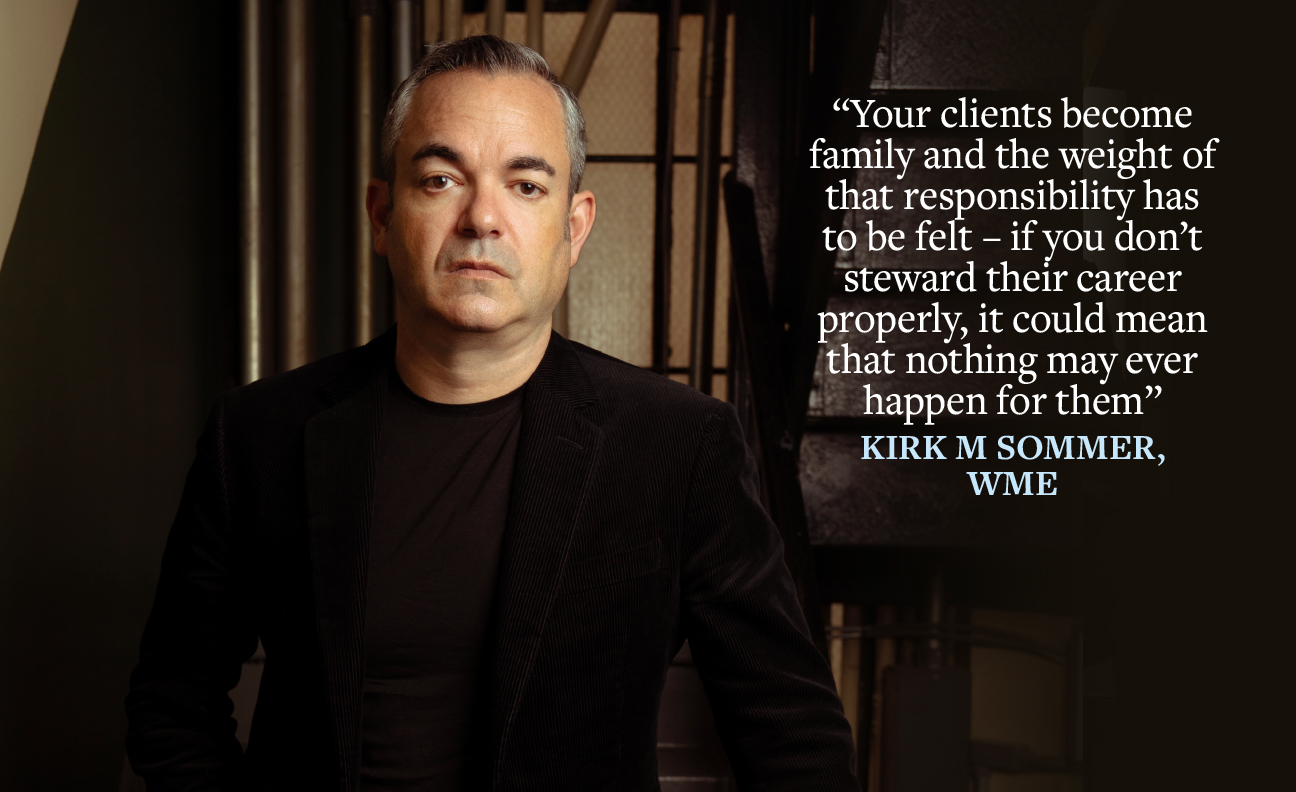
“Well, make no mistake about it, these are people’s livelihoods. Some people only get one shot. These clients become family and the weight of responsibility has to be felt. If you don’t steward that career properly, it may mean that nothing ever happens for that someone.”
Do you still feel that same motivation today?
“One thousand per cent – more than ever. It’s just been my thing. Marc Geiger [chairman & CEO at Gate 52] was my boss years ago, and I would call him a mentor. He once said to me that if there was something I felt strongly about, I should go at it like a heat-seeking missile. I had to work with it, but it didn’t happen every year. He said, ‘You sit back and play clay-pigeon shooting. You’re not signing everything, but the slugging average is huge, meaning the success rate is high.’ I knew I wasn’t someone who was out there with a net or gobbling everything up like Pac-Man, to see if someone has some success and to then benefit from that. I’m looking for it, and when you know, you know. That’s always going to be very important to me. I get great satisfaction from building things, taking them from scratch up to arenas and stadiums.”
Do you put a lot of pressure on yourself in that sense?
“Yeah. I feel that stress right now [laughs]. I wake up with it and I go to sleep with it. Everything has a place, and it’s about asking, ‘Where does it belong and how are you going to move the needle?’ It doesn’t matter who it is, whether it’s some of the biggest artists today, or one of my newer signings, Sienna Spiro or Lola Young. It doesn’t matter if they’ve already sold out arenas and stadiums. With experience, you learn a bit more about things to be mindful of, how to keep people healthy and happy, and how to do everything with purpose and intention.”
Can you elaborate on what you mean?
“A lot of people can go on a merry-go-round of a tour, and it will just be a bunch of shows and a bunch of generic rooms, and then the tour’s over. So, it’s identifying the moments: how are you going to cut through? What’s it going to be? It can’t just be formulated. Not every artist is the same; everyone has different ambitions and aspirations. Oftentimes, when it’s a new relationship – and some people may not know the answer – I’ll start with, ‘If you could do anything in the world, what would it be?’ and, ‘If you could tour with anyone in the world, who would it be?’ I also ask, ‘What have you seen that you think is horrible?’ or, ‘What scares you?’ Obviously, I’m a huge proponent of artist development and the idea that doing too much too soon could be the kiss of death.”
What is your approach to communicating with artists and their teams when building tours?
“You always have to try to lead with what’s right. Sometimes you’re closer to someone or a team and other times you’re not, but that someone still needs help or [given] time to work on things. You have to be responsible and you’ve got to apply the brakes. Making someone do something unsafe or something they’re not going to be happy with isn’t good for anyone. So, when an artist needs help or isn’t happy with something, you can’t tell them to do it. You have to protect them. And I tell a lot of the individuals around here, whether it’s support staff or colleagues, ‘You gotta lead with life first.’”
Following on from the international success of Lola Young, Olivia Dean and others, what do you think of the UK talent pipeline right now?
“The interesting thing is that those artists are homegrown. They were cultivated within the UK and now they’re translating here. Olivia Dean is massive and Lola, she’s the real deal. She’s going to be around a long time. I’m really excited to see what she wants to do and how far she wants to go because the sky’s the limit. It’s the same with Sienna. They’re both very different, but very ambitious. It’s an exciting time, but yeah, it feels like there was a little bit of a lull. Some of that could have been related to Covid, or data-driven decisions, or not spending money on artist development or taking shots on talent. Added to that, nobody could tour, so how were they going to get out there? How were they going to cultivate their craft? So now that these people are getting out there, there’s more to do. And I think the labels are investing again.”
Speaking of labels, do you think they are putting enough emphasis on live?
“Oh, more than ever. I mean, look, I have some nice relationships with some very successful and smart label executives, but I would say it’s the first time in a long while that some managing directors of labels are coming through our offices asking which artists are selling tickets that they’ve never heard of. Because at the end of the day, that’s the biggest commitment a music fan is going to make: buying a ticket and going to a show. That says something; that means something. Also, some music will never be heard if people don’t perform live – it just won’t. We’ve seen a lot of data supporting the direct correlation between performing live and an uptick in streams, followers and social engagement following those shows.”
On the subject of data, you wrote a piece for Variety last year advocating for artists to own their own data. Why is that so important to you?
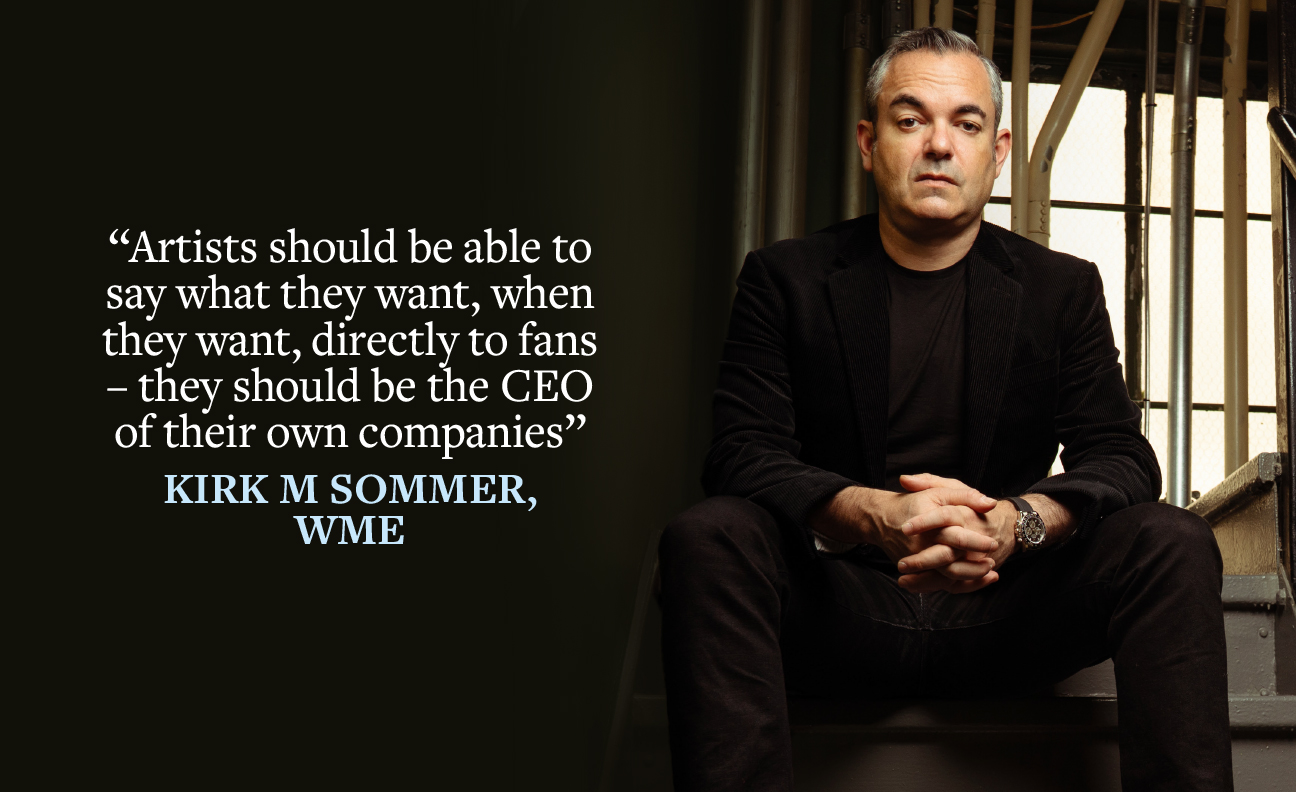
“I’m not a big fan of putting a Band-Aid on something. Even internally here at WME, say we have a bunch of solutions at our fingertips that could be patched together to improve efficiencies, accuracy and deal interrogation. But why wouldn’t we have our own software developer that makes our own programme in real time that never gets outdated? And if we’re looking to broaden the business and we’ve gone private, who’s to say we can’t be the leaders in that [or] lease some of our products? In a similar sense, why should we be beholden to others? Why should artists have to go to different sources to get their customer data? Why do you have to go to Square when the person’s purchasing your merchandise? Why do you have to go to some subscription list when people are signing up to hear from you? The artist should be able to say what they want, when they want, directly to fans – sell them what they want, give them what they want. Artists should be the CEO of their own companies.”
Are there any other issues in the modern industry that bother you?
“I wouldn’t say modern. I’d say archaic, like ticketing.”
Some in the industry are arguing that fans are being priced out of seeing their favourite artists. Where do you stand?
“Of course, there are people who don’t have discretionary income – or who have very little discretionary income – to spend on tickets when they should be paying rent or putting food on the table. But, personally, I’ve always been a strong advocate for the ‘something for everyone’ model. Tickets shouldn’t be cost-prohibitive, and there should be [affordable] get-in prices. At the same time, you should be able to charge what you can get, or what someone’s willing to pay. Once these tickets are sold, the secondary market becomes one of the largest growth areas. It’s a huge business. The more people can price tickets closer to the market [reality], the better off for everyone.”
Another issue for the live sector is the merits of prioritising headline shows over festivals, or vice versa. What’s your take on that debate?
“It depends on the act. I’m a huge advocate of the festival circuit – certainly ones that are culturally relevant. Just the idea that this act would probably be making significantly more money at a festival than they would ordinarily, because they’re playing in front of I don’t even know how many times more people. But recently, the cost of talent acquisition has gone through the roof, as have all expenses. We just talked about pricing the market, which means an artist is going to gross more on that kind of headline run on a per show basis. The other thing; I work with some artists who I firmly believe should be in their environment with their full show – not dealing with other variables, being in an open field or on a stage without their full production. You’re not getting a complete show that way.”
What other challenges is the live business facing in 2026?
“Everyone knows costs are rising and that’s hard on everyone. I’ve also noticed that when you get into big tours, you really need to look after not just the principal players or the artists, but the entire team and crew. Their wellness is really important. It’s not easy being on the road, loading in, loading out, not getting sleep or having a healthy meal and some downtime. You really have to be mindful of that. The other thing is that there could be a lot of improvement from an environmental impact standpoint. I mean, I know some of the newer venues have made a real conscious effort to be a little bit friendlier on the environment, but I think there’s a lot of work to be done.”
In terms of day-to-day at WME, what is the biggest obstacle for you?
“Sleep, if I’m being honest. I’ve done a sleep study, I’ve done everything… I just don’t sleep. I’ll look at the clock and hope that it’s late enough to get out of bed to get to work. And because I’m in New York now, I’m pushing on people in the UK, like, ‘It’s go time!’ I don’t have a lot of patience either, meaning everyone has to be accountable. If you say you’re going to do something, do it. Lately, I’ve also been saying, ‘Every no’s a no until it’s a yes.’ Persistence pays.”
What are your priorities at WME for the rest of 2026 and beyond?
“Opening new offices, acquiring managers, agencies and having strategic partnerships with them so that we can do best-in-class deals locally. It’s having people that feel, smell, touch everything. I was a big advocate of us putting boots on the ground in Sydney, Australia, and I’ve been a big advocate of building out the Miami office. India, Africa, the Middle East, Germany, France, Spain… all of those places are exciting to me. And infrastructure continues to be built. I was in Tanzania recently and someone was showing me plans for a stadium and they had no shoes on. It’s for sport, but I know there will be concerts; it’s just a matter of time.”
Finally, in terms of your own future, what is left to achieve?
“Honestly, I’m not just saying this, but I’m just getting started. I’ve never been more excited. I’ve never had more energy, even though I don’t sleep! Part of it is because our business is always evolving. I’ve been at the company for 25 years. A lot of people say it’s a long time to be at one place and I say, ‘Well, it’s been 10 different places, and we’re continuing to evolve.’ The bigger part of it is because I’ve mentored a good dozen or so people who were my former assistants and are now very successful and are a big part of the backbone here. So, expanding and getting boots on the ground around the world, that’s all super exciting to me.”