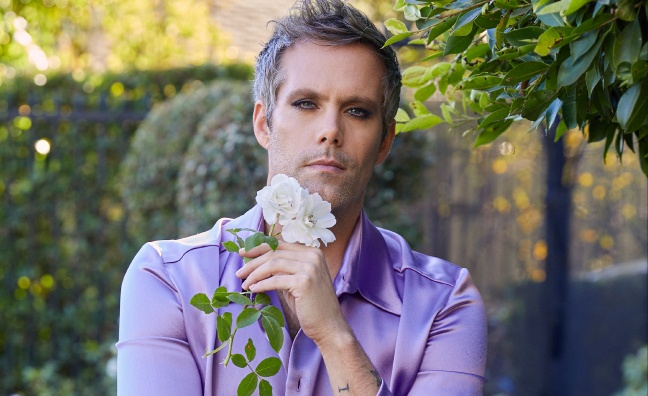
Justin Tranter is, quite simply, a hitmaker extraordinaire. With a CV bursting with top-level talent – from Lady Gaga, Britney Spears and Ariana Grande, to Chappell Roan, Justin Bieber, Selena Gomez and more – they are a force to be reckoned with. What’s more, Tranter also runs Facet House, a records and publishing business, with Bea Miller and Rose Gray among a growing client base. Ahead of MUSEXPO 2026, where they will collect the Global Songwriter Award and take part in a keynote interview, what follows is a riotous insight into an inimitable songwriting legend…
WORDS: KAREN BLISS
PHOTOS: SEQUOIA EMMANUELLE
Justin Tranter is mid-flow, only to be unexpectedly interrupted. Sally (as in Bowles, named after the character from Cabaret), one of Tranter’s two rescue dogs arrives, catching the hitmaker off guard.
“She never leaves the laundry room, so this is very exciting,” they say, adding that their other dog is named Izzy. “Rescuing large dogs that most people don’t want to rescue because they’re too large and too old is a huge part of my daily life.”
But rescuing dogs is not the achievement that has prompted our encounter with Tranter in their Los Angeles home today. We are here to celebrate their monumental achievements as a songwriter, the latest of which is soon to arrive in the shape of MUSEXPO’s Global Songwriter Award from the prestigious A&R Worldwide institution. The news is still sinking in.
“It’s wild,” says Tranter, whose songs have sold over 75 million singles and racked up more than 100 billion streams. “I feel so grateful to have had success for over a decade now. I don’t take a second of it for granted because, in the grand scheme of humanity, coming into success at 34 is very young. In music, becoming successful at 34 is very old on the creative side. So, here I am at 45 being honoured for the craft of songwriting, which I love more than anything.”
Nor is this the first time honours have come their way. They have been up for multiple Grammy and Golden Globe awards, secured 16 BMI pop awards, two BMI Songwriter Of The Year titles in a row, and the 2023 SONA Warrior Award. Tranter also won last year’s International Song Of The Year at the BRITs for Chappell Roan’s Good Luck, Babe!.
“I understand why straight men didn’t get Pink Pony Club because it’s not for them,” they say of Roan’s breakthrough single, which they were not a part of. “They should get it because it’s just a masterpiece. But I feel like if you’re a girl, a gay, or a they, and you hear it and don’t realise that that’s a superstar, you need to have your ears checked.”
Founder of their own label and publishing company Facet House, Tranter is an outspoken advocate for both songwriters and the LGBTQ+ community, and wastes no time in sharing their take on the challenges ahead.
“There is a fear, I can feel it in my daily life,” they say. “Take the government out of it, I can feel it in the music business, [a sense] of people just not giving a fuck anymore. So to see the effects of the government already fucking up the little progress we made in the music business is pretty dark.”
On top of their campaigning, the list of Tranter’s hits is seemingly endless, spanning pop-culture moments such as Justin Bieber’s Sorry, DNCE’s Cake By The Ocean and this year’s Internet Girl by Katseye, as well as songs by Ariana Grande, Dua Lipa, Lady Gaga, Britney Spears, Miley Cyrus, Cardi B, Sam Smith, Kid Cudi, Janelle Monáe, Demi Lovato, Katy Perry, Reneé Rapp, The Chicks and Kim Petras. They were also the executive producer of 2025’s A Very Jonas Christmas Movie, which features seven new Jonas Brothers songs.
All of which is all the more impressive given what happened to Tranter’s initial foray into music with New York rockers Semi Precious Weapons.
“So much of the ethos of the band was about being young, femme and queer and broke,” they smile. “Very specifically, a lot of it was about being broke.”
Now in a significantly different financial position, Tranter offers up deadpan reflections of his rock’n’roll past.
“I had a really awesome, passionate fanbase, and that did include 10 really famous people, which made my band seem way more successful than it was,” they laugh. “But, as far as business was concerned, we did nothing but cost multiple record labels and publishers millions of dollars.”
Fast-forward to the present day and, in addition to executive producing New Jersey singer Bea Miller’s upcoming album, Tranter is busy writing for the CoComelon animated film (due out in 2027).
“Watching Ariel flip her hair and sing her face off in The Little Mermaid changed my DNA, so getting to do an entire animated musical, is something I’ve been dreaming of ever since,” they exclaim. “Obviously, CoComelon is a phenomenon based on nursery rhymes, so we are being very respectful to that, while also taking it to new heights with original songs and interpolations as well.”
What’s more, for the first time in years, Tranter is working on a project of their own called The Great Thirst, with an array of guests.
“It’s a progressive alternative pop one-woman show starring me – those songs are about my life,” they say.
“I call it a post-pop, post-apocalyptic musical. Because I went to a really bad public school 40 miles outside of Chicago, I don’t think I have the education to write an actual novel, so my musical is the closest I should get to it!”
Without naming any names, Tranter tells us that, “some of my favourite musicians ever are going to be on it”.
“I did a couple of private workshops of the show and I’m working on the album now,” they add. “I’ll sing half the album and then other people are gonna sing, people I’ve loved for decades. I’m hoping it will be out around summer-ish.”
Before that, though, there’s much to discuss, as we look back on Tranter’s incredible story so far…
Let’s start with your approach to songwriting. Is there anything in particular that you do when you start working with an artist?
“I follow the artist’s process. None of it is about me. I haven’t written a song about my life – that the world has heard – in 12 or 13 years. So, if they want to go for coffee or dinner first, great. If they just wanna get to work, great. I always feel like I can have a great conversation with the wall, so for me, I don’t need a pre-hang. But, if the artist wants a pre-hang, of course. A lot of the time, I find the song during that first conversation before we start writing. Once you really know the artist, you can end up hanging out longer before you start writing because now you’re friends. But in those first couple of sessions, I basically am trying to perform the most subtle interview possible [laughs].”
Can you shed some more light on those relationships with people who become close collaborators and friends?
“Everyone works completely differently and also exactly the same. The nuance is always different because we’re all different people. With Lady Gaga, for example, I worked on two songs on [2020’s] Chromatica, but we had already known each other for 11 years [before the album came out] and in those 11 years, she became a superstar; I became a hitmaker. You know, I never ever want to spill an artist’s tea, but if you listen to a song like 911, even though it’s up-tempo and fabulous, you can hear there’s some real conversations in there that turned into the song. So even though she’s very possibly one of the top three greatest live performers of the last 20 years, you still just write a song the same way. We all just get in a room and write a song – I always wish the stories were crazier and better.”
You could always just lie to us…
“I could lie! [Laughs]! If I was an artist, if the songs were about my life, I would lie like crazy.”
Speaking of crazy, Internet Girl by Katseye is full of lots of eye-catching lyrics. Tell us about how that came together…
“That process was actually a great one. Mattman & Robin, who I’ve worked with for a decade at this point, are dear, dear friends. During Covid, Robin started a family and they live in Sweden. We’ve been working a lot less just because of logistics, right? First there was Covid, then there was kids. So I was like, ‘Hey, I’ve been working with this girl Livvi Franc. We’re really hitting it off together. We’ve never worked this way, but do you want to just send me some tracks?’ Julia Michaels and I wrote Justin Bieber’s Sorry to a track. Most of the time I don’t write to tracks; we create from scratch in the room, but obviously Sorry did pretty darn well, so I was like, ‘Fuck it. We can write to a track, not from scratch.’ And so, they sent me one, and it already had the baby voice, ‘I’m getting out of here’ and the whole ‘eat zucchini’ part. To me, it feels like Black Eyed Peas meets Le Tigre, riot grrrl meets dance party. When it was done, we were like, ‘I don’t know who would ever, ever do this song.’ We wrote it last February and I was just obsessed with it. I thought, ‘This is so fucking weird, I don’t know who to send this to.’ Then, when Gnarly came out by Katseye, I was like, ‘I have to send it to them. [But I did wonder] Are they gonna just think we’ve lost our minds?’ And I do think that half the internet does think we’ve lost our minds [laughs], but I’m so glad that the song found a home.”
Another of your recent collaborators, Rose Gray, told Music Week that you helped restore her confidence. What does it mean to hear that?
“If I am thinking or feeling something, I say it. Because I am so confident in myself, I am so free with compliments. They’re not bullshit. I am going to share my excitement and my respect for someone’s artistry whenever I’m feeling it. I also think it’s so interesting how many straight men are in charge of the music business, when in pop music, famously, the average straight man is not buying tickets to see Charli XCX, Taylor Swift, Katseye, Adele, Beyoncé... The core of our business is for girls and gays and theys. So much of the business is for us, yet so many decision-makers are people who would never even buy a ticket to a Chappell Roan show. Who are you to say Pink Pony Club isn’t a masterpiece? This isn’t for you. So, when I work with people like Rose or Bea, or even Selena, the list goes on, this music is for me and for my community. So, when I heard Rose’s cool as fuck, late-’90s-inspired dance music four years ago, I was like, ‘Oh, all of my friends would die for this. You’re amazing!’ Whereas for the average hitmaker or executive, that music’s not for them [laughs], so that will erode your confidence. Because Rose is looking at her friend group and going, ‘I’m so confused, my friends think this is dope, are they lying to me?’ No, they’re not lying, they’re right. It’s just that the gatekeepers shouldn’t be keeping these gates [laughs].”
You must be happy Rose was shortlisted for the BRITs Critics’ Choice award?
“We signed Rose to publishing three years ago and to see her nominated was one of the coolest things. When she told me, it was such a cool moment. I’ve been giving her thoughts on her music, co-writing with her, championing her, posting about her, and telling every label person they better get in the conversation quick because she is fucking special. To see the world slowly but surely starting to agree with what I saw three, four years ago is really cool.”
In terms of following early exposure with actual hits, does commercial recognition for a song matter to you?
“No, especially in a post-Covid, TikTok world. I used to be able to know in my heart while I was writing a song, ‘This is a hit.’ If it was an artist that was big enough and the label didn’t fuck it up, I knew a hit song, even if it took six months to break. When I wrote DNCE’s Cake By The Ocean I had one hit, Fall Out Boy’s Centuries, but I was like, ‘This is a fucking smash, if everyone involved is brave enough to make a song called Cake By The Ocean a single.’ And it took months to break. It got put in a cell-phone commercial [for mobile game Just Dance 2017] and it found its way because, back then, everyone could do their job and get a great song to the masses. Now, you have to just pray that seven seconds gets a viral trend behind it. Unless it’s something like Good Luck, Babe!, which was not viral – but writing a song as good as that is rare [laughs]. That’s a double A+! But I used to be able to look at an A and go, ‘That’s a hit. Hope the label figures it out.’ Now that’s not the case, so I really don’t get disappointed when something doesn’t go the distance. No one can guess what kids are going to want to make videos to; there’s no way to plan that. I can’t be upset any more.”

You have your own label and publishing company. When you are in such high demand as a songwriter, why do that too?
“[Laughs] The label side is really, really, really hard. The publishing side is definitely hard, but what’s great is that I can sign people and write with them enough to the point where I’m either mentoring them or opening doors they deserve to have opened – I’m just going to be the person who does it, listens to a song they wrote, and gives them feedback. As a publisher, because of the work that I’ve already done and because of having a degree in songwriting and learning from co-writing with other greats, that’s a very easy job for me to take on. The label side, I’m still learning and I feel like I’ve learned a lot. I just get to do a kind of partnership. I created a partnership with Bea Miller, who is one of my favourite artists I’ve ever written with. She and I have a really special connection. If you listen to songs like Feel Something [you can tell that] there’s something really special between us. We invented a new kind of deal where we’re doing a creative partnership. So, on the label side, I’m learning and I’m determined to break somebody. I’m going to fucking do it. As a publisher, I feel like I already know what I’m doing; I’ve already been able to help some people have some real hits.”
When it comes to the value of the songwriter, are you seeing a significant shift in how the industry remunerates creatives?
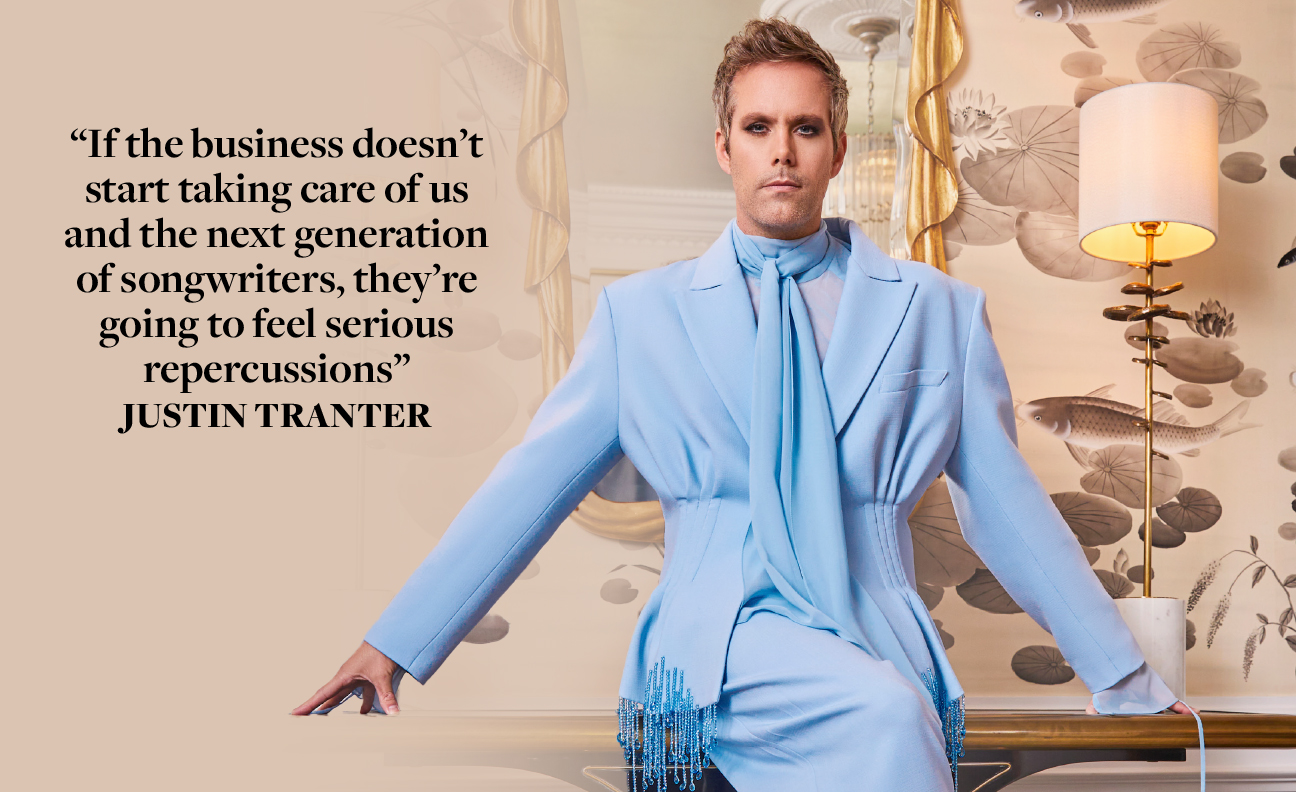
“What I’m feeling positive about is that we’ve reached the breaking point. And if the business doesn’t start taking care of us, and very specifically the next generation of songwriters, they’re going to start to feel serious repercussions. To make the money that all these labels want to make, greatness is required. And new generations of greatness are required. If people can’t afford to pay their rent, they can’t afford to be great. They have to do something else and the labels are not getting the greatness they want. The only reason I am feeling positive is because it is so negative that, if it doesn’t change, lots of people are fucked.”
Last summer, UK major labels committed to giving per diems to writers. What did you make of that change?
“It’s a great idea. When I talk to people who don’t work in the music business, whether they work a very traditional job or even people that work in Hollywood, meaning film and TV, and they hear that even someone at my level goes to work for free every day, they are shocked. They are flabbergasted. They can’t fucking believe it. So, what is happening in the UK is really great because the next generation of songwriters, thanks to that per diem, will be able to keep writing songs that the labels fucking need.”
How do you look back on what it has taken to get to this point in the remuneration debate?
“In the days before iTunes and streaming, one album cut on a medium-selling album could pay your mortgage for a year or two. An album cut on a massive album could change your life. A single would obviously be even crazier. Now, I can have an album cut on an album that is three-times platinum and maybe that album cut, if I am so lucky, makes me, like, 30 grand. A song on the biggest album of the year is $30,000. That’s a problem, when that album cut on the biggest album of the year used to be $3 million and now it’s $30,000 [laughs]. So, having everyone go to work for free, that’s crazy. Back in the day, in the 1970s, ’80s, ’90s, I get why it didn’t fucking matter, because if you’re in there and you’re in the right sessions and your publisher’s doing the job, you’re going to get an album cut a year.”
Yours was the first US label to give your songwriters three percentage points on the masters…
“That’s on anything that my label releases. I have major label partners on all of the releases, so out of the Facet House side of the money, we are setting aside points for anyone who’s a non-producing, non-performing songwriter. We’ve had those agreements on things released by Jake Wesley Rogers, things released by YDE.”
Finally, AI is also dominating the news agenda – where do you stand on that subject?
“Listen, I pray every day that AI just shuts the whole planet down and we can start over [laughs]! I’m very worried about AI watering down the already eroding attention spans. I’m already worried about AI watering down the already questionable taste levels of humanity. And I’m included in this; I’m not above any of this. My attention span is atrocious now. I don’t even know what a taste level is any more, so we are all victims to this! But, overall, yeah,
I hope AI ends the world, but if it doesn’t and if a sci-fi apocalypse doesn’t happen, then I’m very worried about AI stealing from songwriters that are already struggling.”