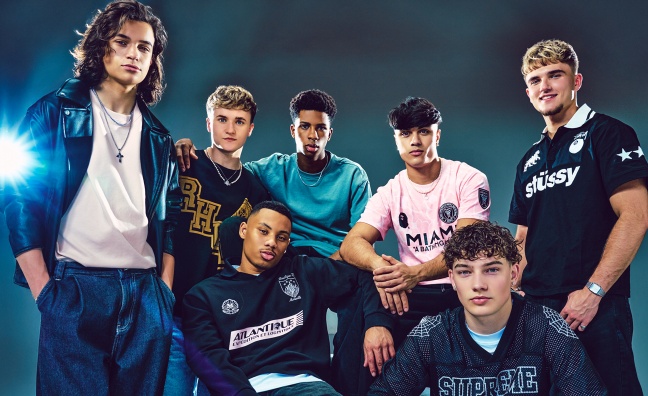
December 10, 2025 could be a date that goes down in music business history. This was the day on which December 10, industry legend Simon Cowell’s newly assembled boyband, were unveiled to the world, via Netflix series Simon Cowell: The Next Act. With additional backing from EMI, manager Cassandra Gracey – plus a dream team of writers and producers – the seven-piece are set on world domination. The question is: after years without a successful UK boyband, can they get there? To answer it, Music Week meets the band, plus Cowell, Gracey, Island EMI Label Group president Louis Bloom and more. What follows is the unmissable story of how some of the finest minds in the business are reigniting the concept of boybands for 2026 and beyond…
WORDS: ANNA FIELDING
PHOTOS: FRANK FIEBER
There are seven of them, that’s the first thing you notice. December 10 are Britain’s newest boyband: chosen by Simon Cowell, backed by Netflix and signed to EMI. Not one of them is older than 19 and they can sing in a range of perfect harmonies.
Remember the names: Cruz Lee-Ojo, Danny Bretherton, Hendrik Christoffersen, John Fadare, Josh Olliver, Nicolas Alves and Seán Hayden.
You may know them already, thanks to the Netflix series that brought them together. Titled Simon Cowell: The Next Act, it dropped on – when else – December 10 last year. They released their first single, Run My Way, on January 30 via EMI.
“It’s been six months of anticipation, waiting for the show to air,” begins Alves, who’s just turned 17 and is the youngest. “When it finally comes, all the months of waiting just bubble up.”
For Simon Cowell, creator of The X Factor and one of the most powerful music executives of his generation, this represents a huge comeback, a chance to prove he can still wield significant influence.
“I haven’t worked with a band like this for a very long time and I found I had really missed it, surprisingly,” he tells Music Week, in his first sit-down with us since 2017. “The buzz of finding people, it’s always exciting, and the people at Syco had missed it too.”

Warming to the subject, Cowell is fizzing with energy.
“I think we all miss that era of when there were a lot of British boybands,” he continues. “I said to the production company, ‘I can’t explain what it feels like. If it works, you’ll understand why I’m doing this.’ They all said to me afterwards, ‘Okay, we get it now!’”
December 10 were signed while the cameras were still rolling, in the sixth and final episode. Before that, there were two label meetings that didn’t work out. “We showed up and did our best, but it just ended up not being for us,” says Bretherton. Then came Universal. On screen, you can see the chaos that ensues when all seven members enter a room full of Universal execs.
“How many of you are there?” says a slightly incredulous Louis Bloom, president of Island EMI Label Group, on the show.
“I was playing spot the scene,” recalls Bloom, who was an intern at BMG during Cowell’s tenure there. “We knew that Simon was cooking something up – it was all over the press – but when it came to the actual deal, that awareness came through Sir Lucian [Grainge, Universal Music Group chairman & CEO]. He’s got a long-standing relationship with Simon, so that was instrumental. Dickon [Stainer, Universal Music Group UK & Ireland chairman & CEO] was very precise about how we did everything; he just wanted to win it for the label group. Thankfully, EMI was the eventual home.”
Completing the heavyweight executive line-up is Cassandra Gracey, who launched management company Gracey & Co after a golden period at the helm of Sony’s 4th Floor Creative department, during which time she won a Music Week Women In Music Award for Businesswoman Of The Year in 2021.
“The show has been an incredible launch pad and the social pick-up has been very strong,” she states. “What is undeniable is that they can really sing, and they have a strong bond because they’ve spent so much time together. Yes, they were put together by a TV show, but that’s given them an opportunity that they couldn’t have dreamt of.”
The band’s John Fadare echoes those sentiments.
“We knew Universal was where we wanted to be – it felt like home,” he says. “They matched our energy, it was just so positive.”
“As soon as we went in, they started clapping,” adds Olliver.
We meet December 10 at a critical moment. It’s the day before their first single is due to drop. They are jet-lagged and drinking cups of hot chocolate in a West London hotel, fascinated by their situation. Clearly, it’s still all very new to them.
All six episodes of the Netflix series were released together, and the show hit the streaming service’s Top 3 in its first week. Their Instagram following is heading rapidly towards 400,000, while they have four million likes on TikTok and over 190,000 monthly Spotify listeners. Single Run My Way is the sound of the new Toyota Aygo X Hybrid advert and this month’s run of live dates – including three shows per day in Glasgow, Dublin and Birmingham, and two in London and Manchester – have completely sold out.
In the midst of it all, the boys have bonded, which is obvious as they go round the table noting one another’s good points.
For Alves, born in Portugal, they take a split second before crediting his intelligence and “the rock’n’roll tone” of his voice. Josh Olliver, from Chorley in Lancashire, is the “good looking” one with a deeper register to his singing. Dublin boy Seán Hayden “is the funniest guy, and with one of the best voices”. Danny Bretherton – also from Chorley, he and Olliver have been good friends for some time – brings energy, singing chops “and biceps!”. Londoner Cruz Lee-Ojo is “swaggy” with the best dance moves, and “would give you a pound if it’s all he had left in the bank”. Then there’s John Fadare from Rochester – “there’s not a sweeter soul in the world, and he’s the best piano player!”. Finally, Walsall’s Hendrik Christoffersen is the older brother, the voice of reason and “musically and vocally very gifted”.
At this point, Bretherton raises his voice above the hubbub.
“Hendrik makes me think of Sensations crisps…” he says. “Because he’s sensational.”
There’s laughter and some groaning. Their view of Simon Cowell is similarly positive.
“Just good vibes!” blurts Olliver.
“A lovely, lovely person,” notes Fadare.
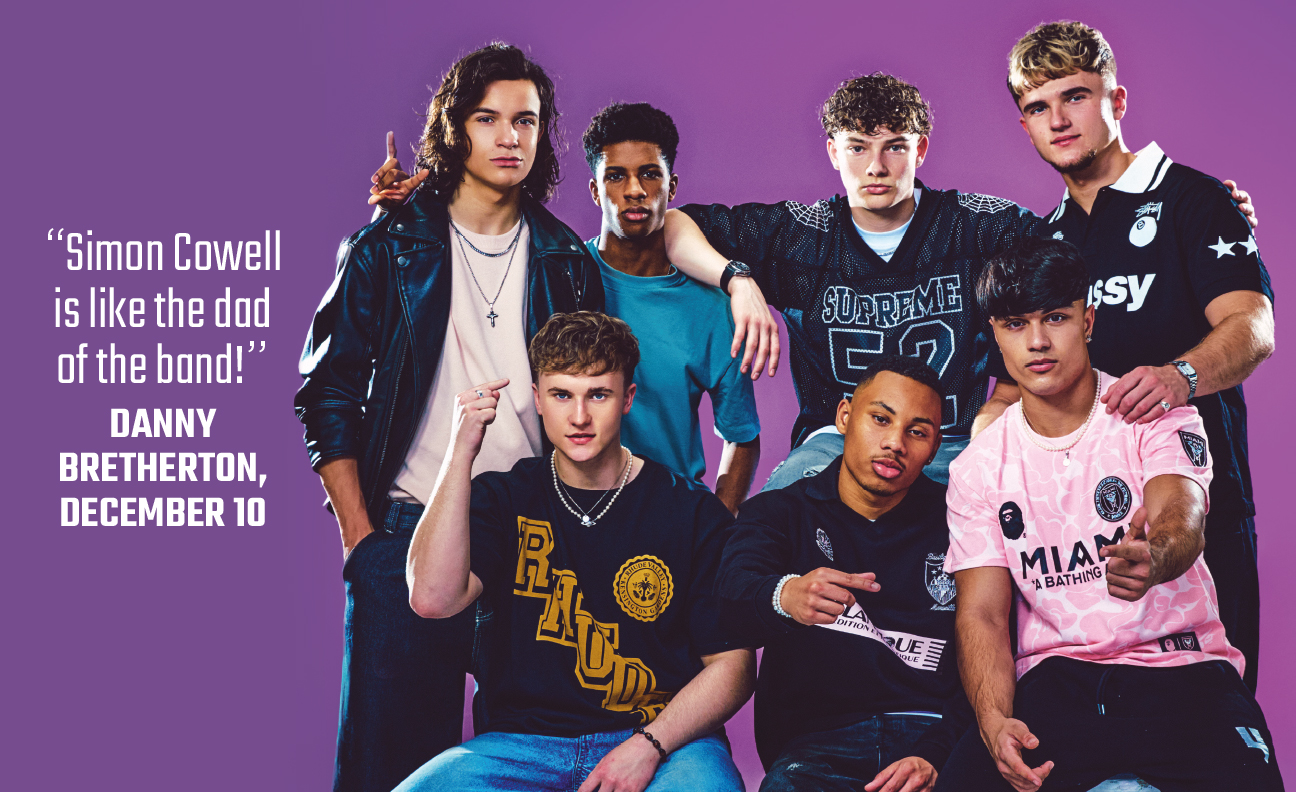
“He’s the dad of the band,” chimes in Bretherton.
“He’s very kind and genuine,” adds Hayden, who has taken the time to think it over. “He treats everyone [to things].”
“There’s a good example of that,” says Christoffersen. “We were at Simon’s house once, just chilling and we’d been talking about how much we love roller coasters. And then, a couple of days later, we found out that he had paid for us all to go to Thorpe Park with the top passes.”
Cowell himself is similarly effusive about his new charges.
“I was quite surprised by how quickly they bonded,” he says. “They really support one another and they’re a lot of fun. They take the piss out of me constantly. They do a very good impression of me and they punk me constantly…”
Cowell notes that he pointed out the value of entering the music industry as a group to December 10.
“I did say to them that I was sure all of them must have thought that they would love to be a solo artist at one point, which I get,” he explains. “But what I would say at this age is, ‘I think you’re going to have a much better time together. You will have more fun and you’re going to find out who you are.’”
Manager Cassandra Gracey also leans on the idea of fun.
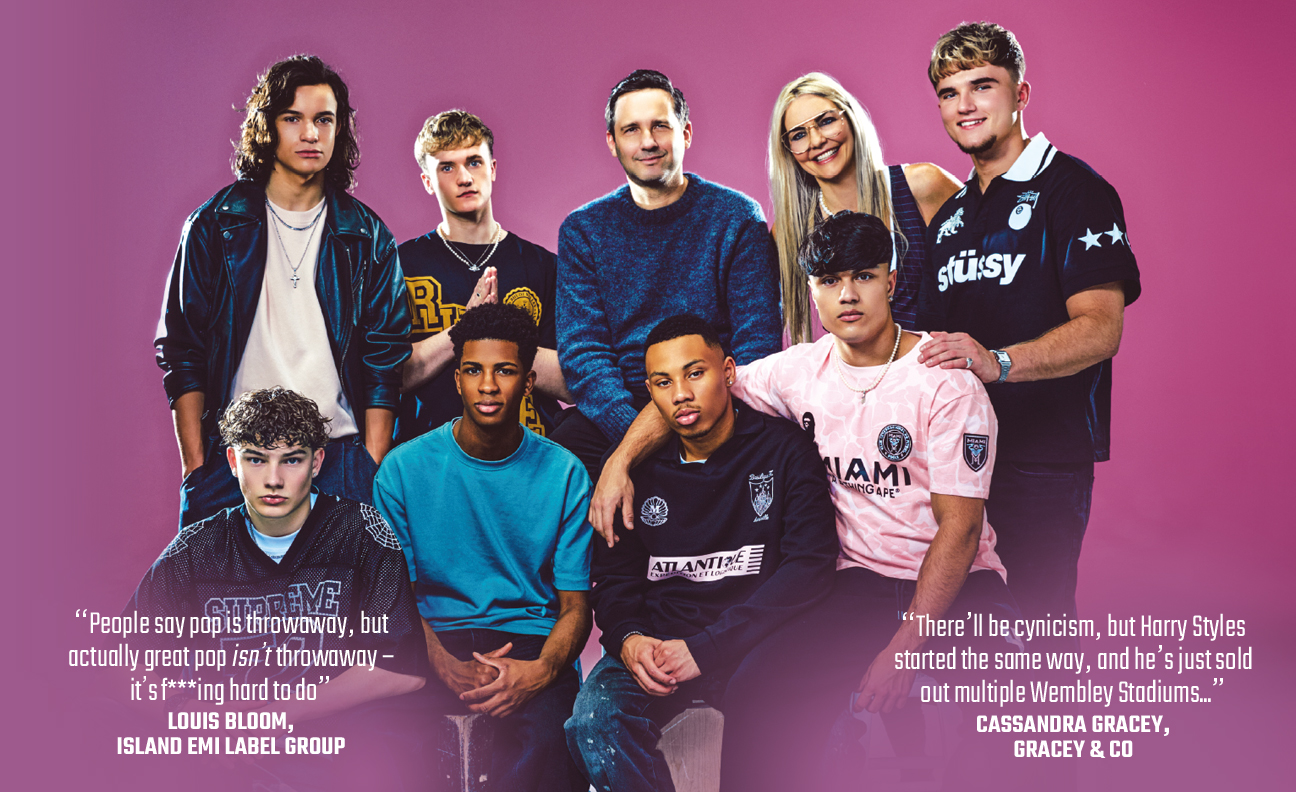
“I tell them that the very worst thing that can happen is that they’ll have had the best gap year ever,” she says. “You know, there’ll be cynicism attached to it, but Harry Styles started the same way, and he’s just sold out multiple Wembley Stadiums…”
The group, reminiscing about the thrills of Thorpe Park, are clearly having fun and have obviously become a gang. Indeed, the sense of a band crystallising before your eyes is inescapable.
There have been no boybands on the UK horizon for some time. It’s almost 15 years since One Direction released their first single, What Makes You Beautiful. Busted’s What I Go To School For came out in 2002. Take That, currently also streaming on Netflix, burst on to the scene in 1991 with Do What U Like.
So, why a boyband, and why now? One of the answers seems to be that the wider culture needs a highly visible, happy, hard-working gang of young men.
“For teenagers today, it’s much harder than it was,” offers Simon Cowell. “It’s certainly harder to get a recording contract than it was 10, 20 years ago. So why did I choose this particular band? I did want them to be role models for people their age. I hoped boys would want to be in the band and would see that, if you put your mind to it, things can change for the better. It sounds a bit corny, but I did think about that.”
“They have so much energy, they light up the room,” says Louis Bloom, who also notes that the first act he brought into Universal as a young A&R was Busted. “You can see Simon’s influence. It’s very, ‘Be yourself, showcase your personality,’ but at the same time, Simon’s acts are always very respectful and hardworking. They were presented to us as the best of young men. We haven’t seen that for a while, from a UK act in the pop space.”
Bloom says that he’s hoping December 10 will become positive role models.
“That’s not necessarily what they’re thinking about, because they’re just being themselves, but that’s what I’m hoping for,” he says.
“They’re chaos personified, but also delightful and really polite,” says Cassandra Gracey. “On the plane to New York recently the air hostess came up and said, ‘Oh, you manage those boys?’ and my first thought was, ‘Oh God!’ and she said, ‘They’re so polite, I took a picture with them. My daughter’s going to die.’”
Gracey mentions another Netflix hit, the Stephen Graham drama Adolescence, which showed the dark side of teenage boyhood. She also tells a story about Bretherton visiting his old school and confessing he wasn’t always the best pupil.
“A kid came up to him at the end and said, ‘I’m quite naughty too, but you’ve given me hope,’” she says.
“This band feels really fresh,” says Bloom. “There’s a joy to these boys; it’s pure joy to me. They offer something to the culture, a bit of escapism. I know it sounds clichéd, but we need more joy in the world right now. I’ve got two young sons. And in a world [where] Andrew Tate [exists], I want them to be looking at December 10.”
The band themselves, with their cheerfulness and willingness to show affection to one another, are embodying that ideal.
“I feel that if we show we can speak, within the seven of us, about our feelings, about mental health, about whether we’re doing good or not, that’s important,” says Christoffersen. “It’s perfectly fine for us to say we’re not doing well mentally. I’ve done it before – the not speaking – and you just don’t help yourself if you do that.”
“We want to show people that we can talk about it,” says Olliver. “That it’s alright to talk about it and then hopefully other people will too.”
“And through our music, we want to represent positivity,” says Fadare. “If we can be something that improves someone’s day, that’s important to us.”
Their team are laser-focused on caring for their new charges.
“Their welfare is a big priority,” says Gracey. “I’m very strict with it, we have to be. We have welfare and security with us permanently. We have to get licences so they’re never allowed to work longer than eight hours a day and so on.”
Bloom notes that Universal is “very front-facing” on the subject, referencing the culture of artist wellbeing and the in-house support service at the major, and describing Dickon Stainer and chief artist and strategy officer Rebecca Allen as “very, very big advocates”.
“It’s really important that they have time off and the schedule has to suit them,” he adds. “We’re very respectful generally; I want them to have the final say on everything.”
The band talk glowingly about their team, and Hayden emphasises the importance of their support.
“The industry can be very tough for young people, and also getting judged a lot can be very tough,” he adds. “So it is definitely needed.”
Given that December 10 haven’t really lived through any of the major boyband eras, they are reasonably well clued up on their predecessors.
“For John and me, coming from a Black background, we love Boyz II Men,” says Lee-Ojo.
Fadare, nodding, adds, “And you love JLS.”
“Yep, massive one for me,” his bandmate replies.
“I’ve always loved New Kids On The Block,” says Alves. “Backstreet Boys and, of course, One Direction. Massive respect to all these bands that have come before us and the mark they’ve left on the industry.”
Hayden is thoughtful on the topic.
“Because there has been almost a hiatus for boybands, as you get older, it just goes out of your brain, so when the auditions came up it was very much, ‘What’s all this about?’” he says. “But I’ve noticed through this process that we’re not really going for the full look of what a boyband has to be, or was. We’re going our own way, making something new. We’ve been ourselves through all this; we’re not singing in different accents or anything.”
“It’s been a few years since there’s been a really big UK boyband,” says Fadare. “Hopefully we can fill that gap.”
Simon Cowell, obviously, is an old hand at the boyband game, having played a huge role in the careers of Westlife, One Direction and more.
“You find one or two people and think, ‘I might have a shot here,’” he says. “We thought, if we were going to do it, then it needed to have a documentary so we had a platform when we launched.”
Cowell and his team are relishing the campaign as it unfolds.
“We speak nearly every day,” he says. “Whether it’s to the label, Cassandra or the boys, when a song comes in, there’s information to share, or we’re looking at video scripts. It’s been brilliant, because everyone is on the same side.”
Lucy Dann, MD of Island EMI, was once part of Cowell’s operation at Syco, giving her previous experience of seeing the boyband machine cranking into action.
“This is a full-circle moment for me and I completely understood the vision,” she states. “The stars have aligned and a lot of us that used to work together have been reunited. The energy in the team feels great, and the band and the music are excellent.”
Between them, the members of December 10 have significant musical experience. There’s musical theatre, a cathedral choir, an opera company, previous brushes with the reality TV format. Many of them play instruments, something Cassandra Gracey says they will be leaning on heavily in the live shows. “It’s been a great joy to see how talented they are as musicians,” she says. “They play 14 instruments between them.”
They have assembled something of a dream team in the studio, where Gracey says they have had “an incredible experience – I am overwhelmed by the amount of incredible records they’ve made”.
Producer and writer Poo Bear (Justin Bieber, Usher) works extensively with the band in the Miami portion of the TV show. He tells Music Week he is pleased to “play a role in helping to secure the new biggest boyband in the world’s future record deal!”
Also involved is Savan Kotecha, writer of One Direction’s What Makes You Beautiful and hits for Ariana Grande and others.
“The boys are fantastic talents and it’s been very inspiring,” he says. “I’m excited for them to continue to grow their audience and for more and more people to get to know them. They’re special kids.”
Producer and vocal coach Robert ‘Raab’ Stevenson has worked with Justin Timberlake, Rihanna, Pharrell Williams and more.
“The most exciting thing is when I look across the desk and see their passion, hunger and desire to be in this industry, it reminds me of when I was an artist aged 18 or 19,” he says. “Wanting to put out good music, inspire people and change the world.”
UK hitmaker Kamille reflects on the pleasure of “watching their dreams unfold so quickly – it’s not often you get to be part of spotting talent from across the country and helping it click into place”.
December 10 now have an extensive bank of music to draw from for their debut album, which is currently in the works.
“We just want to put out a lot of songs and let everyone hear what we’ve been working on,” says Fadare.
“With the amount of incredible music we have and because the band want to tour a lot, we want to do a high number of releases throughout the year, probably higher than most [artists],” Gracey says. “And we’ll continue to play live later in the year as well.”
The sync pick-up has also been notable, she says. The December 10 tourbus will also be wrapped in a Toyota Aygo ad and Gracey is working on having Aygo cars as mobile merch stores.
Among themselves, the band make jokes about driving free Toyotas and recall Fadare’s “terrifying” laps of a Miami go-kart track. In reality, only Christoffersen has a driving licence.
“But Josh can drive if his parents are in the car!” shouts Bretherton, with background chorusing of “Provisional! Provisional!”. This is an affectionate tease, as Olliver, they say, is fond of mentioning his almost-driver status.
Beyond sync, the overall plan is to build at pace, with an understanding that success has to be earned.
Simon Cowell says that, amidst rapidly growing social numbers, the team are building a responsive strategy.
“We’ve got to do it in a slightly unconventional way compared to, say, 15 years ago,” he says. “Then, you would wait a few months, put a single out, then wait a few more and do another one. Things are different now. The fans keep asking for more music, so we are recording a lot, and I think putting out quite a few songs – which I deem singles, by the way – and then seeing where we are at the end of the year is the way to go.”
Louis Bloom picks up the baton.
“December 10 are instantly in culture because of Netflix, Simon and a show that’s in 170 countries,” he says. “So through jumping on trends, influencer marketing and so on, there are so many routes to create attention.”
But that “isn’t the core” of the strategy, he says.
“It’s firstly about a great artist proposition,” he adds. “Then we’ve got amazing music. We’re working with the best in the business, so the music will come thick and fast for the next four to six months. But I don’t want to rely on one song to break. It’s not going to be that – it’s an attrition of greatness. We’ll keep on with different styles and showcase their personalities. Eventually, the live ticket is a true test of success. We’re very encouraged by the early signs, while being focused on having substance, weight and greatness.”
Bloom says that is no easy task.
“People say pop is throwaway, but actually, great pop isn’t throwaway – great pop is fucking hard to do,” he says. “You have to be meticulous in the decision-making, and the artist has to really embody it for it to be successful. That’s why a boyband hasn’t been successful for a long time.”
The question, then, is: how will they do it?
“There’s no silver bullet,” answers Bloom. “It has to be bottom up. You can’t tell people to care; you have to deliver the goods by being great. The band have the potential to win over a large cross section of the world and I really, really believe in them.”
The Netflix series was trailed as a chance to see why Cowell is returning to the pop-audition TV format that served him so well.
“It has certainly been a new act for me,” he reflects. “I love being on Got Talent – we all say it’s one of the best jobs on TV as it’s so much fun. However, when you do something like this, there’s no safety net. There’s no ending you can have other than ‘this worked’ or ‘this was a complete disaster.’ There’s an extra thrill and sometimes unbelievable pressure.”
It’s also a next act for the band. Secrecy around the show meant they couldn’t talk about what they were doing.
“That was hard,” says Hayden. “When everyone is going to uni and getting jobs and you look like you’re stuck doing the same thing.”
Christoffersen, for one, has been able to quit his job in Nando’s (his bandmates are incredulous about the amount he still enjoys the food – “the capacity is immense!” says Fadare.)
Christoffersen takes a moment before responding.
“Rather than, ‘I’m still in the same job I had at 16, working at Nando’s,’ it’s been great to be able to say, ‘I’m in a boyband!’” he adds.
Working alongside December 10 has also coincided with new beginnings for both Cassandra Gracey and Louis Bloom.
“Look, if you’d read the notes from my session with my life coach last January, you’d see that going back into management was very much on the cards,” Gracey says of her career move.
She sums up her time at Sony as “a great eight years, fantastic” – but her heart was pulling her back to management “where I’ve spent most of my career”.
December 10, she notes, are only just younger than her sons.
“They come round for dinner and I make them all Bolognese and we play card games like Mafia,” she shares, breaking into laughter. “I took my son to university and started working with the band all in the same week. And there I was, just about to start my empty-nesting lifestyle…”
The band are also part of a new chapter for Island EMI Label Group. Following UMG’s UK reorganisation, Island and EMI were brought together with Louis Bloom as president of both. Each label retains its identity (even down to how the offices look and smell – Bloom reveals that experiments with diffusers are underway), but the team are carving a new path to success.
“December 10 don’t fit in with previous EMI acts and that’s why it’s good,” says Bloom. “I’ve always liked original concepts, ideas or styles… When I first started out, everyone was doing boybands. Simon took that and ran with it and put it on TV. We weren’t in the game at Universal on any of that at that point, and so we had to work with more organic acts. We really had to understand culture and context, and how to break acts with no platforms. That has really helped in terms of the knowledge and awareness of how to build fandom. K-Pop shows there’s a market for pure pop, and it’s brilliant what’s happening there. But there hasn’t been a Western boyband for so long and there’s a gap in the market.”
As for grand ambitions, Bloom brings up an EMI big hitter.
“There’s a lineage from Take That to what we’re trying to do here,” he says. “We pray it will be as successful and be something that will help define what EMI is about moving forward.”
“It’d be incredible to tour Europe, Australia, America and I would love to have international hits,” says Gracey. “We have a 10-year pact for the band, and then we’ll discuss any other options. That’s what they’ve decided. It’s an incredible opportunity to have a career in music, and that’s the aim.”
December 10 are a boyband for modern Britain, from the very normal spaces of Saturday jobs, driving lessons and school music rooms. Success would be a totem for ordinary boys everywhere.
The boys have found that, for now, they fill in the gaps in one another’s lives very well.
“We have a really close relationship,” says Fadare. “It’s like with siblings, how sometimes you’re so close that you just argue a tiny bit. I think we have that a bit sometimes, but we also sort it out, like siblings.”
“We definitely love each other,” says Olliver, as the rest of them chorus in agreement.
“I was really shy with the guys at first,” says Alves. “But it’s really impressive how far we’ve grown together. I really feel like I have six brothers now.”
“You see how our bond has grown in the show,” says Fadare.
“I couldn’t be more grateful to you guys,” smiles Alves, by way of a fittingly heartfelt conclusion, as the rest of them beam right back at him.