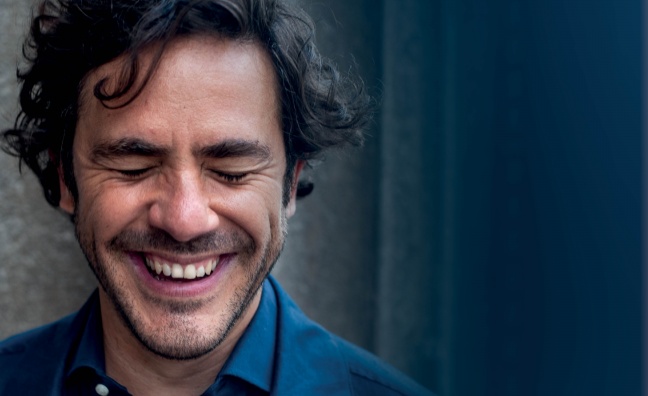
For 20 years, the prolific Jack Savoretti has carved his own path, picking up No.1s along the way. We meet the star to hear about his Italian heritage, Portobello Road escapades, and his new LP, We Will Always Be The Way We Were, which debuted at No.2...
INTERVIEW: Charlotte Krol
PHOTO: Aleksandar Crnogorac
What’s different about your new album and the process behind it?
“My more recent albums were three strong, conceptual works. Miss Italia [released in 2024] saw me go to Italy to learn how to write in Italian. After my father’s passing, I tried to discover my Italianness without him, through music. I found so much authenticity. They intellectualise a lot in Italian music, and I became a student again. That student feeling is what led me to make this album. I felt liberated in having no plan, concept or style. It’s clichéd, but it was the most powerful album process yet. I was observing and not driving.”
It’s billed as a ‘return to your roots’. Can you elaborate?
“When I moved to London over 20 years ago, I was living in Portobello Road. Everybody I met was a writer, a poet, a graffiti artist, a singer or an actor. And I was like, ‘I didn’t know you could do that!’ I was songwriting at home just for me, never doing it with a great career ambition. Portobello became a school of hard knocks: a lot of open mics, standing on tables and singing your heart out to nobody listening. But it’s where I found my voice. I got my education there, where I met all of the band – pretty much all of them still play with me now. Tommaso Colliva [engineer on Muse’s Grammy-winning Drones album], who I worked with on Miss Italia, produced this album. It was a bit of a no-brainer to do it with him, back in my old neighbourhood. Tom has a very solid way of supporting you – everything you want from a producer – to make bold decisions. He’s kind of held my hand through a vulnerable time.”
How would you describe the album’s overarching tone or sound?
“This is a roundabout way of explaining it, but sonically you can hear: this is us. And when I say ‘us’, it’s me and the whole band playing how we play, [both as a group] and as individuals. I said to them, ‘Don’t ask me; play what you want.’ We’ve made a few records together, but this one really sounds like a band. I just wanted to open up my chest to the world and see what hit. You can hear that excitement in the record, that feeling of freedom. And I wanted the band to have ownership, too, because we’re at that age where that shit matters.”
After parting ways amicably with EMI, you’ve independently released this LP but with distro support from The Orchard. How’s that been?
“It’s early days, but the team at The Orchard are incredible. Just look at the acts they’re working with, like Raye. She’s an inspiration to all in this game. I feel very supported. And, look, I have an incredible team of my own – some I’ve worked with for 15, even 20 years. We don’t lack heart and soul; I don’t need any label for that. But what we do sometimes lack is infrastructure.”
Broadening out, what do you think is a key challenge for artists in 2026?
“Brexit hasn’t helped the live scene for a lot of artists; that’s a major kick. Live, generally, is becoming very expensive. The world is changing and the experiential economy is booming. But I have no desire for smoke and explosions. I’m not a great showman. I love connecting and creating intimate moments that are to be lived only once. That’s what we try to provide for an audience that’s sacrificing so much to see us. But we’re okay – we have a healthy, stable business. I make this joke a lot, but every album cycle is like a restaurant: if it works, I get to open another one!”
Finally, how does it feel to be booked in for a sold-out show at the Royal Albert Hall?
“I was curious to see how it was going to be received. When we put it on sale, we made a real statement – then we broke the website! I try to not follow the crowd or the industry, and build my own little business. But that was really reaffirming for us. I think, ‘You guys are good.’”