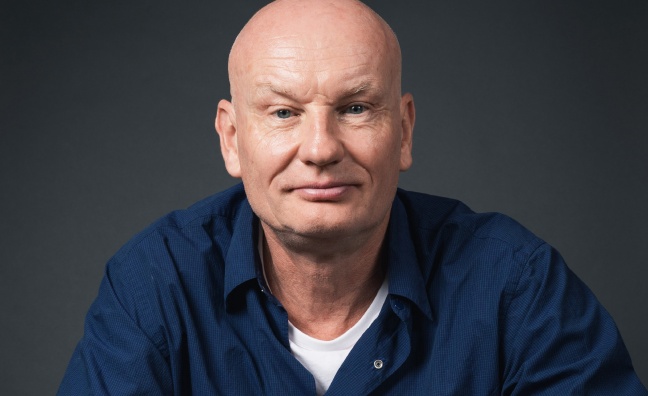
It has now been six years since Guy Moot joined forces with Carianne Marshall to run Warner Chappell Music. In that time, the publisher’s CEO and co-chair has been hard at work to build a new culture at the company from the ground up. As the stellar success of their signings like Benson Boone, Teddy Swims and Amy Allen prove, it’s been working wonders. Here, the executive talks mass change at Warner Music Group, AI, and invaluable A&R lessons learned from his formative years driving around the UK in his Ford Fiesta 900…
WORDS: GEORGE GARNER
PHOTOS: PAUL HARRIES
"I’m a fast lane, slow lane person,” Warner Chappell’s CEO and co-chair Guy Moot explains as he settles down for a catch-up with Music Week at the publishing giant’s London HQ. “I can’t be in the middle lane.”
After decades spent cementing his reputation as one of the global music business’ biggest names, the “slow lane” side of his life is the one we know the least about. Away from the limelight, he’s devoted to his wife Kristina and family, plus Kimba and Kai, his two Rhodesian Ridgeback dogs. “Don’t put it the other way around or I’m fucking toast,” he quips. Moot’s also an Arsenal season ticket holder, a keen fisherman (he recommends Colorado for it, FYI) and a regular at his local gym. You might also spot Moot taking a beating in a park near you.
“I do an Indonesian form of martial arts called silat,” he says. “Don’t worry, I’ve done it for years but I’m not very good at it. I always tell my tutor that I must be his worst pupil. It’s particularly nice, we just go in the park and have it out!”
Make no mistake, though, when it comes to his other life – the one lived in the “fast lane” – his competitive streak is very different. It’s now been six years since Moot ended his successful tenure at Sony Music Publishing to become Warner Chappell CEO, as well as its co-chair alongside Carianne Marshall. Moot – who grew up in the Cotswolds – is, of course, now well-adapted to life in LA. He’s walked enough dusty trails with his dogs to get acquainted with the sound of rattlesnakes and learned that it’s the baby ones you should fear the most. “They haven’t learned to regulate how much venom to use in their bites,” he explains. He still travels as much as ever, though, including a current summer stint in his homeland.
“I’ve got the perfect blend,” he smiles. “I get to come back to London, experience the culture and creativity and meet some rude people again... I’m joking! Everybody’s just so positive in LA, but people bring me right down to earth here, I love it.”
As for his mood right now about Warner Chappell?
“Good!” he beams. “Always optimistic, always passionate. We had the Triple Crown at the end of [Q4] last year in America: No.1 in the Country Radio and Hit 100 Songs [Shaboozey’s A Bar Song (Tipsy)], plus Top Radio Airplay [Amy Allen for Sabrina Carpenter’s Espresso]. We signed some great stuff. We were incredibly blessed to have Benson Boone, Teddy Swims and Amy Allen, and lots of others.”
In Q4 of 2024, Warner Chappell had a stake in 64 songs (a 25.29% market share) on the Radio Airplay list, and 49 songs (a 23.62% market share) on the Hot 100 Songs list. It also dominated the Country Airplay chart with a 33.67% market share.
Impressively, WCM had writers on nine of the Top 10 Hot 100 tracks of 2024 and six of the Top 10 Global 200, including the top of both via Teddy Swims and Benson Boone respectively. Some of those names helped achieve one of Moot’s primary goals when he first arrived: to make the publisher home to a lot more artists.
To that end, Warner Chappell’s recent signings have included Rosé and Diplo, while the Grammy-winning jazz crossover star Laufey continues to impress. “She’s absolutely amazing,” Moot praises. “She brings music, which we once presumed gen Z didn’t like, to them in such a unique way.”
In other recent headlines, WCM UK’s Dua Lipa was the UK’s most played artist of 2024 (according to PPL data for radio, TV and public places), Amy Allen won Songwriter Of The Year (Non-Classical) at the 2025 Grammy Awards, while WCM UK’s Jacob Manson co-wrote the UK No.1 hit Dior by MK featuring Chrystal. In July, meanwhile, Warner Music Group partnered with private investment firm Bain Capital for a joint venture that will deploy up to $1.2 billion to spend on “legendary music catalogues” across both recorded music and music publishing.
In person, Moot’s pride for all things Warner Chappell is contagious.
“Don’t say I never give you anything,” he says as he chucks a Warner Chappell brand cap at Music Week from across the room. He goes on to showcase WCM hoodies, trainers, raincoats and socks. Everything but a WCM wetsuit, basically.
“The German company actually made underpants, but they were purple,” he reveals, shaking his head in disapproval. “And very large.”
Germany – where WCM is the No.1 publisher in terms of market share – is just one of many territories he cites. Moot is constantly name-checking different countries, their results and their teams. Within that, of course, is WCM UK’s EVP, MD and head of international A&R Shani Gonzales and SVP/head of A&R Amber Davis. He often speaks of both with a mischievous glint in his eye.
“They give me a really hard time,” he jokes, alluding not to conflict but excess levels of banter. “We have the best time, I think the world of them. When Shani was at BMG she came after every one of my roster – it was war! When I moved to Warner Chappell she said, ‘I think you hate me’, but I actually respect competition, and we immediately hit it off. She’s doing a great job here.”
Indeed, he believes there are some “green shoots of hope” coming from our shores after a relative quiet patch on the global stage, though he is quick to note that the UK government should be doing more to help. “In France you get cultural subsidies,” he explains. “You go to Scandinavia, you get cultural subsidies.”
Moot must also – like everyone else – contend with a business changing by the day, and not just concerning the storms around AI. Warner has seen many changes since he arrived, including the departure of the revered Max Lousada and Julie Greenwald, plus the arrival of Elliot Grainge as the new CEO of Atlantic Music Group. This July, meanwhile, a second round of “cost cutting” was announced by WMG CEO Robert Kyncl, which will seek to reduce the company’s annual costs to the tune of $300 million. But just as Kyncl has a game plan for WMG so, too, do Moot and Marshall at Warner Chappell.
“Our values are: Culture, Commitment and Curiosity,” he says. “Those are the lenses that we try and look through at everything. You have to evolve every day.”
Moot, it turns out, has a lot of evolution to talk about…
When you took over at Warner Chappell, you told us that at Sony you felt like your job was mainly “trying to stop a bit falling off”, whereas what excited you about working with Carianne Marshall was to focus on growing something. How enjoyable has that proven to be in practice?
“Growing is the exciting thing. When I left Sony, it was a unique opportunity to be a CEO and co-chair of a worldwide publishing company. That was an offer, obviously, that I couldn’t turn down. I’ve explained the joys of publishing, the potential of it, all of my career, but a lot of people thought publishing wasn’t a growth business, and we’ve defied that – the numbers have been fantastic. We had another great year in 2024, and we’re going to have another good year this year but the growth of our reputation is just as important. Yes, numbers are great, but market share comes organically, growth comes organically and your reputation is organic. What’s most fulfilling for me now is when people re-sign to us. That is the ultimate health check of our company – that means we’ve done what we said we would. We’re so proud of Raye [who re-signed with WCM in 2023]. What she’s done as an artist is say, ‘No, this is not a one-off record or TikTok moment.’ She’s got incredible artistry. We’re lucky to have been on that journey with her.”

You have often seemed somewhat sceptical of market shares, at least in terms of how much insight they can offer at any given time? Is that a fair observation?
“Look, it’s a percentage of the Top 100 usually. Hits are good – we still love hits. But the industry is struggling with re-identifying what success means. Success when I started in the industry was, ‘We’ve done five million albums!’ It’s a different industry now, and I’m not sure that we’ve recalibrated what success is or celebrated some of the newer forms I see of it in our business. If you look at the algorithm and data, you’re always looking for the spike. But I think consistency is really important in the streaming world; there’ll be songs and artists that we’re not seeing in the charts that stream consistently. I’m looking for tangibility, somebody who can sell out shows. [Warner Chappell’s] Zach Bryan has sold out two nights at BST Hyde Park, but I don’t think I’ve seen him in the UK Top 10.”
The words ‘cultural relevance’ seem to be your yardstick for signings, but what does that look like in practice?
“It means that stories will be written about them and films or musicals made, and they will attract other artists because they look up to them. Longevity, too. That’s cultural relevance to me. Now, don’t get me wrong, I did some very cheesy one-off dance records! I’m not against that [laughs]. There have always been one-offs – before we were talking about viral TikTok hits it was the 7” single, the 12” single. But you’ve got to be able to see the difference. We just did the Extravaganza [the publishing arm of DWA Records] deal, mainly for [Corona’s] The Rhythm Of The Night. That is still culturally relevant, it instantly conjures up images and takes you right back to your clubbing days.”
In 2019, you paraphrased NATO by telling Music Week that A&R was moving “from land armies to special forces”. Is that still the case now?
“I feel we might be going back to land forces [laughs]. When I grew up [doing A&R], I’d go wherever the music was. It wasn’t glamorous. I had a Ford Fiesta 900 and I would drive it all over the UK and get to know everybody in every city. That approach later took me all over the world as well. That’s how your network builds up. If you’re tackling that on an international level, you want your best names in front of people. A&R to me means you’ve got to be travelling. At the moment in the UK, it’s a little bit leaner than it was when I grew up in terms of producing new talent. If there’s great music coming out of Australia, we need to put more people there. That’s the way I look at it. And that’s also how I look at how we budget A&R and work out how we will get the most bang for our buck. American repertoire is very dominant right now. We saw that at Chappell a couple of years ago, and I think we’ve done really well from that. Ryan Press is our president of North America, he is one of the very best. He spends a lot of money, I have to try and stop him, but he was right because there was great talent coming out of North America. And that’s what drove a lot of our success, internationally, when you look at the charts around the world.”
As everyone is scouring the same data these days, is the path to success now more reliant on individual A&R instinct than ever?
“If you go with the algorithm, data and research, it’s only going to take you where everyone else is. I was going to festivals in recent years thinking, ‘I would quite like an elbow in my eye again – where is that energy in the festival line-ups?’ And so we deliberately pivoted a bit more to rock. Dave Goldsen – who signed Zach Bryan – went and signed Sleep Token. That’s one of the UK’s biggest successes. Everybody looked at them, but I don’t think it was in the ‘cool lane’ of UK A&R. When I was growing up, the UK was always trying to do something different but the algorithm only pushes you to the same stuff.”
Who didn’t look great data-wise on paper, but you took a punt on anyway?
“So many of them. During Covid, we really tried to go for quality, not just virality. Of course, we all have a few failures, but we managed to avoid any huge pitfalls. When you meet a new artist, you, as a publisher, don’t want to think, ‘Do I get my money back from your one big song?’ which I think for a lot of people, if they’re honest, is the case. Sometimes, A) the artist hasn’t had time to perfect their artistry, and they won’t; B) Maybe they were never quite good enough, sadly. And C), sometimes it’s really hard to get the public to buy in over a short period of time. To have a big hit without a base [and last]? It’s almost impossible. I’m almost scared for some of our newer signings. We’ve got a young band called Florence Road, who I love, and I’m like, ‘Don’t let it happen too soon!’ They’re getting better and better live. They’ll build a fanbase, have a hit, and then we’ll have a volume of people who can see their true artistry once it’s been perfected. I really want to double down on artist development. I firmly believe publishing is the space to do that because we have time and flexibility in every contract. If someone wants to do a one-page admin agreement with us, we’ll do a one-page admin. If someone wants to do a full-blown co-pub, we’ll do it. Someone wants an advance? We’ll do it. Some people want the biggest cheque and we can do that, too. We can do all of that. We’ve got a contract for everybody!”
Surely that’s got to become Warner Chappell’s new slogan?
“I’ve got a drawer full of them! [Pretending to be a salesman] ‘Have I got a contract for you! Maybe try this one, I’ll measure you up!’ About two years ago, I brought in a short-form agreement and, honestly, I think my A&R people were a bit sceptical about how it would work. It’s not a ‘throw it out there’ thing – it comes with some ownership and some A&R input, and it’s been hugely successful. I’m not saying I’m a visionary, but I don’t think we anticipated just how appealing it was to a lot of people who were very happy to have their songs admin’ed on a rolling basis. I’d rather have them in the house and show them we can do a good job. If they do then want money down the line or a different type of deal, you’re going to see investment coming in from different places. The record company model is still alive and kicking, but people have alternatives now. That’s true in publishing, too. The way the industry contracts with people, in a lot of cases, hasn’t changed dramatically at all. I’m very happy with where we are, but we’re trying even more stuff.”
Executives often tell Music Week they don’t pay attention to the competition. Where do you stand on that?
“The blinkers are on. I compete with them every day in a deal but I never look at them, and I never really think ill of them, either. Marty Bandier [ex-Sony Music Publishing CEO/chairman] taught us all, but we’re all very, very different people, which I respect. I’ve got a lot of time for Jon [Platt, chairman/CEO of Sony Music Publishing] and Jody [Gerson, chairman/CEO of Universal Music Publishing Group] but I don’t wake up thinking, ‘How can I get one over on them?’ That’s just negative energy. I’m grateful to them because competition keeps you on your toes. But if you have a clear path, if you’re doing the right things, then you win.”
What is unique at Warner Chappell that would attract artists to you and not them?
“When I came here, we had the new logo and the tag line, ‘Where songwriters are heard’, and that’s what we do. We listen to our people. I want everybody to feel, for example, that they can have input into our strategy or contribute if they’ve got an idea. We are not a top down, ‘This is how you do it!’ place. Of course, Carianne and I can say no, but we want people to feel that when they come here they can really excel and do things outside of the norm. Whenever we recruit for a position, we always say, ‘That was the job, but is the job different now? Do we now need a role that’s slightly different?’ We’re constantly trying to evolve.”
Is there anything you think Warner Chappell hasn’t received credit for as a publisher that it should have?
“I think people are starting to take heed of our creative services department. It is unique. They work with social media, work with DSPs when we get a big sync or there’s an anniversary or non-traditional licensing stuff, and can help facilitate a documentary or a print book. I’ve seen some of our competitors appoint people trying to do it, but we’re miles ahead because we’ve got a large team and it works. We can actually see how it affects streaming numbers where there’s an anniversary or a big moment.”

You told the All About Music conference in your keynote that “there’s a huge difference between somebody with deep pockets putting up the money to buy a catalogue and music publishers, like ourselves, that have a responsibility to our writers to look after and revitalise their songs”. What is your take on the catalogue boom of recent years and where it stands now in 2025?
“I always use the old garden analogy: you can buy the garden, but that doesn’t mean you can tend to or grow the garden. Sometimes it’s one song we buy and it gets us excited. But we can also buy a big artist catalogue with our partnership with Bain. We talked to a number of people because, even as Warner Music Group, we don’t have huge amounts of access to funds for those large, large transactions. We did Bowie and Bruno Mars, of course, and we spent wisely and prudently. But with Michael Ryan-Southern [EVP & chief corporate development officer] coming in, we wanted another dimension. Bain get music and that passion for music really helps. They are experts at what they do and we complement that with what we’re experts at. That’s the difference with the Bain relationship. You’ve got to keep a brand high, you don’t just take the cheapest syncs. There’s also a moral obligation to add long-term value to catalogues and it’s all about picking the right things, the right syncs, the right projects when they come along.”
The Bowie catalogue deal was a major moment for Warner Chappell. What do you see as being left to do with it? We’re in the age of the biopic, after all…
“The great people who run the estate explained that Bowie never wanted a biopic, because a biopic was finite. Maybe one day in the future, but there’s not really just one David Bowie. There are multiple phases of David Bowie to be talked about. We’re very respectful of the estate and the legacy.”
Where are you with getting gen Z into Bowie? And gen Alpha, for that matter?
“Speaking in terms of numbers and revenue, we’ve done a great job, we have grown substantially. But I would actually say there’s work to do there. With catalogues you’re constantly trying to introduce it to a younger audience. It’s all very well people and superfans in my generation saying, ‘I love him!’ but how do we get a younger demographic to go to the Bowie V&A East exhibition? That’s what we think about all the time. You’ve got to find so many different touch points. If we’re just talking to the fans who already exist, we’re missing a trick.”
There’s been a lot of change at Warner Music Group of late. Have you had a lot of time to spend with Elliot Grainge to talk collaboration, for example?
“Oh yeah, but he supports Arsenal too, so it’s hard not to just talk about that! I’ve known Elliot since he was walking into Highbury as a young man, he’s a force of nature. He’s a super smart guy, smart in the way of business, music, technology and also numbers. I’m really surprised how good he is with numbers. He is formidable. Just on the cost cutting [at Warner Music Group], it has to evolve and we’re having to do this because we need to look at where we put our money and our future for growth. We’ve run a very tight ship with Warner Chappell, but we’re not immune to change, and I hope it settles down quickly because the whole group is doing really well in terms of music and hits. Everybody’s going through it, it’s not unique to WMG, but we hope to do it so that we can be fuelled for growth and be future-proof.”
Regarding AI, you have been one of the people who, as well as acknowledging worries, has also noted that it may be really helpful to the future, especially with publishing admin…
“Rightfully, with the debate about protecting IP, we’re passionate about that and Robert Kyncl’s been at the forefront of it. We’ve got to look at how it can affect our business, both internally and then externally. If it’s ingesting – hopefully legally, or maybe some illegally – our repertoire, it should also be able to then fingerprint that and have the DNA of everything. It can be a help. We’re going to protect artists’ rights and get them recognition, we’re passionate about that. I’m really surprised that, out of all the companies, nobody has stood up and said, ‘We’ll do the right thing, credit you and work out a way to remunerate you.’ You’d win the creative community over in a heartbeat. I’ve spoken to some of those people and I’m like, ‘Why don’t you just do the right thing? You’d smash it!’”
After campaigns by the Ivors and Raye, we’ve now seen major UK record labels commit to introduce a £75 per diem and cover expenses for songwriters attending their writing sessions. What did you make of that?
“It’s great they drew attention to the fact that songwriters need to be paid more and it’s something the industry discussed in the Creator Remuneration Working Group. You’ve seen the result, with Warner Music, among others, introducing a per diem payment, which is really welcome. But we should also focus on protecting IP and growing the revenues coming in. Look at streaming rates, bundling loopholes, AI developers not remunerating us, these are battles we need to win together. And publishers need to do more to help raise writers’ awareness of where the challenges lie and how we’re tackling them.”
So you think that they’re maybe unaware of the challenges publishers are under, in terms of what will be needed to give them what they want?
“I’m not criticising because some of these areas are really complex and we have specialists working on them. But it’s better for everyone if artists, songwriters, labels and publishers can be aligned and vocal about some of the collective challenges we face. There are some big fights ahead with powerful companies and we need everyone’s support. And yes, we can also look at how we do things. We, of course, pay advances to our writers when we sign them, but in Nashville, for example, those advances are paid in 12 monthly increments, so writers know where they are and have a living wage. They go to work and write. They have success, they build a catalogue, they sell it, and they do a go forward deal. That’s an interesting model to explore, we don’t have to be stuck in the same way things have been done for decades.”
Finally, as of right now, what keeps you awake at night about your job?
“Something that worries me is how do we get more of our songs monetised from writing camps held by our writers around the world every day. Only a small percentage of those songs will ever be monetised. How do we, even if it’s micro cents, get more out of those songs. That’s a big, big thing for us. I do have some solutions. We’re working on that!”
 FOLLOW