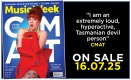
In April, Ghost’s sixth album Skeletá rocketed to No.2 in the UK, and went one better in America, where it became their first No.1. It was the latest of many milestones for the Grammy-winning metal band and their manager Kristen Mulderig at The Rick Sales Entertainment Group. Given the unique challenges presented by Ghost over the years – including much mystery and chameleon-like change – their achievements are all the more remarkable. Here, Mulderig tells Music Week the secrets to their success...
WORDS: JAMES HICKIE
PHOTOS: ANDREW STUART
For all the success stories in Kristen Mulderig’s career, one of the most notable had its first chapter in a Swedish bowling alley. Back in 2011, a month after being wowed by the mysterious band Ghost’s debut appearance at Download Festival, and having been tipped off that they were in need of a manager, Mulderig made the 5,500+ mile trip from Los Angeles to Linköping, the hometown of Ghost’s mastermind, frontman, songwriter and musician Tobias Forge.
“It’s about two hours south of Stockholm,” says Mulderig of the journey made by air and rail. She was met at Linköping train station by Tobias, then 30, his boyish looks at odds with his appearance as Ghost’s aged devil pope frontman, “Papa Emeritus I”. The pair walked together through the town’s beautiful cobbled square and past the vast Gothic cathedral that fascinated and terrified Tobias in equal measure when he was a child. In spite of the more traditional attractions, however, the pair ultimately decided to go bowling, which proved the ultimate icebreaker.
“I think Tobias liked that I was very competitive,” recalls Mulderig of the response from a man whose subsequent meteoric rise with Ghost would suggest he plays to win, too. A successful artist-manager partnership was brokered that day 14 years ago, combining the forces of two people who thrive being involved in all stages of the creative process. Meanwhile, nine years on from that trip, in 2020, Mulderig’s contributions to The Rick Sales Entertainment Group, where she’s now worked for 25 years, were acknowledged as she became its president.
“To take on so much of that responsibility and be recognised for all of my work was fantastic,” says Mulderig. “It’s been a long-standing relationship with Rick [Sales, founder/CEO], so when he wanted to give me a title to cement myself, that’s when I felt, ‘Wow, what I’m doing is making a difference and being recognised.’”
Ghost have been similarly rewarded for putting in the hard work. Even after forming way back in 2006, the Swedish band are still achieving firsts. Their sixth album, Skeletá, secured their highest UK chart position to date when it debuted at No.2 in April, while in the US it became their first No.1. In the States, it was the first hard rock album to achieve the feat in more than four years, while it is also the first chart-topper for their US label, Loma Vista Recordings. Skeletá also secured the biggest week for a hard rock album on vinyl in the US since Luminate began tracking data in 1991, shifting just over 44,000 copies upon release. In the UK, it has 37,345 sales so far, while their biggest seller is 2022’s Impera (71,493), which also hit No.2.
“There’s always been a part of me, the little girl inside, who could never have imagined that one day I’d work with a band that would get a No.1 record,” reveals Mulderig.
Indeed, Mulderig’s path to music wasn’t straightforward. She started college at the Fashion Institute Of Technology (FIT) in New York in 1991, opting to study business and fashion (“For some reason, I thought that’s what I wanted to do,” she recalls). But, given FIT’s Manhattan location was close to numerous venues, it wasn’t long before music was back on the agenda. Several internships followed, the last of which before graduation was with Epic Records.
“It was with a woman named Cheryl Valentine and she was amazing,” explains Mulderig. “She introduced me to everybody. When my internship was up, I still snuck in the building with my ID. I was afraid I was going to miss something major.”
Mulderig’s break came when Valentine introduced her to Walter O’Brien, the president of Concrete Management. Mulderig interviewed for the role of assistant and was given the job on the spot. She worked there from 1996 to 2000, with the likes of Pantera, Anthrax, Ministry, Prong and more. “I learned such a lot from Walter and [VP, artist management] Kim Zide,” she says.
Mulderig, who had long dreamed of living in California, then took a job as a day-to-day junior manager at The Rick Sales Entertainment Group, where she would settle for the long haul. Alongside Ghost, their roster also includes Slayer, Mastodon and Gojira. Despite the Swedish group becoming one of the true success stories of modern metal, it hasn’t always been an easy ride.
Bringing Ghost to the masses was not without its challenges. For one, Tobias Forge presented himself to the world in character as the demonic pope “Papa”, who didn’t speak to the press. Adding more complexity, that character has subsequently been updated in both name and appearance across most of their campaigns, the latest seeing Tobias as “Papa V Perpetua”.
Over the years, the band has been completed by anonymous members, known as the “Nameless Ghouls”. That secrecy was, however, momentarily undone by a very public (but unsuccessful) 2017 lawsuit, in which former members filed against Forge for alleged unpaid compensation from band profits.
Not that any of that fazed Mulderig, whose relationship with Forge has seen Ghost release increasingly successful albums, play arenas globally (they played four sold-out headline UK arena shows in April, including one at The O2), and win a Grammy in 2015.
“I think anything that happens that’s really close to the bone makes you have a closer relationship with your client,” says Mulderig, as she looks back on her career. “I’m really close with Tobias’ family. I’m blessed to have the relationship we have on a friendship and a professional level.”
With that, we settle in for a discussion of all things Ghost, Mulderig’s managerial philosophy and her take on the current state of rock...
First, what’s the biggest lesson you’ve learned in the music business?
“That you can’t make everyone like you, no matter what, and all you can do is your best. There are going to be some artists, colleagues or business people you deal with that are not going to get it. I remember we had a band we were working with and they didn’t want to work with us anymore, and I took that to heart. I realised in the end we just weren’t the right fit, and you shouldn’t force something. Different artists need different kinds of managers.”

And what kind of manager are you?
“I like to be a part of the whole process and want to be trusted. And there are some artists that aren’t that way. I’ve found that those are the kinds of artists that I don’t really gel with, because if they want to do too much on their own, I become a facilitator, and I would rather be a collaborator. I’m here to help and guide the career of the artist. I want to earn my keep. If I’m just doing clerical work and pushing emails around, I don’t think it benefits the artist or me.”
Tobias is known for being very involved with all aspects of being in a band. As the manager, is that a positive thing?
“I think so. I love that he wants to learn and he wants to be a part of it all. He’s a sponge – not only for musical history, but he can tell you the specs of a venue. He puts his own tour routings together. His perfect routing doesn’t always pan out, because of avails and stuff like that, but he knows where he wants to go. I’ve always told him that he could be an agent.”
Initially, Ghost were a somewhat tricky sell. What did you see that others struggled to?
“I had an insight into Tobias’ vision and where he wanted to get to – which, by the way, we’ve not reached yet. I’ve always said, once someone talks to him, they’re going to have an amazing interview and they’re going to see the greatness that I see. But in the beginning it was really hard because he wasn’t really doing interviews and there was the whole anonymity thing, which was an obstacle we had to overcome, marketing and promotion-wise. It was a hill we had to climb and we did it, little by little.”
Tobias would conduct interviews as one of the Nameless Ghouls in the early days. Was that one of the ways of solving the challenges?
“Yes, because you had to look at Papa like Eddie from Iron Maiden. If you go to see Phantom Of The Opera, the actor who plays the Phantom doesn’t do interviews in his make-up. It was a constant struggle to explain to the press, with a wink, that you’re going to get the guy who does everything, but as a Nameless Ghoul. We came up against a lot of resistance in the beginning, as [the press] didn’t want to talk to anyone but Papa. Thank God our label and our publicists have always been so respectful of [Tobias’] feelings about that. Every cycle, it comes back to: what are we willing or not willing to do? Has anything changed? That’s how the [band’s] lore came about. It became a mouthpiece for the band without having to have them talk all the time.”
The lore also came from a need highlighted by the band’s American label, didn’t it?
“We had a meeting with Loma Vista where [label founder] Tom Whalley said, ‘This is great and everything, but you don’t talk. How are we going to get to the fans? There needs to be a story.’ That’s when Tobias started thinking about it. He knew, concept-wise, what he wanted to do from album to album, so that was never going to change and there was always going to be a new [version of Papa]. The rest of the story and all the characters in it were all from Tobias’ brain. The team and I come in during the fun brainstorming meetings where we ask, ‘What if this happened?’ But it’s always with Tobias’ direction. We try to find ways to enhance it, to hit every goal we need to.”
Ghost change their image with each record. How far do you think the band would have got if they’d stuck with their original look?
“I think there would probably have been a ceiling. The one thing that Tobias has always had is being an amazing songwriter, so I think there would still be a career because the music speaks for itself. But he would have been static if he’d stayed as that first iteration of Papa. He couldn’t really move a lot in those old costumes. That’s why, as we evolved, we looked into fabrics and clothing so that he didn’t have to play the whole show in a cassock. The masks have evolved over time too, getting better and better. For this cycle, I think it’s a game-changer seeing Tobias’ lips move and seeing the bottom half of his face. Fans can see his expressions.”
Tobias has gone on record saying Ghost is, technically, his solo project. Was that the case from day one of working with him?
“That’s a difficult question. Tobias had some co-writers in the beginning, but mostly everything was his, and the idea of Ghost was his. He did use the band that was touring to record as well [initially]. And then there was some fallout, and from there we set the precedent that it’s better to keep [touring and recording] separate. Tobias was the guy I made all the plans with. He was the one who came out and we went to visit labels, so [Ghost] was always him in my eyes.”
You mention ‘some fallout’ – namely the lawsuit filed by four former members of Ghost against Tobias. Although the case was eventually thrown out, it revealed Tobias as the man behind Ghost. Did you ever worry it would undermine the project?
“We knew it was a storm [that Tobias and I] would weather together. When anything like that happens and all of a sudden you’re exposed, you get that feeling in your stomach like, ‘Oh, fucking shit!’ But we were able to make lemonade out of lemons. I think it helped us in the end, by making us rethink what we can do, and made us [think] more creatively about how to move forward. So, from something where we thought, ‘Oh no, this isn’t the plan’, we were able to pivot and it ended up being to our advantage.”
Bringing things up to date, were you at all surprised by the success of the Skeletá campaign?
“Because I’ve been in it for so long, it wasn’t surprising to me. On [previous record] Impera, we got to No.2 in the US and No.1 in a lot of other countries, so we did really well with that cycle. But we were determined to get No.1 this time, and we did it. I never doubted it would happen at some point, I just didn’t know when.”

What did you and the label do differently to make it a reality?
“We just thought bigger. We studied analytics and data and were having group calls every week to go over everything and how to create moments. The one thing that I feel our team has never lacked is the ability to think outside the box. And I think a good start to this cycle came with the [concert] movie, Rite Here Rite Now. Tobias’ idea for the movie was always, ‘Let’s use it as a promotional piece for the album, and in 2024, when we’re not going to be touring or doing anything, this will keep us in the public eye.’ I learned how to be a producer and I made lots of phone calls. Tobias financed the whole thing himself, so I felt it was my job to be mindful of what we spent money on. The film ended up being a huge success and did exactly what we wanted it to, but we had obstacles every step of the way.”
What were those obstacles?
“The main one, which made us finance it mostly on our own, was trying to explain the concept to the money people. I can put the best onesheet together you’ve ever seen, but if you don’t know the band, and if you don’t know the crazy fandom that surrounds them, are you really going to put money in? We did get down the road with a couple of different financiers, but then you don’t own it. And I think it’s really important that Tobias owns his IP, going forward, because there are so many things you can do with this, so many stories and sub stories to be told, prequels and sequels in different formats. We have this Sister Imperator comic, so what’s next? Do we do a series? A movie? I don’t know – the sky’s the limit.”
Ghost’s success story is incredible, but fairly anomalous for a metal band in the mainstream. How do you assess the state of heavy music right now?
“There have been many things in the last couple of years that have brought metal more to the forefront than ever. One of those things would be Ghost getting to No.1. Another is Sleep Token getting to No.1. Then you have bands like Knocked Loose and Lorna Shore giving hardcore its day right now – Knocked Loose were on Kimmel, that’s incredible! And you can’t overlook Gojira playing the [Paris] Olympics.”
What are the heavy bands bucking trends doing now that means they’re achieving this success?
“I don’t know if I really think there’s one thing. For instance, when I think of Lorna Shore, I think of the singer [Will Ramos] and what a big influencer he is. So he is getting his music out there in another way that back in the 1990s and early 2000s we couldn’t do. So social media is helping get far more people to be exposed to this music. And it’s fans starting these trends. They’re taking music and manipulating it, doing different things to it. And bands, too. Look at what Turnstile did, taking hardcore and throwing alternative on top. It’s about taking the influences, then adding that modern edge.”
How much of a surprise was a version of the Ghost track Mary On A Cross becoming a TikTok smash hit, resulting in it now having more than 770 million streams on Spotify?
“It was a big surprise! All of a sudden you’re looking at analytics and you’re seeing movement, something in your streams, and you think, ‘What the hell is going on?’ And then you start to dig. Us and the label were saying, ‘We’re having a moment here – let’s figure out what we can do to keep it alive.’ But it was one of those viral moments, honestly, that we couldn’t have planned. I’m grateful it happened; it was the way we managed it that meant it was able to become as successful as it did.”
We’re seeing more and more artists speak up about AI – what would you like to see happen there?
“That’s a sticky one… we have so much more to learn. The thing that worries me is that there aren’t any strong rules in place just yet. In terms of artwork and all that kind of stuff, we’re completely against it. We’re all about creativity; hand-drawn, beautiful pieces of art that accompany the music we put out. I think we need to figure out how to coexist. If you go back to all of the Napster shit, how the music industry fought technology, we lost every time. And we ended up getting horrible rates from streaming services because the labels weren’t playing ball in the beginning. So I just feel like we need to learn. We can be angry about it, but we need to do something about it. We need to put laws and rules in place that are going to protect our artists. I live in the real world, so I know it’s going to be a long road to get there.”
Lastly, what do you think people can learn from Ghost’s story?
“That ‘slow and steady’ wins the race. In the early days, Tobias would have these grandiose ideas that we’re now doing. And we knew that we would do them, but we knew it would take time. We weren’t on a sprint for the finish line – not that we’re there now. Building this band is building a business – you’ve got to build it in steps. And that’s what we’ve successfully done, which is what I’m most proud of.”