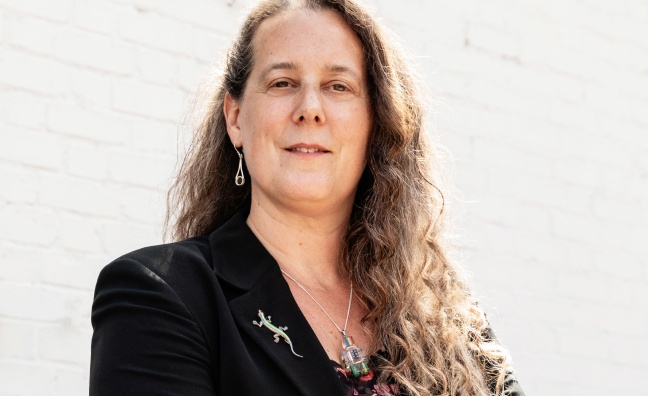
Gee Davy joined the Association Of Independent Music (AIM) in 2017 and now, as CEO, has become the new face of the indie sector in the UK and beyond. Relentlessly passionate and dedicated to supporting AIM’s members, she has been a prominent voice on a range of issues including AI, proposed acquisitions of independent companies by majors and more. Ahead of this month’s 15th edition of the Independent Music Awards, Music Week gets an audience with Davy to hear how she’s been “flexing my leadership muscles”...
WORDS: COLLEEN HARRIS
PHOTOS: LOUISE HAYWOOD-SCHIEFER
Nearly a year into her role as CEO of the Association Of Independent Music (AIM), where she is a longtime servant, Gee Davy has had plenty to get her teeth into in the top job. The executive has been steering AIM through thorny policy debates, championing the indie sector and pushing for fair pay as technology reshapes the music landscape. Given her varied career, Davy being at the helm feels like she’s coming full circle.
“This is really the role where I feel like everything’s come together,” she smiles as we settle down to talk in the late afternoon on a sweltering London summer’s day in the run-up to the 15th anniversary edition of AIM’s Independent Music Awards, which take place on September 23 at the Roundhouse.
“There are a lot of newcomers, not just in terms of artists, but in terms of the label businesses coming up through the ranks,” she beams of this year’s shortlist.
Davy began her career building high-speed telecoms systems but soon realised she didn’t fit into the “male-heavy culture”. Outside work, she spent her time at gigs with her DJ brother, and together they built a promotions and DJ agency, Transmission London. But after realising the lifestyle wasn’t sustainable long term, Davy retrained in law using inheritance money left by her grandmother.
“She always wanted to study law and didn’t have the opportunity, so I thought, ‘I’ll do that’, because it’s another area I was interested in,” says Davy.
That decision set the stage for a career that has touched nearly every corner of the music industry. She joined AIM in 2017 as head of legal and business affairs, was promoted to COO in 2020, later moved up to chief policy officer, and finally added interim CEO to her remit last April after the departure of predecessor Silvia Montello, before taking the role permanently in November. Before that, she worked with independent businesses including Cooking Vinyl and Essential Music & Marketing, gaining hands-on experience across live, label and marketing operations. She was inducted into the Music Week Women In Music Awards Roll Of Honour in 2019.
“Having an affinity with technology and the digital space, the legal side and working within record labels, but also understanding how the ecosystem fits together from having worked in live as well, has brought me to a really interesting and healthy place,” she observes.
It doesn’t take long for Davy to bring up AI, a topic that clearly energises her. She’s been vocal about concerns over proposed government changes to copyright law, and AIM is supporting the Make It Fair campaign, an industry-led copyright fightback against global tech firms’ AI models.
At the same time, with a background spanning both technology and music, Davy sees strong parallels between the two from a creator’s perspective.
“That’s why my affinity to technology is so great, or at least my keenness for it,” she says. “It’s just people who really believe in creating new stuff and doing really inventive things and finding an audience or home for it. It’s so similar and yet sometimes the two sides speak in such different languages. It’s bizarre.”
Like many in the indie sector, Davy has been similarly absorbed in the spate of acquisition stories, with the completion of PIAS’ sale to Universal Music Group last October being swiftly followed by the news that Virgin Music Group had entered into a definitive agreement to acquire Downtown Music Holdings.
Following opposition to the deal (which prompted Virgin Music Group co-CEOs JT Myers and Nat Pastor to speak out about “juvenile, offensive” insinuations about the company’s role in the independent sector), it is now subject to a competition probe by the European Commission.
“The market has been very healthy, and this is why we have been seeing so much good music, with so much choice for artists and in the supply chain,” says Davy, who spoke out in favour of regulatory action when the European Commission confirmed its investigation in July. “I think it would be a real shame if, through an acquisition of this scale, that starts to get closed down and artists and, ultimately, consumers have fewer choices.”
It’s safe to say, then, that there is much on the agenda for the cheerful Davy to address, and we waste no time in getting right to it…
How much have you changed things up during your time as AIM CEO so far?
“I think one of the reasons that the board had so much trust in me stepping in as interim and were happy to ratify me as CEO was because I was very clear that I didn’t want to change anything drastically – certainly not all at once – because there’s a great team here. I have a lot of trust in them, and they trust me back. A lot of the early conversations were about responding to the changes in the market and taking AIM forward. Because I know the members, I spend a lot of time talking about what they need. People are always surprised that the team at AIM is so small, because we’re doing so much for them, and we get a lot of positive feedback. So it feels quite solid, and I would like to think that a lot of that has been through my stepping in and making sure that the team and organisation were settled very quickly. Obviously, as that happened, I was faced with financial difficulties and market consolidation. But that’s the stuff you roll with.”
Unlike Silvia Montello and her predecessor Paul Pacifico, you got the job as an AIM insider. Did that offer any advantage?
“Because I’ve been with AIM for so long in so many different guises, I know the team incredibly well. So in some ways, it’s been an easy transition. But in another way, it’s very difficult to re-establish yourself with some of the same people in a different role. The CEO role is much more wide-ranging. I think the board and the team hadn’t been able to see me flex my strategic and leadership muscles, to some extent.”
What’s been the biggest challenge so far?
“The external challenges are pretty brutal. The global markets have all taken a hit. Some are recovering faster than the UK from the effects of Covid and Brexit, but it’s changed how people respond to music. It’s changed gig-going and how many people are attending gigs and festivals. And that’s partly through, if you like, those teenagers who came through Covid and didn’t come through their teenage years as gig-goers. That doesn’t affect the recorded side of the market as much as live, but wherever artists’ revenues are squeezed, they look to the other areas to try and fill those gaps. That’s a real challenge for independent record labels and distributors who, as small businesses, have their own financial challenges. These are partly challenges for members, but there are also challenges for AIM, because we want to be responding to all of those things.”

How do you stay on top of it all?
“It’s difficult for a small team to be able to deliver all of what members need from so many different areas. We’ve been asked to respond to the US tariffs that are coming in and how that’s going to affect exports. On top of that, you’ve got AI thundering down the road, which is a hugely exciting opportunity with a million different creative outlets that seem almost limitless, while the dangers seem almost limitless in return. All these things seem to hit in a snowball effect, so I’m trying to prioritise some of the biggest issues for our members, whilst at the same time trying to tell the story of how great the music is.”
Virgin Music Group’s proposed acquisition of Downtown has been dominating the agenda lately. What’s the main principle behind AIM’s stance on the matter?
“For me, it’s as simple as a competition issue. What’s concerning is the slowdown in UK market growth. Where we sit in the global market, in terms of chart positions, you can see there’s a drop-off of UK releases, perhaps overwhelmed by US releases and US artists, which is difficult with Covid and Brexit and everything else. All these things have an effect on the market, but either way, my point is that it gets difficult to have a healthy, competitive market when you’ve got one player that’s so big and could put their thumb on the scales and change things up for the whole industry. Just look at all of the discussion around the artist-centric model, which was all led by Universal. We know that across DSPs, that change has been completely integrated, and everyone has just had to follow suit. We know that some of those models are particularly difficult for emerging artists. They’re reducing the early-stage revenues for some of them and forcing some of the smaller end out of business. So, I think there’s just a point where big is too big.”
After the PIAS sale to Universal Music Group, co-founder Kenny Gates told Music Week that if “someone has a principle problem because it’s UMG, that’s fine – it’s their prerogative”. What’s your position on that deal?
“I think if Kenny wants to throw stones, that’s his prerogative, but I think that’s a disappointing place for him to be given how active he was in the early stages of making sure that there was an open market. He’s made his choice, and that’s fair enough. It’s interesting, someone said to me that there was a spat going on in the industry and I did point out that the only comments coming in were not from the independent side. We supported Universal when they had their issues with TikTok. It’s worth noting they didn’t support us when TikTok walked away from Merlin’s negotiating table. We work closely with all three majors at AIM on the Music Climate Pact, so there’s lots of crossover and times where we align. So it’s nothing personal. Of course, there’s going to be a concern about a business of that scale taking on such a major acquisition. The industry didn’t have a huge outcry when PIAS was absorbed into that. This [the proposed Downtown deal] is about the scale of the acquisition. It’s just an acquisition too far.”
Gates also told us that “the concept of independents being the good guys and majors being the bad guys is completely outdated”. Do you agree with that?
“Well, it’s an interesting thing to say as someone who’s been so involved in setting up so many of the independent structures over time. The independent community set up things like AIM and structures around itself to demonstrate that building success in partnership between labels and artists, and now between distributors and artists, is at the heart of independence, and you have to be a good guy to get those partnerships. People aren’t going to want to partner with you if you’re not behaving very well. It’s inherent to building partnerships that you need to run business in a ‘best practice’ way, and we see that all the time. In 2021, we launched the Digital Distribution Switch Code [guideline for moving between distributors], which came from independently owned and run distributors themselves. So, no, I think independence is just a different way of doing business. It’s caring about the art as much as the commerce. It’s being fearlessly artistic. It’s being experimenters and innovators in a way that’s just more raw than you have to be when you’re a corporation and you have that safety net.”
One final thing concerning our interview with Gates – he suggested he was more concerned with people coming into the industry who don’t care about music and buying things up. Do you agree?
“I think that’s such a strange thing to say, because surely a healthy market is all about options. For me, having other sources of finance is largely a positive thing. You’ve got everything from those short-term advance companies like BeatBread, through to venture capital funders who want to be part of a music business and want to mentor and work in partnership. That’s a model that works for a lot of folks. You look at something like Bella Figura, which is going great guns at the moment. There have always been changing models of how that funding and finance happens. Yes, of course, you always need to be careful who you get into bed with. It should always be someone who has the best interests at heart. It shouldn’t be someone who’s going to undermine the nature of being an ethical business, which is so important to independence. And of course, some who are exiting the sector will always take the path of the majors’ money, and that’s what PIAS decided.”
What’s your take on indie market share in the UK? Is it actually independent, given the prominence of distribution deals with organisations that are major-owned?
“It’s a tricky one. I wouldn’t say that it’s anything more than a useful indicator. At the moment, we’re focusing on the market share based on distribution, not to say that market share by ownership isn’t important. But for example, where you’ve got an artist who is entirely financed by a major-owned distributor and able to access the deal terms that, say, Universal only can access, as opposed to others, then effectively that’s not real independence. I think independence is a bit more than that. So we’ve got to be careful about looking at just the ownership alone as an indicator. There are a lot of artists who are doing things in many different ways, and we don’t make any judgments on how you find your money because, if you’ve got an independent spirit, you’re going to find different ways and people to work with. We’re completely market agnostic as to how you choose to get your music out there. But realistically, we’ve got to shine a light more on the people who are working without a safety net.”
There’s been a decent showing in No.1 albums for the independents of late. Should the sector be cheered by the mix of newer acts such as Wet Leg and The K’s, rock acts like Those Damn Crows and returning names such as Pulp?
“This year, the interesting thing for me is that there’s a spread of labels that we’ve never had come through to the nominee lists for the Independent Music Awards before. That’s great but without a little bit more data, it’s hard to tell whether that’s a real emergence or just the bigger ones having a bit of a squeeze and more of a tumultuous time. What I’d say is, it’s probably a relatively healthy market right now, but I certainly don’t want to do anything to tip it, particularly when I’m seeing the other data coming through about a general decline in growth. That’s one of the reasons why I’ve been so outspoken since I stepped in, to try and push the government to give tax relief to independent labels.”
How is that idea progressing at the moment?
“It’s complicated. Other countries have given a lot of support to their creative industries. There is government support in the UK, but it tends to be very project-focused. If we had a tax-relief scheme more similar to the French model, that would underpin a music creation vehicle. What they have, effectively, is a tax relief for when music is recorded. That’s the pivotal moment when intellectual property is created. By supporting that element, which is funded by the music businesses primarily, they’re then able to either make that money go further, and make an even better project, or use their resources in a more widespread way to pay more for tour support or marketing. We desperately need that and we have needed it for a number of years. It’s getting quite stark, particularly with how the UK’s dropping off in growth compared with other nations. The UK needs to step up and really support the music industry in a way that’s more sustainable. That has been a watchword of my tenure. I want the organisation and our members’ businesses to be sustainable. We’re driving projects that are about climate sustainability as well. They are really important to me.”
AIM has been supporting regional UK industry endeavours too, such as Tileyard North. Why is that so important?
“That’s really been the push for the last few years, making sure that AIM is in those places, listening to local people. We’re connected to a whole swathe of initiatives in the North East, from Generator, where one of the team sits on their steering group, to working with Sam Nicholls who runs the Launchpad conference. We’ve been working with Come Play With Me in Leeds too, so all of that’s been building and, in the last year, we’ve solidified a couple of those relationships. One was with Tileyard North, and the other was with the Bristol Beacon. Ben Wynter [director of business development & partnerships] and Nina Radojewski [head of membership] on our team spent a lot of time getting to know folks in the different regions, but particularly up in and around Leeds and Wakefield and Sheffield and so on. With Bristol Beacon, it’s been a bit different. We participated in their newly formed conference, and we helped programme it. We also brought a lot of speakers, not just from London, but from other areas to make sure there was lots of expertise. But there’s more work to be done with them.”

Do you think the indie sector has a different take on AI to the majors?
“A lot of folks are equally excited about the potential opportunities, but the devil is in the detail. For independents, it’s very hard to get the leverage for negotiation. The partnership model is very different from the corporate structure. So as a result, independents will likely need different terms. They’ll need equity, not just equality. What was interesting is a member survey that we ran under my predecessor three years ago to look at how AI was being used in the sector. It was so widespread already at that point, and this was really where LLM [large language models] suddenly emerged into the public space in a really big way. I’ve certainly seen over time that independents take risks, they’re early adopters and innovate more. While being concerned about potential consequences, you’ve got to take those risks to keep up.”
Can you expand on your personal view on AI?
“I’m really excited about it, but I’m also concerned that we haven’t got a mechanism yet to make sure where AI is used in music that it’s properly paid for. This is especially relevant where it’s generative music rather than assistive tools, so that the generative music that’s put out doesn’t do things like exacerbate piracy and streaming fraud and train a generation of people to dissociate from the humanity of music. All of those big philosophical and existential issues need to be addressed at the same time as latching onto something that’s really exciting. It’s difficult to have those nuanced conversations at the moment.”
Finally, are there any misconceptions about independent music you want to debunk?
“Ah, so many! [Laughs]. A big struggle, when I started, was that independent music was all seen as guitar music. It was clear from our member surveys that there was a really wide genre spread. I also think independents were just seen as bedroom hobbyists, not very professional or organised, only able to really support someone emerging on their first or second album and not able to find global success. That’s been absolutely blown out of the water. Look at Fontaines DC, or Adele back in the day, or Arlo Parks, these are huge global names that have all come through the independent space. A lot of them are staying in this space because they believe in it.”
Nat Pastor and JT Myers, co-CEOs of Virgin Music Group, offered their response to Davy regarding some of the key points she, and other organisations, have made about the PIAS and Downtown acquisitions. You can read it here.