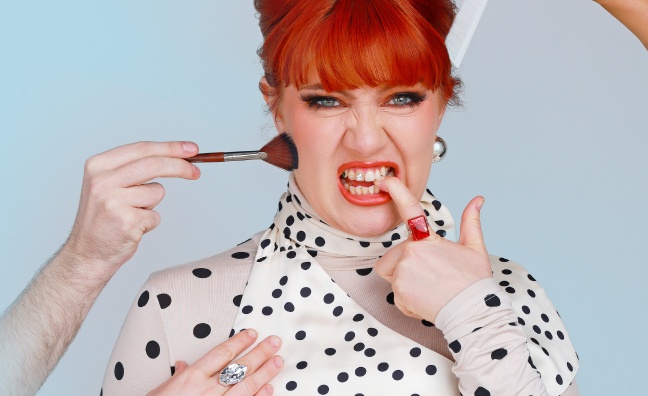
CMAT has a lot on her mind ahead of her third album Euro-Country, from the “f****d up and gross” way society treats young women, to the things the music industry can do to “tank people’s careers”, not to mention the “bollocks” romanticism of Ireland in the mass media. All this and more is on the table as Music Week meets the soon-to-be-stratospheric musician – alongside manager Barry O’Donoghue, AWAL and Mother Artists – to find out how her mix of positive, progressive messaging, giant choruses, TikTok virality and a voracious work ethic has created one of the industry stories of 2025…
WORDS: ANNA FIELDING
PHOTOS: SARAH DOYLE
CMAT is stretching out her eyelid to get at her lashes, pulling her face into new shapes and attacking it with a piece of cotton wool.
“I’m taking all my make-up off because I hate the amount I have to wear every day,” she begins. “It’s absolutely doing my head in and destroying my skin, so if I keep dabbing myself, that’s why.”
She does, repeatedly, causing her golden tooth jewel to twinkle as she moves her face.
Events demanding full-on pop star glam are coming thick and fast for CMAT, who uses the initials from her real name (Ciara Mary-Alice Thompson) for her artist project. We meet after Primavera Sound in Barcelona where, with her six-piece Very Sexy CMAT Band, she played to a huge crowd. That date came in amongst a run of support slots on Sam Fender’s stadium tour, which was followed by a landmark afternoon slot on Glastonbury’s Pyramid Stage.
Her viral single Take A Sexy Picture Of Me – replete with its signature TikTok dance christened the ‘Woke Macarena’ – became her first UK hit at the start of June (her Ivor Novello and Mercury Prize-nominated last album, Crazymad, For Me, hit No.25 in 2023). Last year, meanwhile, the backless dress she wore to the BRITs (where she was up for International Artist Of The Year) attracted attention from the Daily Mail, and saw Thompson discuss it on BBC Radio 4.
The singer has two million monthly listeners on Spotify, with 3.4m likes and more than 130,000 followers on TikTok. Never mind building up a head of steam, CMAT is quickly becoming a force of nature.
“CMAT is one of the most distinctive and original artists and songwriters in the world,” says AWAL COO Paul Hitchman. “She has never compromised her vision and it’s hugely gratifying to now see her music breaking through to a wide audience globally on her terms.”
SVP Victoria Needs also has high praise.
“CMAT has cleared a space for a different type of female artist,” she posits. “One who can be an exceptional songwriter and taken seriously at the Ivors, but also fun and provocative.”
Today, Thompson has just finished recording a BBC Radio 1 session in the station’s Maida Vale studios. CMAT is a lightning strike of a performer, taking what she chooses from pop, country and rock. The 29-year-old is clever, with a sharp turn of phrase, but she’s also unafraid of a bit of camp and a bit of kitsch. She once told an audience that she was the “unwashed version, the ITV version” of Taylor Swift.

But now, with her third album Euro-Country (released via AWAL on August 29) and a gargantuan run of live dates across Europe and the US that stretches all the way to a sold-out night at Dublin’s 3Arena in December, CMAT is scrubbing off some of the glitter and letting her real face show through.
She’s always had a keen sense of the absurd (‘Who needs God when I have Robbie Williams?’ she sang on 2022’s Lonely). And she’s always been emotionally honest (‘I’m worth more when I’m in pain’, went 2023’s Whatever’s Inconvenient). But on Euro-Country, Thompson is facing up to the death of a friend and the fallout from Ireland’s Celtic Tiger economic boom of the mid-1990s to mid-2000s.
“I feel like I grew up a bit, to be frank, I went from being about 12 to being 29 overnight,” she says. “There’s just a lot going on in the world right now and it’s hard to stay apathetic. I am someone who is a pop artist and loves pop and big, stupid, escapist dance routines. But there was an element that was really falling flat, I wanted to re-centre things so it was less about my personality and more about my songwriting. It felt like a natural progression.”
Her direction is fully backed up by AWAL, who signed her in 2021.
“She writes exceptional songs and has an ability to connect with people,” says Will Hunt, VP, A&R. “She’s addressing issues like Irish economics, but also referencing Elon Musk and Jamie Oliver.”
Hunt says AWAL’s partnership with CMAT “means a lot of trust between artist and label”.
“Great records get made this way, as well as campaigns that marry critical and commercial success,” he notes.
“Euro-Country deserves to win every award going this year,” adds Hitchman.
CMAT is a proper self-made pop star, of the kind you don’t often see these days.
“I think my version of events is quite interesting, and I feel more and more like my origin story is interesting,” she offers. “I meet more people in music and I realise how fucking unique it is… Pretty much almost everyone I know in London went to BRIT School.”
Thompson finds that fact “very telling”.
“Off the top of my head, with the exception of a handful, people either went to BRIT School, or they got signed when they were 15,” she adds. “Those are the two types of musicians that are in my songwriter-y, performer-y position. And neither of those things happened to me. What’s unique is that I made contact with people through the internet, I had a complete lack of education and was never in a scene. I’ve always been very isolated.”
Ciara Mary-Alice Thompson grew up in Dunboyne, a suburban town in County Meath in the east of Ireland. She was a bedroom dreamer with a guitar and an internet connection. What she describes as her “first contact with the music industry” came about through being a fan of the band Bombay Bicycle Club. She ran two blogs about them and spent her time doing things like editing pictures of their heads on to the bodies of One Direction and posting them online.
“I was a full-time fangirl,” she recalls. “I was obsessed, they all knew who I was because I was such a psychopath. They’d get asked about me in Irish interviews and say I was quite witty.”
At around 17, Thompson began to post her own songs anonymously on SoundCloud, sharing them on Twitter “when it was very different and the 50 or 60 people who followed you would always respond when you posted something”.
It was Bombay Bicycle Club guitarist Jamie MacColl who correctly identified Thompson as the anonymous artist. By 18, she had a band together and MacColl became her manager (his band’s own manager Jason Marcus later stepped in, and introduced CMAT to Oli Deakin, who produced her first record and Euro-Country). Things took off fast.
“I wasn’t [ready] for it at all,” she notes. “Talking to indie labels in New York because one song had been picked up by DIY Magazine… I had no money, no resources, no friends that made music. I didn’t know what I was fucking doing. I was just writing songs and they were enough to get me noticed.”
This lack of resources was a problem.
“I was working in a SuperValu supermarket,” she says. “Once every two or three months, I would call in sick, which in the end got me fired, and go over to London on the ‘sail & rail’, work in the studio for three or four days and then go back to the village.”

Thompson was mostly making music in her bedroom, but that didn’t suit her full-blown vision.
“I lived with my nanny and grandad and it wasn’t even as though I was in my bedroom producing bedroom pop,” she says. “It just wasn’t my genre, it wasn’t the kind of music I wanted to make. I had to write so vociferously, and then take a huge backlog of songs to a studio for the days I could afford and work through it as quickly as possible. I think that’s unique, because everybody else learns how to be self-sufficient in a bedroom-producer way, that’s the route now.”
A period living in Manchester followed, where Thompson endured a relationship that wasn’t working and spent her nights working as a “sexy shots girl” in a club. Once again, it was music fandom that pulled her out of the doldrums. At a meet-and-greet with Charli XCX, Thompson quizzed the singer in depth, leading XCX to ask why Thompson wasn’t making music and telling her to “sort your shit out”. She split with her boyfriend and moved to Dublin.
It was back in Ireland that things started to shift.
“Ciara had just moved to Dublin, started solo as CMAT, and was uploading live videos of songs and very amusing ramblings to YouTube most Fridays,” says Thompson’s manager Barry O’Donoghue of This Management. “One song was [2022 single] I Wanna Be A Cowboy, Baby!. It made my jaw drop. I went to see her the following week, and we hung out a bit. She was funny, smart, a pop-culture encyclopedia and knew more about music than anyone I have ever met. We started working together after that.”
O’Donoghue says it was easy to see that CMAT would fly.
“Her potential was obvious, she had great songs, a great personality and worked very hard at everything she did, including having fun,” he says. “We were very indie and self-funding at the start. Her first single came out just at the start of the Covid-19 lockdown in Ireland, so there was a captive, receptive audience, and her adventures on the internet helped develop a fanbase really quickly. We put some merch on sale, and it flew. We did a livestream and hundreds of people bought tickets. Her first solo shows sold out immediately, and every show after that sold out, too. So at that point it was clear something was happening.”
Thompson signed her deal with AWAL at the age of 25.
“By the standards of the music industry, that is so old,” she says, laughing.
CMAT’s first two albums – Crazymad, For Me and 2022’s If My Wife New I’d Be Dead – both topped the Irish charts.
“Ciara is really good at what she does; there is a team around her who really believe in her; and we’ve been able to develop at our own pace,” says O’Donoghue.
Victoria Needs adds that CMAT’s “relentless commitment to live performances” has been key. Elsewhere, fellow AWAL SVP Sam Potts suggests the team has focused on “translating the live experience into something that people who weren’t there can still feel a part of” via digital content.
“Once you see her live you are in for life,” hails Natasha Gregory, CMAT’s agent at Mother Artists. “And it’s the attention to detail on touring that will see her through for years to come, from arenas, top festival billings and beyond.”
Gregory points out that no one on the team underestimates the importance of her kinship with touring buddy Sam Fender.
“It’s been an amazing opportunity to see her play on the big stages,” Gregory states. “It’s where CMAT belongs.”
Interestingly, Ciara Thompson has been describing herself as a “global pop star” since before she even had a record deal. But as she is stretching into new territories, Ireland – her starting point – is the subject of much attention, not least for exports such as Fontaines DC. Their Romance album was the biggest independent LP of last year.
“I certainly wasn’t part of an Irish scene,” says Thompson, who lives in London. “I didn’t know any of those people until after I was successful and famous.”
Neither is she a huge fan of “traditional Irish music”.
“It’s amazing and it’s beautiful, but there are so many nights where musicians end up in the same pub and people will pass the guitar around,” she says. “You have The Mary Wallopers, Lankum, Lemoncello and Junior Brother and they’re all singing a traditional song. Then it comes to me, and I don’t know any of those songs, so they have to listen to me singing my own. Everyone has always been nice and respected me and no one’s been a fucking dickhead or anything, but it has always made me feel a bit insecure and not a part of things.”

But Thompson – who describes herself as “an extremely loud, hyperactive, Tasmanian devil person” – is content to forge her own path.
“I can’t go on a stage and not talk into the mic,” she explains. “I have to talk to people, and I have to make a stupid little joke and I have to be surrounded by gay people at all times!”
Nonetheless, while Thompson is full of admiration for her musical compatriots, she has little time for those with misty-eyed visions of an Emerald Isle.
“It’s complete bollocks, so many people waxing lyrical about Ireland from afar,” she says. “I’m one of them, I’m living in fucking London, but I’m from a family of four and three of us have emigrated – that’s standard. My community doesn’t exist any more.”
She traces this mass emigration back to the economic policies of the 2000s, enacted by the centre-right Fianna Fáil party. Thompson is angry at what she sees as a lack of care and a dereliction of duty.
“They decided to prioritise letting American corporations have headquarters in Dublin for the grand prize of having to pay low corporation tax and thinking that this was somehow going to benefit the economy,” she says. “And clearly it hasn’t. It’s completely fucking decimated it. Only about 50% of the people I grew up with still live in Dublin or Dunboyne. That’s my school class, decimated. There’s nothing wrong with emigrating, but there comes a time when we have to ask, who are we making Ireland palatable for? Is it for people that want to live and work there, or is it for American tourists who want to spend a significant amount of cash in a very short amount of time and then leave?”
Euro-Country’s title track is partly sung in Irish and addresses the consequences of the failure of the Celtic Tiger.
‘I was 12 when the das started killing themselves around me’, she sings, referencing male depression and death by suicide. The record’s cover pays homage to Dublin’s Blanchardstown shopping centre (a popular CMAT haunt during her youth), suggesting that her childhood was more about cheap thrills from buying nicknacks than gazing across the peat. Her fierce patriotism is focused on reality.
“The rise of white nationalism is particularly dark,” she says. “I’ve never known it to have as many legs as right now. With the younger generation of working-class Irish people leaving, people from other countries are coming in… so you have those that are appalled that people might want to move to Ireland and make a life for themselves, and we have race riots. I find that absolutely horrific.”
She believes that Ireland’s thriving cultural output is “born of suffering”.
“It’s when a population in a small area suddenly has lots to write about and lots to sing about and lots to perform with,” she says. “We need to talk about the whole story of Ireland and not just keep patting ourselves on the back.”
Euro-Country does make use of CMAT’s wry take on relationships and will please fans of her first two records. But it’s another of her more serious takes that has become a TikTok hit, with its own dance trend, the ‘Woke Macarena’, coined by influencer Sam Morris in May. Take A Sexy Picture Of Me has since accompanied more than 139,000 clips at the time of writing. Enthusiastic adopters have included Julia Fox and Amelia Dimoldenberg.
The song details the contortions women and girls put themselves through in order to be deemed attractive by society. For Thompson, the dance’s viral spread shows that the message is hitting home.
“Firstly, it’s so incongruous,” she says. “I don’t have TikTok on my phone because people were so mean to me. There were so many nasty comments about my physical appearance. That kind of stuff was the genesis of the song.”
She has watched its growth keenly.
“It’s been so valuable to know I’m not out here on my own, that I did a really good job of describing something that is difficult to describe and make someone understand,” she says.
Thompson continues, expanding on the song’s message.
“When you’re a woman aged 18 to 25 people are really, really nice to you all the time everywhere, if you’re, you know, somewhat attractive or pretty,” she says. “Then, you get to your late 20s, and suddenly all those people have just disappeared, people holding doors open for you and that kind of thing. I thought, ‘I will continue to keep rapidly becoming less and less important and of less commercial value to society as I was when I was a 20-year-old girl,’ which is really fucked up and gross.”
AWAL’s Will Hunt praises her ability to translate that sentiment.
“The duality of CMAT is compelling and is central to why she resonates so deeply,” he says. “The lyrics to Take A Sexy Picture… call out the challenges of the female experience while providing a space for people to dance – how many artists can make you feel both of those things at once?”
While Thompson doesn’t “see signing a deal as a measure of success”, she speaks fondly about her bond with AWAL.
“Well, they signed me, which was a start!” she smiles. “They gave me a very good and fair deal. Maybe you don’t get the big fat advance you might with a major, but you will own your music, and you will earn residuals off it, and be able to do whatever you want with it once you come out of the deal after a short number of years, instead of someone owning 85% of the songwriting for 80 years. I needed to have control of my own ship.”
Creative freedom has been particularly beneficial for CMAT.
“I’ve made three albums with pretty much no interference; if I turn round and say I want to release an album in three weeks, they can’t do anything because I have control,” she says. “It’s not a model that works for everybody, some people want more guidance, but I’d been wanting to make music professionally for so long that I made three albums in four years. If I had signed with a major, I would still probably be on my first album cycle.”
Thompson has enjoyed being able to experiment creatively and in business.
“You need to understand your audience and when you’re [doing] good or badly,” she says. “I’ve released songs that I didn’t like, and the immediacy with which I was able to understand that I didn’t like them was only as a result of being able to release so prolifically. Releasing as much stuff as I could in such a short amount of time has been the best education I could have had. The fact that other labels don’t work like that is crazy, because they tank people’s careers that way.”
“We believe our artists maintain their independence because they own their own rights,” says AWAL’s Sam Potts. “Ciara has a record company full of genuine fans who understand her, fight every single step of the way for her, and know how to take alternative music into the mainstream.”
Up next? Potts insists AWAL are targeting her “best ever week-one results”.
“The plan is optimised to have the album live a long life,” he says. “We are operating around market factors like Grammy and Mercury Prize submission dates, but we are very much in this for the long haul.”
Thompson has inspired many of the campaign elements, such as the Sinceremat newsletter, which goes out to over 16,000 fans as “a compendium of brilliant words and thoughts from your local gorgeous pop star CMAT”.
“That was Ciara’s idea,” says Victoria Needs. “Newsletters are typically part of the marketing funnel to drive revenue. In this case it wasn’t that; it was a choice by Ciara about how she wanted to talk to her audience, and we trust our artists’ instincts.”
Thompson’s instincts are still those of the fangirl she always was.
“Being a superfan herself, Ciara understands what an audience needs and can talk to them without barriers,” says Needs. “We had a lot of fun when she turned up unannounced at a fan-promoted karaoke night dedicated to her. The power is in the hands of the audience in 2025, and hers is smart, inclusive and fun.”
Potts says that CMAT is “a typical AWAL artist – she’s difficult to categorise, isn’t driven by overnight commercial success and is uncompromisingly independent.”
“There is no ceiling,” says Needs. “She wanted to break the mould on this album and she will do so again and again.”
Thompson herself has total confidence in Euro-Country, which seems set to propel her into the stratosphere.
“This is a good album,” she smiles. “Life happened to me and bad things happened to me, but my creative wheels were really, really greased and my muscles were there; that’s why it’s so good. I don’t think I ever would have been able to make an album this good if I had been forced to wait to release it.”
As she takes stock of her story so far before we part ways, it’s difficult to imagine anyone forcing Thompson to do anything.
“Look, I have friends who are panicking about turning 30, but I am fine with it,” she offers, her facial dabbing now complete. “If I’m being honest, that’s because I’ve done so much already. It’s easy to turn 30 when you’ve achieved everything on your life-goals list…”