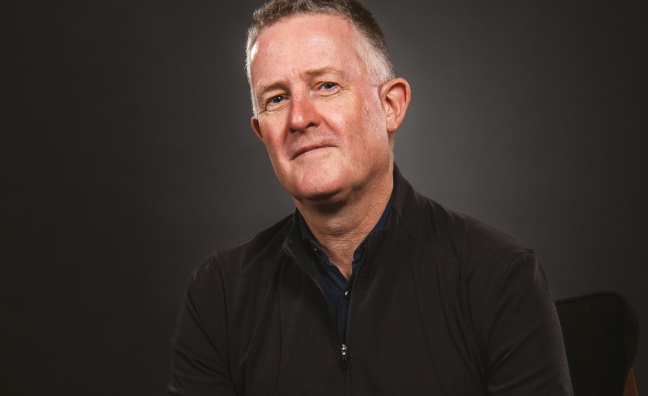
As he joins Music Week to give us his world exclusive first interview since taking over the role of Universal Music Group UK & Ireland chairman and CEO, Dickon Stainer has a lot on his mind right now. In just over a year, he has already overseen incredible international and domestic success, but has also been doing a lot of work behind the scenes to ensure the market-leading company is built for the future. And the years ahead, he says, are all geared around delivering one thing: helping British artists make their mark on the global stage once again...
WORDS: George Garner PHOTOS: Carsten Windhorst & Gerard Hynes
Ask Dickon Stainer to paint a picture of who he is away from the pressures of his day job, and he proceeds to detail a life that revolves around simple pleasures. Charmingly, he seems almost apologetic not to be armed with some more flamboyant hobbies. You might, for example, find him walking around the Isle Of Wight in his rare moments of downtime. You may also see him out and about indulging in his passion for cycling. “At one point I was also a violin player,” he says, issuing a grin that soon dissolves into a wince. “But it has spent a long time sitting in its case.”
That said case is collecting dust right now should come as no big surprise considering that, in September 2024, Stainer became the chairman and CEO of Universal Music Group UK & Ireland. Today, Music Week has been granted the world exclusive first face-to-face interview with him since his appointment, and he is quick to set the real agenda. Frankly, that violin will have to wait...
“Breaking British artists globally is Universal Music Group UK’s number one most important mission,” he says, cutting a friendly and relaxed figure as he sinks into a sofa in his office in the major’s London HQ. “That’s our job.”
And if that is the job at hand, well, right now his company has provided ample evidence of doing it in style, with both Olivia Dean and Lola Young making big waves internationally in 2025. This, too, coming hot on the heels of Universal Music Group UK’s artists and executives recently delivering a high-profile British talent showcase in LA where Olivia Dean, FLO, Holly Humberstone and Sekou all played, alongside a surprise appearance from Sir Elton John, no less.
“There is a real excitement in the building,” Stainer says, before offering the first of what will be a recurring addendum from him today. “But there’s also a sense of this being a job that is just being started.”
The excitement in the building described by Stainer is plain to see when he is joined by a host of key names from across Universal Music Group UK – 14 of the busiest people in the music business taking time out to congregate for a landmark series of interviews in Music Week. During the shoot Stainer and chief people officer Andrea ‘Ange’ Pattico are accompanied by executives from Island EMI, Polydor, Capitol UK, 0207 Def Jam, Universal Music Recordings, Fontana, Decca, Globe, and the Audience & Media and International divisions. It is quite the sight to see the 14 of them chatting away, selecting songs to play during the shoot before they break off to offer us the most comprehensive insight ever given into the inner workings of the market-leading major.
And the timing couldn’t be better because this is a major that has, of course, undergone significant change of late, not just with the appointment of a new chairman and CEO, but also the formation of new label groups – Island EMI and Polydor Label Group – plus one revived label and an innovative new division. All of this and more – including the world-famous Abbey Road recording studios – now come under Stainer’s direct remit. But again, behind all of these strands, there is a plan to build in one direction only.
“One of our key ambitions is to give our artists international reach, which is something that, traditionally, British artists have had around the world,” Stainer says. “It’s one of our greatest legacies, but for a variety of reasons, it’s something that we have struggled with a bit as an industry [of late]. Were you to ask artists what they want, it’s the idea that audiences are borderless, that they can travel wherever they want, have careers wherever they want, that their music can reach the four corners of the world. That’s something that we take incredibly seriously: how to be international. The feeling here in the company is we’re making a start in trying to offer artists international reach in a year in which Lola Young has had very significant global success. As we sit here today, Olivia Dean has been in the Top 10 of the albums chart in America for four consecutive weeks. She’s in the Top 10 from Belgium to Australia, New Zealand, and the Netherlands. She’s an example of an artist who is breaking globally. That’s something we can build on.”
Since Stainer’s appointment, Universal Music Group UK’s successes have included Sam Fender’s People Watching scoring the biggest-selling UK album of the year so far and scooping the Mercury Prize, the return of The Last Dinner Party, and No.1 albums for Taylor Swift, Elton John, Sabrina Carpenter, Lady Gaga, Mumford & Sons, The Weeknd and more. All signs point to both a very successful first year in charge, and a deft migration from Stainer’s most previous role as president and CEO of Global Classics & Jazz and Verve Label Group.
This was no mean feat. Stainer picked up the baton from former chairman and CEO David Joseph, the highly respected executive who occupied the role for almost 17 years. As such, it was a moment of profound change not only for Universal UK, but for the British music industry as a whole.
“David Joseph was a formidable team builder,” reflects Stainer. “You can’t underestimate what it takes to run a company like Universal UK for 17 years, the skill and dedication it takes.”
At the time of Stainer’s appointment, Universal Music Group CEO & chairman Sir Lucian Grainge said his “expansive musical worldview”, “deep experience in leveraging our worldwide organisation on behalf of our artists” and “a track record that includes global commercial and creative artist successes and countless awards in many countries” made him the perfect successor.
Today, Sir Lucian offers more insight with Music Week.
“Having worked directly with Dickon for many years, I know first-hand that he is a true music executive, brilliant manager and advocate of talent,” he tells us. “He is both respected and liked by his international colleagues and I’m delighted with the progress the entire UK company is making under this leadership. We’re all counting on him!”
But how did Stainer actually feel to be told he was being entrusted to build a new legacy for Universal in the UK? What runs through your mind during that call?
“Well, obviously a bit of blind panic,” he laughs. “But then that blind panic subsided. Plus, I’ve got a very supportive person in Sir Lucian Grainge, who I’ve known for many, many years. Lucian is the greatest champion and guardian of British music who has ever lived. The drive we feel to constantly elevate British artists, it starts and ends in one place – with him.”

Dickon Stainer and Sir Lucian Grainge with FLO, Olivia Dean, Sekou and Holly Humberstone at the Universal Music Group UK showcase in LA (Photo: Christopher Polk)
Another reason, he explains, why that “blind panic” soon subsided was not just his support network, but also the rich experience he has forged in his storied career – which includes over 20 years served at Universal – in roles based both in Britain and internationally. Stainer’s name may be synonymous with the worlds of classical and jazz, but it would be shortsighted to think these are the only ones he’s inhabited. Over the years, he has worked across campaigns for the likes of INXS, U2, Bon Jovi, Madness, Sir Rod Stewart and Diana Ross. In fact, his first job at Universal was working on the campaign of one of the biggest-selling records of all time. A heavy metal record, FYI.
“The first video I ever worked on was Metallica’s Enter Sandman when I joined PolyGram Video in 1991,” he laughs. “I was the video product manager for Metallica [during the 30-million selling Black Album campaign]. I remember the video turning up and I really didn’t know what I was talking about, I was more used to talking about Pavarotti than Metallica!”
Indeed, Stainer’s longevity in the business sometimes even comes as a surprise to the man himself. Just take one recent meeting, for example.
“I’m fortunate to have worked for the company [for a long time],” he says. “We have a quarterly Andrea Bocelli board meeting, which I sit on, and they were talking about the 30th year of Romanza, the record that broke him.”
At the end of the meeting, Stainer suggested they needed to develop a storyline for the upcoming 30th anniversary campaign celebrations.
“Well, there is a storyline because there’s someone in the company who was there at the start.”
“Well, who was that?” Stainer asked, oblivious.
“You!” they replied.
“That wasn’t really the story I had in mind,” he laughs. “But I suppose the point is, I’ve been at the company a long time, so I know the key players, I know the global landscape. I’ve worked in America quite a lot. So although there was a bit of a mind shift that needed to take place, I had the global contacts and I knew the ecosystem. I felt supported by all that experience.”
But while Stainer may draw on his rich past to guide him, in conversation he is hyper-focused on the future. He’s making big moves, be it with Ange Pattico in terms of the company culture or, notably, relaunching Fontana as a frontline label, headed up by former Decca co-president Tom Lewis. And let’s not forget, alongside his UK leadership role, Stainer is also chairman of Global Classics & Jazz and Verve Label Group, which is without mentioning the host of industry hot topics brushing up against his door right now, from AI to the resurgence of the ‘indie vs major’ debates. So, without further ado, it’s time to get into all of the above and tell the inside story of the bold changes at Universal Music Group UK. “Thanks for this,” he says. “Because if these stories don’t get told, no-one knows about them…”
So, where should we begin, Dickon?

Looking back to your appointment as chairman and CEO, did Sir Lucian Grainge offer you any advice when you took over?
“He told me to get on with it [laughs]. But I know that I’ve got a great deal of support, and I also know that at Universal we’re expected to lead the market. We’re not here to wait on anyone else. We’re here to make our own future and to provide the ultimate solution for artists, and I mean artists of every type in every genre. Our ambition is to help artists create their careers and be the very best they can be in every single genre. We want to help them. We want to lead in every single area. That’s the thinking.”
Before we get into some of the tweaks you’ve made, let’s talk about the label structure you inherited at Universal Music Group UK. What did the formation of Island EMI and Polydor Label Group bring to the company?
“What happened here with the restructuring mirrored some of the changes happening in the US, where they consolidated both label groups on either side of the states, Republic and Interscope. What it’s done is give the organisation more muscle, and those label groups a greater degree of control and leverage. It’s made those two groups work more effectively as units. But a year on, one of the things we need to ensure is that the individual label identities are curated and preserved. That’s important. So EMI, for example, is one of the great British labels. We’re very ambitious for EMI, but it needs a great deal of focus. For Louis Bloom, I know a big objective of his is to give EMI its moment in the sun. Ultimately, our job, our existence, is predicated on being able to meet the needs of the broadest possible artist spectrum. In order to do that properly, we need to have a portfolio of labels that offer many different philosophies, business practices, musical tastes and histories, and there’s a huge amount of that within Universal. So, whilst we made changes in order to give more strength, we mustn’t forget the incredible tapestry of musical history that exists inside these labels. I’m a big fan of what labels mean and stand for, but you can only see it through the eyes of artists and managers and the musician community. They’re the ones, ultimately, that we’re there to serve. Some artists want to sign to labels purely because of who was on the label historically before them. They care about the artists that defined it. Once you forget about the artist, then the identity of the label is going to fail. Artists sign because of artists, so it’s very important that we don’t forget what those labels have meant in the past and what they could mean in the future. Sometimes when you bunch things together, you can lose identity.”
Regarding the new label structures, do you think you would have had the incredible success you’ve had without some of that synergy from the label groups like, say, Sam Fender and Olivia Dean’s Rein Me In duet?
“Probably not without that move, for Polydor and Capitol to be affiliated. There’s more creativity between the label groups now. But what I would say, again, is that it’s a work in progress. It’s an evolution. I don’t think we’re there yet, there’s a lot of work to be done.”
One of the most interesting other things that changed before your appointment was the launch of Rebecca Allen’s new Audience & Media Division. What has that – plus the work being done by Nickie Owen in the International department – done to help the label groups?
“The principle, which applies to both those divisions, is that you can learn best practice by having eyes across the entire organisation. And what Becky and Nickie aspire to do is to ensure that the very best of what we’ve done for one artist can be learned to apply to someone else. That’s about standards as well. If you’re operating as a standalone label without any reference points across the company, how high are your standards going to be? Do you have the right information and intelligence to make the best decisions for the artists? What we’ve seen in both areas is that if something has really worked for a particular artist, we can apply it to someone else. So, I’m in a slightly odd position where I’m at once wanting to preserve the individual identity of the labels, and at the same time have the collective scale of the company and the shared intelligence be a weapon that nobody else has. There is a meeting point of those two things, they can both live concurrently, but you have to preserve both. So, with Nickie and Becky, what they’ve managed to do is to apply learnings from one part of the company and apply it to another, and one set of artists and apply it to another.”
A big move you have just overseen involved Decca, with Laura Monks going forward as its sole president while former co-president Tom Lewis now heads up the relaunched Fontana. What was the strategic thinking behind that separation?
“Well, simply, it’s that we aspire – and it could equally apply to hip-hop or to other types of music – to be the best in all genres. What the previous manifestation of Decca had become was a label that was a lot of things to a lot of different artists, and I’m not interested in being a jack of all trades. We need to be the best curator of genres and the best artist servants that we can be in all areas of music. So if you want to be the best in blues, jazz, folk, classical, soundtrack, film or anime, you need to have specialists. [Decca] was becoming very, very broad in the offering that was coming through that previous entity. I feel you can offer a better service to artists if your specialist skills are more carefully honed within a different label offering. That’s why I think Fontana, with its quite storied history, is a big opportunity. With Decca, we’re in a world now where – as we’ve seen this year in pop – anime and the relationship between film, the moving image and music has been a driver of incredible global success. Decca have just secured the soundtrack to Hamnet, a great new movie starring Paul Mescal and Jessie Buckley, which has been lined up for awards season. That’s a Max Richter score and that’s exactly the kind of area that Decca should score in.”
Going back to your stated mission of taking British music to the world, this year we’ve seen Universal Music Group UK have very notable success with Lola Young and Olivia Dean. Why are you getting it right on the global level at the moment after, as so many have pointed out, it has been tough for British acts to get international traction in recent years?
“Well, with Olivia, there are lots of different reasons for it. You can’t underestimate the magic of the artist herself, and the particular quality that she brings that is something different. She exudes a warmth as an artist. I also think it’s the amazing work of her manager, Emily [Braham, of Yo&Co Management], who is a principal person in this. What should also be said is that with both Lola and Olivia, these are ‘overnight’ six-year successes. That’s a responsibility on labels, the British label system, to support and invest in the artists over a long period, and to let the artists find their pace. Every artist is different. Every single artist will have their own vision for themselves, and our job is to support them. So, when you come back to why have they been successful internationally? It’s intentional. Everybody needs to be pointed towards international success. If you were to go into the building here and ask anybody, they all know that’s the objective of the company. We live in an era where there is something, still, about British creative talent that means people want to hear about it all over the world, whether it’s the success of [Netflix TV series] Adolescence, or British art, there’s an excitement. If you go to Tokyo and you talk about the UK, they talk about the culture, music, film and creative energy that flows out of every part of this country. Maybe because the gatekeeping for streaming moved, to an extent, to the US, we forgot the art of staying in the conversation, and getting in the conversation. You’ve got to get a loud hailer, and you’ve got to get on a plane. You can’t let other people dictate the conversation for you. You’ve got to do it.”
Is that what Universal UK’s LA showcase represented?
“The LA showcase was aimed principally at the audiovisual streaming community and the music supervisor community in the US, which is incredibly important. The US lead the world in that area so you have to go there. The other important point, though, is we’re fiercely independent here. We’re fiercely autonomous when it comes to A&R, and we’re proud of the fact we make our own decisions about UK A&R, and about the success of Universal Music UK. Independence and autonomy are incredibly important. Next thing you know, there’ll be American A&Rs sent over [to companies in the UK], which would not be the right thing. What I would say, though, is if you’re inside Universal – and this is part of the reason that Olivia and Lola have seen such big success – there’s not a cigarette paper between us and the world-leading label system we have in the US. Justin Eshak and Imran Majid at Island Records US and John Janick [Interscope Geffen A&M] and Monte Lipman [Republic] are doing the most incredible jobs. Their organisations are incredibly closely attuned to the UK, but we are an autonomous A&R source. Our desire to be more successful for artists is at an all-time high.”

As you were just talking about UK and US relations there, what did you make of Warner Music Group’s move to have Atlantic Records and Warner Records UK join the global leadership team and report directly to the US? Does that affect you?
“For the entire industry in the UK, it’s important that we need all of the companies to do well. Of course, we’re Universal, and we’re proud of the fact that we’ve been the strongest company for a long period of time. But I worked for Warner for three years, so I’ve got an affinity with that company. I want to see the whole industry doing well. When it comes to the UK, we need autonomous UK record labels that can make their own decisions and sign their own acts from anywhere in the country and be able to take that anywhere in the world. The UK should not be beholden to anybody. It’s going to be very hard to have global success if you’re beholden to other people. That kind of freedom inside the company is something we’re very fortunate to have, and it’s a responsibility as well. Ultimately, you are beholden to one set of people: the artists. So, we need to make sure that we are best-in-class all the time, in any discipline of the recorded music business. That is the challenge we need to meet.”
It’s easy when focusing on the global picture to lose track of the roots of that domestically when it comes to what actually gets signed. Sam Fender, a regional UK talent who scored the biggest-selling week one in 2025 for a UK artist and won the Mercury Prize, served as a potent reminder that potential exists everywhere in the UK, not just London…
“Sam is a very special artist. As well as going out to the four corners of the world, we have a responsibility across the scope of Universal, to make sure that in the four corners of the UK, we’re just as active and sensitive. Our reach needs to be as broad as it can possibly be, so you can’t just sit looking at computer screens. You’ve got to get on trains. We’ve got artists signed from Orkney in this company, we’ve got EMI North. And actually, that’s something where there is a lot of work to do. If you look at the history of UK music, from the importance of Liverpool to Leeds and Sheffield, it’s incredible. The A&R reach inside the country needs to be very broad and intense, and it’s a responsibility for us.”
Keeping to this theme, your team have all spoken to Music Week about how fiercely passionate and competitive you are in regard to British talent getting recognised. What’s fuelling that drive for you?
“I spent time working for the UK company, time working for the international part of the company, and time working in the US. I do have the perspective of someone who’s spent time inside Universal working from different global perspectives, and I have always been proud of the impact that UK music has had on the global scene. I also think there’s an opportunity for British artists, because there’s a creativity and a sound here that is not the same as anywhere else in the world. And a sense of humour! It’s got to be championed. I have a perspective of having seen it from different parts of the world and knowing the value of it, but it’s not going to happen unless you shout about it. And by the way, it’s an ongoing evolution. We’re having some success, but I think we need a lot more. We’re right at the start of the process. We tweaked various parts of the organisation. That has to continue. But our mindset is one of dissatisfaction; we’re continually dissatisfied because, really, you’re only as good as next week’s chart. Anybody who happens to think they’ve found out all the answers, well, they haven’t. There is no template in the business. We can see that the business models are completely changing inside the industry, and that’s because every artist needs something different. It’s up to the industry to provide artists and entrepreneurs with solutions to their needs, to act as partners. I feel a sense of constant unease that success is very fleeting. What we’ve got to do is get into a rhythm and offer a broad enough suite of labels and business options for our artist and manager community that can fulfil their dreams. Artists need freedom and space, and they also need, from their managers and their record labels, support, good advice, sometimes investment, and belief. Belief is the ultimate elixir. If you’ve got an artist and you’re six years in and it’s hurting, belief is the thing that’s going to carry you through when other things don’t go right.”
So is there a sense in which Britain needs to really take the initiative when it comes to vocally championing our artists now?
“That’s a good word, being a ‘champion’. But there is sometimes a question of timing, too. I think we’ve learned, sometimes the hard way, that if you go and, for want of a better word, put your artist out there and sell them on the global stage when they’re not ready, or when you’re not ready, you set yourselves back. Timing is important, and so is the artist being ready, for things to be in the right place musically, and for the audience to be developed at the right time. Understanding pace is important. That is why you need good people in labels. You need good label presidents and A&R people who are sensitive to the needs of the artist. And you can’t do it without supremely good management. Good managers are fundamental to the entirety of an artist’s career, not just the recording piece of it. We work in close harmony with great managers – I can’t think of an artist that we’ve broken that hasn’t been managed incredibly well. It’s just never happened.”
So what does a true artist/manager and label partnership look like to you right now in 2025?
“Amazing flexibility, because there’s no one system that works. You’ve got to be a great listener, not a talker. What do they want? What’s important to the artist and manager? Speed can also sometimes be important. Taking your time can be important, too. It all comes back to everybody needing their own bespoke answer. A company like Universal has to be innovative, by which I mean we have to be able to provide knowledge about things that people don’t know. And expertise is something that needs to be revised and revised constantly because we need to be the best in the disciplines that matter. We’re quite fortunate inside Universal Music; we’ve got people like Marc Robinson, who runs Globe, and that serves the branding business and the synchronisation business, which was so important in Los Angeles [at the showcase]. It also offers creative solutions to artists in film, theatre and television; it’s unique. We have to have things within Universal that we can offer to artists that they can’t get anywhere else to the same level of expertise, to the same level of excellence.”

You mentioned there how the industry is constantly changing. How does that inform your leadership style, especially when it comes to working with your executives to make sure they are future-proofed for what lies ahead?
“I believe in empowerment and, to a certain extent, getting out of the way. People who are empowered and who sense that they can change things through their own initiative, and that there is no ceiling, can do incredible things. People need a mindset where they’re not worried about things going wrong, and also to think about what could happen if things really went right. If you’re not careful, you can think only within your own term of reference when it comes to success and think it looks like ‘this’. But it might not look like that. What I’m trying to say is, people need the freedom not to think within some geometry that you’ve imagined for them, they need their own capacity to dream. But we’re fortunate to have a [global] organisation that’s run by the ultimate winner and that has flowed through the company for decades, that feeling of, ‘Take your power.’”
Do you have any philosophies or mantras that you live by when things don’t go to plan?
“It always feels terrible when things go wrong. There’s no point trying to get away from it, it feels shit. [Laughs] Sometimes when something goes really wrong for a second, you’ve just got to have a bit of a smile about it, because it’s all about what happens next that’s important. It’s your mindset at that moment of what you do next, once you’ve recovered yourself, that is the most important thing. Take the pressure off yourself for a minute. Then your next move can be a good one.”
And what is the broader culture you’re trying to instil in the UK company?
“The first and most important thing comes back to communication. You need to be able to bring people with you, to share what the ambitions of the company are with everybody, openly. And being open in a big company with lots of floors is hard. I also think: it’s a music company. The first company I ever worked for when I came out of college was a chocolate company. We’re not making chocolate. A music company needs to be built around the needs of artists. So: excitement, energy, direction, sensitivity and incredible positivity. It’s a tough business. It’s a tough market. It’s competitive, not just within music, but within entertainment, and we’ve got threats from all over the place. If you want to succeed, you’ve got to go in with, if not a smile on your face, then great confidence to be positive with everybody. Because anything’s possible. When I look back at the success of the industry across the last 50, 60 and 70 years, all of the artists who achieved astonishing success, they were all riding on a tidal wave of optimism themselves.”
It’s hard to imagine the Spice Girls and Britpop without thinking of the optimism underpinning it, for example…
“Oh my God. When you talk about it, you just start to smile. You’ve got to bottle that lightning – that’s magic stuff. It doesn’t last forever, but if you can infuse a company with that kind of energy, you’ve got a great chance of success. I also think you’ve got to be impatient and constantly wary that you’re not on top of your game. Because technology changes with us all the time. The needs of the business are changing. Evolution is everywhere.”
On the topic of technology, what are Universal Music Group UK’s artists and managers asking from you when it comes to AI?
“I mean, AI is such a broad topic, it covers anything, [including] operationally, how to use AI to improve your systems, or general working procedures. Like a lot of people in the whole [spectrum] of industry, we’ve got a responsibility to make sure that we’re up to the minute when it comes to ensuring that AI is a part of the way we do business, and that we utilise those advantages that it offers in the right way. When it comes to artists and AI, the important message is that we’re not going to do anything that would allow AI operators to mess with music or lyrics without the consent of the artist. But the debate about AI is going to continue to run and run.”

Do you ever feel that the debate is too one-sided in the music industry, that the focus is, understandably for so many, grounded in fear?
“That’s why I said at the start, it’s incumbent on people to make sure that they are utilising the advantages of AI, of which there are many. That requires a lot of hard work, it’s a bit like I was saying earlier on about applying yourself to change. It requires a lot for people to understand AI. In an organisation like this, how do you actually drill it into the building? It’s quite hard. But I think it’s very important. But we are in the original thought business. We’re in the writing music and performing music business. Our mission is to take British artists and British musicians – and by the way, also all of the artists that come to us from our incredibly successful labels around the world – and have incredible success here in the UK and overseas. Anything that threatens the efficacy of their work is a concern to us, absolutely.”
And are you happy, say, with the level of support British music is getting at a policy level from the government?
“I mean, I think it could be better. Sir Keir Starmer made a comment the other day in an interview about the importance of creativity. Well, you know, if creativity is important, then we need to lean into that. Sometimes people talk about international success like it is export. You’re kind of missing the point if you think it’s just export.”
So how do you see it instead?
“Export is about taking a product and plonking it somewhere else. If you go to other countries and you talk about British creativity, the reflected glow back onto the UK and the creators that people talk about is not just what they’ve just consumed. It’s reputational. It’s about the value of the craft, and where the craft originates. And that’s in the UK. Do we treat our creative communities and our musicians with the kind of reverence that we should? I don’t think we do. I think we’ve got room for improvement.”
If, say, the prime minister was here right now, what would you tell him he should really focus on?
“When it comes to music venues and small music venues, we need to look after them. When you talk about artistic talent from across this country, we need to look at where they started – I mean, The Beatles started in the Cavern Club. The small music venues need looking after. And then, of course, it’s also very important that we protect the copyright of our artists. And that’s been a well-debated public issue. But it’s not just about musicians. It’s about people who create things. If we’re saying, as people are, and Keir Starmer is in interviews, that creativity and creative people are very important, well, you’re right. Look after their stuff.”
Elsewhere, between the PIAS sale, and now the proposed acquisition of Downtown by Virgin Music Group, the old ‘indie vs major’ debate has been raging lately. Do you think that is a useful way of framing things in 2025?
“The relationship between independent labels and major labels has been going on since time began. When I think back to 1991, when I started working at PolyGram, I was based in the Island Records building – Classics And Jazz was in the Island building in St Peter’s Square. That wasn’t so long after Island Records had been acquired, and the sense of independence in that label was absolutely incredible, and their success was astonishing. That was interesting, because what was an independent label then became part of a major label. I look at artists like Adele or Oasis, or many other examples of artists who started in one form of record label and ended up somewhere else. There’s a place for independent record labels. I think there’s a place for major record labels. As history has shown, from time to time, what starts off as independent becomes major. The question is, what do the artists need? Artists are going to need different things at different points of their careers. I know that there are debates involving PIAS and Downtown, but history shows you how independents and majors can co-exist incredibly well alongside each other, and have relationships with each other, and evolve from one thing to the other. I think it’s necessary to have both.”
Especially in a year that’s seen Olivia Dean do what she has internationally, do you think people of late have been a bit too quick to forget what majors offer, especially amid all the other choices artists now have?
“I don’t think that’s for me to say. I do think that when it comes to audience building and scale, the major record label can offer something special. And when I say that, I’m thinking about Universal, because I can’t speak for the other ones. I know what they can do and I know what they can’t do. And I know what we can do. I do think that it’s very important that there is a spectrum [of choices] available to the artist, and that should include independent record labels. Look at the list of artists who started out independent. It’s very important. And also, what do artists need at certain stages of their career? We want to be able to offer the broadest possible set of homes and services to the artist community. Does that mean that we should be the only game in town? Definitely not. Does it mean that there should be other opportunities and other options for them? There certainly should. Do I feel that we can do things that other people can’t? Yes, I do. But I am experienced enough to know that you need many different ways to deliver music to the world.”
Finally, then, what would you say is the biggest difference between the Dickon Stainer that started on day one of your current role in 2024 and the Dickon Stainer sitting before us today?
“Have you seen the film Interstellar? There is that bit where some people go down to the planet and the ones [who stay behind on the ship] age a lot faster? I’m in the fast-ageing community [laughs]. There’s a year in Earth time, and then a year in this.”
 FOLLOW