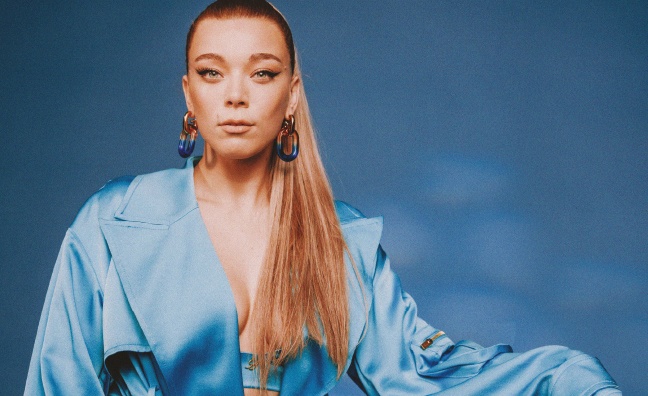
As Becky Hill drops her new single with Alesso, Surrender, here's a chance to revisit our cover feature from April 2024...
With myriad hits and a Top 10 debut album to her name already, Becky Hill has proved herself time and again. Yet, for the Bewdley-born dance music obsessive, there remains a sense that she has never really got the respect she deserves – until now. With her anthem-packed, ultra personal second album Believe Me Now? she intends to underline her chart-busting superpowers and write her name into dance music history. This is Becky Hill’s moment and, to celebrate, Music Week meets the singer, alongside Polydor’s Ben Mortimer and manager Alex Martin, to tell the powerful story of how she beat the odds to blaze her own trail through the music industry…
WORDS: NIALL DOHERTY PHOTOS: SAM NEILL
When Becky Hill wants to measure gender equality in dance music, she thinks of touching down at the airport in Ibiza.
“You land and all you see are men’s faces on billboards,” says Hill. “That’s when I realise how far we’ve got to go with music. We don’t have a situation in the superclubs like Hï or Amnesia where a woman is doing a headline residency.”
It’s something that Hill is determined to remedy. The 30-year-old from Bewdley, Worcestershire, is one of the breakthrough stars of the past decade but as far as Hill is concerned, she is only just getting started.
“I won’t stop until I’m stood shoulder to shoulder with Calvin Harris, David Guetta and Tiësto in Ushuaïa in Ibiza,” she says. “That is a goal I’ve had for a couple of years now.”
Hill is speaking from her home in London. It’s a grey morning in spring and she’s not been up for long. Hill is not usually one for lie-ins but she got in late last night from a promo blitz in Germany and crashed out for an impressive 11 hours. Now she’s raring to go all over again. There is lots to get done before the release of her second record on May 31, via Polydor/Eko. Titled Believe Me Now?, it’s a euphoric dance record that pairs Hill’s love of mid-’00s rave culture with her knack for widescreen, jubilant pop hooks. Hill has her sights set on the biggest prizes, eager to replicate the success she’s achieved on home turf with triumphs further afield.
“It feels like I’ve achieved breaking the UK, which is what I always wanted to do. It took me probably 12 years and now I feel like I’m onto the rest of the world,” she states. “That feels really good. I’m just hoping the rest of the world gets with the Becky Hill programme.”
But first, how about a quick recap? The singer has almost 18 million monthly listeners on Spotify and has racked up over 10 billion streams. She has multiple million-selling UK singles, six Top 10 hits, a No.1, won Best Dance Act at the BRITs twice and her 2021 full-length debut Only Honest On The Weekend hit No.7. That record has 268,767 sales to date, according to the Official Charts Company, while Get To Know, the 2019 compilation album that preceded it, has 422,037.
Hill originally emerged as a contestant on The Voice and then came a long, up-and-down journey of carving out a career on her own terms. It’s a road that has taken in flop singles and being dropped on the way to hard-won success.
Something in those early career hurdles have imbued a fiery determination in the likeable Hill, the singer intent on doing things her way. The easy option on Believe Me Now?, you imagine, would be to keep things ticking over and not tamper with a winning formula. But Hill had other ideas.
“When we did [2021 single, with David Guetta] Remember, the idea was to be as overly saturated on radio as possible, to get people to link the dots on who I was and what music I did. We definitely did that and it was a great move commercially,” she says, nodding to the success of a song that won her another BRIT and has 1,680,512 sales. “But I felt like I’d become a bit of a radio commodity.”
This phase of her career, she explains, was to try and get “some cool points back”, an idea that prompted the drum & bass banger and No.3 hit Disconnect (672,779 sales), a team-up with Chase & Status. It’s an approach that has its roots in Hill wanting her music to be more like the material she actually listens to.
“It’s not that I don’t like my own music,” she protests. “But I’m very immersed in dance culture and I wanted to have a new body of work that didn’t isolate the commercial by any means but fitted a little better into the dance world. The new album is still great pop songs – I can’t write anything other than pop music – but it’s teamed up with a weightier, purer production and I can’t wait to see what people think of it.”
“Making an album that was a body of work is really important to Becky,” says Hill’s manager Alex Martin, who has worked with the singer since 2012. “As a dance music artist, it is sometimes difficult to get people to buy into you as an albums act. She has accomplished something which is very, very impressive. Her directive was to create a really idiosyncratic body of work but one that didn’t alienate her fanbase, that brought them along with it and that was a step up as well – sonically, visually, everything about the project is taken several notches up.”
Hill recalls speaking to Ben Mortimer and telling him that she wanted to go more dancey on the production with this record.
“I said to him, ‘I’m always gonna make commercial music but I just want it to be a little bit cooler and less try-hard and a lot more heads-y,’” she says. “I want to be an artist. This is my artist era and I hope it’s as successful as my chart era.”
“Becky has served her time in the rave, it’s in her DNA and this album really reflects that,” salutes Mortimer. “But I love her vocal when she sings ballads and does more pop moments. One of my favourite songs of hers is [2014 single] Losing. I’d love to hear her do more things like that.”
Mortimer says that whilst Polydor doesn’t distinguish their artists as being ‘singles’ acts or ‘albums’ acts, he does feel it’s worth pointing out that Hill’s debut is just shy of platinum sales in the UK. “That’s no mean feat for an alleged ‘singles’ artist!” he states.
Hill says she has a great relationship with her label, where she signed in 2017, following a short stint as an independent act after parting ways with Parlophone in 2014.
“They’re amazing because they see how scared I am and they try to reassure me that they’re not gonna leave me, at least not any time soon anyway,” Hill states. “The whole relationship has really been lovely because they just see that I want to sell loads of records for them and for me. It’s been a bit of a journey with this album and it’s been lovely that I’ve had the label behind me.”
Chase & Status are amongst a collective of new names, including Parisi, Toddla T, Maur, Mark Ralph and Jax Jones, joining Hill’s tried and trusted collaborators.
“Generally, the people who have worked on the album I’ve worked with for my entire career,” Hill says, pinpointing the songwriting relationships she has with Karen Poole, Mike Kintish, Charlotte Haining, Rob Harvey and Emily Makis as pivotal to her creative process. “The songwriters I have on this album know me incredibly well and have put me at the most ease to write the record I want to write.”
Makis, with whom Hill wrote Disconnect, prompted the singer to start up her own publishing imprint, Eko Publishing.
“The moment I heard her music, I thought she was gonna be special,” Hill raves. “I don’t do a writing session without her in it. People don’t have their eyes firmly enough on who is coming up in the drum & bass scene to be able to sign them for records and publishing. As soon as I heard Emily, I was like, ‘Yeah, I’ve got to develop her’ and not just as a writer, I want to move her into a space so she is her own artist.”

Lyrically, too, Hill wanted to move the needle. She recently turned 30 and wanted the words to reflect where she was in life.
“I wanted to speak about things that weren’t ‘lying in bed on my own, I wake up and I don’t see your name on my phone,’” she says, quoting the words to her hit song Remember. “I wanted to step it up a little bit in terms of the subject matter… I’m eight years into my relationship now, I’m getting married this year, I’m probably going to start looking to buy a family home – I’m at a very different point in my life than where I was when I did Only Honest On The Weekend.”
The title of Believe Me Now? could be construed as a playful nod of vindication towards an industry that really made Hill work for it – in an interview with Music Week three years ago, she winced at the memory of begging dismissive record company execs to give her a record deal. And it is a little bit that, she says.
“The industry took so long to pick up on the fact that I am valid in what I do, I deserve what I do and I deserve the success,” she says. “It took me a long time [too]. I feel like now I’m at a point where I’m able to hold my head up high and fucking go for it, because, why not me?”
A more poignant and emotional reading of the title, though, can be found in storming opener True Colours. Content warning: it’s a song about a sexual assault suffered by Hill a decade ago, what follows is her account of the incident.
“I was raped by my best friend when I was 21,” she says. “I had a big group of friends at the time and I knew they wouldn’t believe me. I went into years of therapy and when I was 25… I’d say 2018 was my worst year ever because that was the year me and my fiancé broke up for eight or nine months, my grandad died of cancer and I found out he had died when I was in the middle of an interview reporting my rape to the police. Pretty intense shit.”
She says she’d talk about the incident in writing sessions but could never find a way to write about it in a song.
“I wanted this to be the album where I at least had one record where I fucking talked about it in the way that I wanted to – and the way I wanted to wasn’t a sad, fragile part, it was an angry part and I loved how powerful that was,” she continues. “We referenced Bodyrox’s Yeah Yeah, the D Ramirez remix, another 2005 dance record that I loved that had the right balance of attitude and grit and anger. I’d dealt with the rape through the therapy but I’d never dealt with the fact that my friends had never backed me up or believed me.”
It was last year, she recalls, that she finally gathered her friends in a room and asked them if they now believed her.
“They all went, ‘Yeah, and to be honest we probably believed you the whole time and we didn’t say anything and Becky we’re so sorry.’” she recalls. “That was the closing of a chapter that I had been subconsciously ruminating on for the entirety of my 20s. I wanted to call the album Believe Me Now? because the petty side of me wanted to show my friends how much it had hurt me, even though I don’t think they needed to be reminded; they all know.”
Hill thinks True Colours will probably be the only song she’ll ever be able to write about the experience.
“As you go through the album, there’s a lot of vulnerability there as a woman rather than a child or a girl in her 20s,” she says. “It’s a more considered record and what I’m writing about feels more considered.”
As the stages – and the stakes – have got bigger in her career, Hill has had to get better at taking care of herself. Always aware that a bout of anxiety could take hold at any given moment, she decided to cut down on her drinking and partying.
“I had to sit down and have a big chat with myself about where we wanted to go, how we wanted to do that, what was standing in my way and how I was going to overcome those barriers,” she says. “I think compassion for myself has been a really big play, to not beat myself up so much.”
She is proud at how she’s surrounded herself with such a supportive crew.
“I work with an incredible team and that goes from Phoebe [Sinclair, PR], to Amanda [Barker, Hill’s day-to-day manager], to my manager Alex, to Polydor. I’ve really curated the best team. I’ve got 12 years of experience in the industry now and I’ve met a lot of amazing people. I’ve met a lot of c**ts as well, don’t get me wrong, but I feel like I’ve held on tightest to the people I love and love working with the most. Alex is the only manager I’ve ever had since I was 18 and I love the Polydor team so much.”
When it comes to gauging success for his label’s acts, Ben Mortimer has spent a considerable amount of time drumming into his team not to focus solely on chart positions.
“It’s more about the general health of our artist’s business,” says the Polydor president. “Becky’s business is incredibly healthy. The music on this record is superb and she seems in great spirits. Those are the important metrics for me.”
Even so, Mortimer says that the label has seen significant growth in Hill’s audience in the run-up to her second album.
“Her arena tour sold out fast, her merch sales are firing and there’s increased interest around the world,” he adds. “That points to an artist with depth, not just ‘moments’.”
Hill is balancing being commercially successful and a credible dance act perfectly, Mortimer says.
“She’s really getting the props she deserves from the dance scene now,” he opines. “The way the drum & bass community galvanised behind Disconnect was one of the reasons it was so successful. And to see her winning Best Vocalist at the DNB Awards meant a huge amount to her. It’s recognition from her peers.”
Hill’s manager Martin adds that he admires Hill’s decision to mix things up on her second record rather than try and replicate what she did on her debut.
“She’s someone who wants to take risks and that for me is what artistry is about,” he says. “I’m not going to deny I was slightly nervous about what this next album would bring, because she’d had great success with the previous album and her compilation album Get To Know before. Her trajectory was phenomenal and no one wants to see anything that’s gonna rock the boat too much. But I think she’s landed in an incredible sweet spot where she’s been able to satisfy her creative urges.”
Martin highlights the importance of those working with an artist to simply let them be, to let the music come.
“The team around her have been fantastic helping her to realise that, Polydor have been fantastic once again in supporting her vision, visually, aesthetically and musically,” he says. “Never once did they stand in the way of anything. That has been a fantastic foundation for our relationship; they’ve trusted in her vision for this and it has been executed really well.”
Martin says this campaign is all about expansion.
“The scale of the project has increased immeasurably,” he reflects. “This new album and stage of her career has been about turning domestic success into global success.”
He pinpoints the team in place around Hill as crucial to that coming to fruition.
“We have an incredible team around us: Emma Banks and Ben Coles over at CAA, Ed Weidman, her lawyer, David Ventura at Sony Music Publishing and all of their teams,” he states. “And then the label, especially David Joseph, who has been incredibly supportive, and obviously Ben Mortimer and his team, Richard O’Donovan, Jamie Ahye, Stephen Hallowes, Jodie Cammidge, Ollie Hunter. It’s important to shout out all these people.”
“Becky and Richard O’Donovan have an open and honest relationship,” adds Ben Mortimer. “There is mutual respect and that’s exactly how it should be.”

Credit: Simon Joyner, Getty
Mortimer says that Hill now gets the kudos she deserves for her songwriting prowess.
“The recognition is there now,” he smiles. “People are aware of just how involved she is in the creative process and quite how many hits she’s been involved in. She is no longer a best-kept secret, thankfully.”
Martin says that the team’s mentality is to always keep on pushing forward.
“We have great support at DSPs and radio,” he says. “I’ve always been really proud of the fact that whenever there’s been a door put in our way, then we come with the mentality, ‘OK, well that door is closed, but we’re going to boot it open.’ That’s been our MO from day one.”
With a huge tour on the horizon in the autumn – including a date at OVO Arena, Wembley in October – Martin says Hill’s live business is stepping up, too.
“It’s huge,” he smiles. “She’s going to have a sold-out arena tour in the UK in October. We’ve built up a really great live business over in the States that strategically we’ve worked on very hard for the last four years. Becky is headlining festivals domestically and starting to headline them internationally. We’re starting to make those moves. People want to see Becky live; she’s an amazing live performer.”
These days, when Becky Hill goes backstage and sees women in the crew and in the production office, as well as women on stage, she feels like steps are slowly being made forward for gender parity in the dance world.
“I’m now seeing bookers being more conscious about who they’re booking, people listening to people like Kenya Grace and Cat Burns on places like TikTok, which feels progressive,” Hill says. “There has been a mission that was greater than me, which was that we were going to pave a way for women in dance music and I know that sounds really cheesy but I feel like I’m at a point now where I have seen things change.”
The dream is that no emerging female artist has to put up with some of the horrifying scenarios Hill herself had
to navigate. She remembers one nasty exchange early in her career after a show.
“I was in a production office with my friend and about seven other men who either worked there or didn’t, and some guy came in, another performer, and he took one look at me and started asking the rest of the room what I was doing in the production office,” she recounts. “He went through every man, pointing at them and going, ‘Is she shagging you? Are you shagging her? Are you? Are you? What’s she doing here, then? If no one is shagging her, what’s she doing here?’ and I remember being the only person who was speaking up. I was like, ‘I’m getting paid more than you to be here, you fucking arsehole.’ I was looking round the room for help and nobody did, nobody said a word.”
If Hill encountered a young version of herself just starting out, she would pass on the following key pieces of advice.
“Be as much a businesswoman as you are an artist,” she says, reeling them off one by one. “Read your contracts, sit down with your lawyer and understand everything. Work out what’s commercially right, what’s artistically right and pick your battles. And don’t fucking stop, be as ambitious as you can be and try and enjoy the process. I have to keep reminding myself of that one.”
Hill would love a No.1 album with Believe Me Now? but, more than that, she’d love it to be the record that made people take dance music more seriously.
“I think it’s quite notorious that dance albums don’t do much in terms of sales and people not really giving a shit,” she reasons. “I’d like to buck that trend, I’d like it to be the dance album that brings it back home for dance music.”
She learned things about herself making this album, Hill says, emerging as more determined, driven and ambitious than she has ever been.
“I’m a hard motherfucker, I am such a bad bitch,” she declares. “I have worked my fucking arse off and I’m still here 12 years later to make a second record when a lot of people thought I was going to fall by the wayside. I’m completely unstoppable and I’m completely unbreakable and this is just the beginning.”
Becky Hill won’t stop until she comes out of Ibiza Airport and is greeted by the sight of herself standing shoulder to shoulder on a billboard with her male counterparts. Because, like she says, why not her?