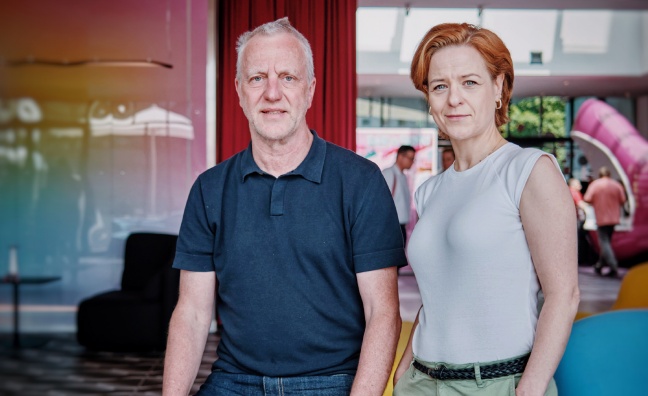
Zebralution co-CEOs Tina Jürgens and Konrad von Löhneysen have reflected on the in an interview with Music Week.
The duo jointly took over at the helm of German-hailing digital distributor at the beginning of 2024. And at a critical juncture for the independent world, given Universal Music Group’s acquisition of PIAS and proposed deal for Downtown Music Holdings, they remain steadfast in their belief in the sector.
"I think there is a need for independence," said Jürgens, speaking in our August issue. "There’s something in us as humans that treasures that and that’s why it’s a core value of our company to make that happen.”
Berlin-based Von Löhneysen, who is one of three independent representatives on the IFPI board, has experienced life through both lenses during his 30-year career in the record business.
“I worked for BMG for five years, then Universal for three years, but the rest of my time I worked for independents and we always thought, ‘Now we’re going to be in a very difficult period,’" he said. "In a physical world, we got a lot less from the major record chains or department stores, so that has completely changed. With the introduction of the digital marketplace, we came into a better space."
I think there is a need for independence... there's something in us as humans that treasures that
Tina Jürgens
He continued: "I think the launch of Merlin was one of the best things the indie community ever did and put us on a different level when negotiating with the DSPs, so I’m not concerned. Where I am a little bit concerned is with hits. The indies have a very good market share in terms of albums, but with singles it’s very major-driven and US-led.”
Von Löhneysen is careful not to overstate the case for the indies, but pointed to obvious benefits.
“At the end of the day, we all deliver to the same shops, so it would be bullshit to say, ‘We have some secret rocket science,’" he said. "I think it [comes down to] flexibility, because we have deals with the shops directly, whereas the majors have one deal that sits in the US and if you sit in the UK or Germany, everything needs to go through the US first if you want to change something. If you’re an artist or a label with a certain story, you will get more attention with an indie than with a major because they constantly have another US priority.”
In 2019, German collection society GEMA acquired a majority stake in Zebralution, which was previously part of Warner Music Group until it was sold off to a consortium as part of the Parlophone Label Group divestments.
“We’re owned by the community that we serve through GEMA – songwriters and artists – and not necessarily by a financial institution," said William Hallström, Zebralution's SVP UK, Ireland & the Nordics. "That is part of the definition of our independence. As an organisation, we’re not dictated just by maximising shareholder value; it’s about focusing on the human element of our operation.”
I don’t think there’s another independent on a level like we are
Konrad von Löhneysen
Von Löhneysen suggested Zebralution, whose clients include Röyksopp, WhoMadeWho, The Whitest Boy Alive, Charlotte OC and Anoushka Shankar, offered a clear USP.
"If you look at France, there are at least three capable, independent digital distribution companies," he said. "If we look at the UK, you have the ones owned by the majors, but I don’t think there’s another independent on a level like we are. Of course, there’s Republic Of Music, but they come more from a physical side.”
Turning to AI, Jürgens, who joined the firm in 2018 as MD of Zebralution Podcast, said she was open-minded about the threats and opportunities presented by the technology.
“I do believe there’s a lot of opportunity there when it’s done in the right way, but we have to set boundaries in terms of what is useful and what is not," she said. "I mean that in a broader sense, because we’re not selling milk here, the things that we are spreading into the world have a cultural impact.”
Music Week subscribers can read the full interview with Zebralution here.