There was some surprise news in the industry with the announcement of Daniel Ek’s decision to step down as CEO of Spotify.
But it’s now clear that the decision had been made some time ago and Ek was getting ready to move into a new role as executive chairman. He even hinted at it in a discussion including balancing life and family with the David Senra podcast a few days ago.
The company announced that Gustav Söderström, co-president and chief product and technology officer, and Alex Norström, co-president and chief business officer, will be promoted to become co-CEOs. They will report to Daniel Ek and will also serve on the company’s board of directors, subject to shareholder approval.
Ek promoted Norström and Söderström to the roles of co-presidents in 2023, perhaps with a view to a leadership handover in a few years’ time. The change will happen from January 1, 2026.
It also follows a series of big licensing renewals and expanded agreements with majors across recordings and publishing.
While there has been coverage of a boycott of Spotify by some acts, including Massive Attack, over Ek’s outside investments, that does not appear to have been a factor in his sideways move.
To mark the end of an era after two decades – Ek has been running Spotify since he co-founded it in early 2006 – the three of them gathered for a Q&A call for investors to discuss the big decision and the future. Here, Music Week highlights some of the key areas of discussion…
THE TIME IS RIGHT
Spotify reported 276 million subscribers in Q2, with net additions of eight million exceeding the guidance by three million. The share price is up around 50% for the year to date.
“Alex and Gustav are truly delivering exceptionally well already,” said Ek during the Q&A. “And I feel like this is a natural evolution of what we already do as a leadership team. Gustav and Alex, since taking over as co-presidents in 2023, have really stepped up in a material way, taking much of the day-to-day responsibilities. As they've been growing, I've been handing them more and more of the tasks. So I feel like this is actually more of a natural reflection of how the company actually works and operates already.”
He added: “I've evolved from being more of a player to more of a coach type model, and I will work with Gustav and Alex on the big strategic decisions that we face in the long arc of the company.”
NEW LEADERS
With two co-CEOs of Spotify, how will the new leadership work in terms of day-to-day operations?
“Alex and I will have the same divisional responsibilities that we've had as co-presidents,” said Gustav Söderström. “My core responsibilities are product and technology, and Alex's core responsibilities are business markets and content. But as we've said before on earnings calls, the way Alex and I work is a little bit different. We work very closely together. Alex is deeply interested and knowledgeable about product, and I'm very interested in business, so we run this as a single team – our joint teams together. So in practice, not that much will change from how we run the company – but these are the core responsibilities that we have.”
COLLABORATIVE WORKING
While the typical chief executive might consider it to be about leading from the front, the Stockholm-based Spotify leadership are all about working together – even with Ek still in the CEO role.
“The three of us have worked together for more than a decade and a half now, and if there's one thing both Gustav and I know about Daniel, is that he's a learning machine,” said Alex Norström. “And, as such, he's not only learning a lot himself, he's also expecting us to learn a lot too. So this has been a gradual change where he's progressively pushed more and more responsibility and accountability over to us. Like Gustav said, three years ago, we started with this integrated team at the top. We took on more and more of the strategy and operations.
“And a fun fact is that we actually sit in the same room, the three of us. People are very surprised when they see that, but that has just meant so much in terms of momentum and impact for us as a business. So for me and Gustav, though, this is not so much a change in direction. This is more doubling down on the set-up that we think is working, and it will increase in pace even more.”
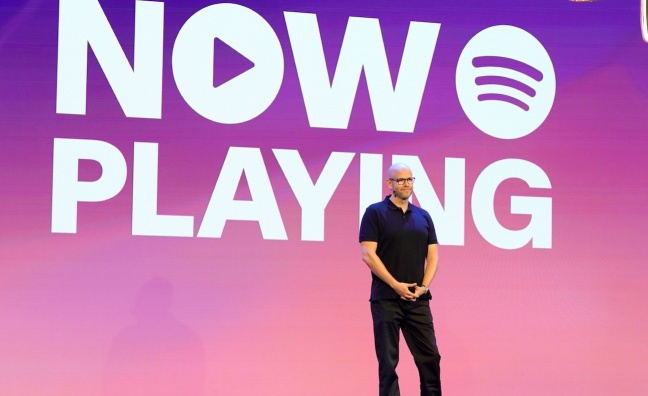
 Dustee Jenkins, Chief Public Affairs Officer, Spotify, Daniel Ek, Jon Batiste, Alex Norström and Gustav Söderström (Photo by Presley Ann/Getty Images)
NEW CONSUMERS AND MARKETS
In his previous addresses, Daniel Ek has at times sounded like a prophet for streaming. Even as he prepares to move sideways, he is still proselytising about the company’s expansion.
“What I think is very important is that I still believe, with every fibre of my being, that we're early on this journey,” he said. “When you look out and see what's still left on the table for Spotify, there are some amazing opportunities. One of them, of course, is there's the next generation of consumers that are now coming online in a very big way. We have a huge part of the world that still isn't really accustomed to streaming as much as we take it for granted today, with everything from Asia to Africa, which are also incredibly populous regions and very young demographics too.
“And then, of course, we have new technology advancements, new form factors, AI, all of these other things too. I'm reminded of the Bill Gates’ quote that people tend to overestimate the short term and underestimate the long term, and that's certainly one of the things that Alex, Gustav and I talk a lot about. I'm going to keep pushing for us to look around the corner, stay focused on the long term, and keep showing up every day and make gradual improvements, because that's, long term, what leads to the best results, and that I know is the product of what Spotify is today.”
AI BENEFITS
For Söderström, leveraging the power of AI for Spotify is a priority – and he anticipates it taking the platform in new areas. Spotify users have already been used to their AI DJ playlist, as well as the bespoke AI podcast for Spotify Wrapped.
“There are better recommendations, there's more personalisation, but we also think it's going to eventually end up in new form factors,” he said. “My top priority, my one, two and three, is to make sure that we capture this opportunity and make it a tailwind that actually accelerates us.”
EUROPEAN MODEL
While Spotify is a US-listed company, Ek was at pains to stress that the executive chairman role is an active European executive role that Americans may not be familiar with.
“Everyone probably has different anticipations about what a chairman is, but I think most investors may come at it from a US perspective, where it's mostly a ceremonial role,” said Ek. “In Europe, it isn't. In fact, a chairman is someone who's quite active in the business, sometimes even represents the business externally to different stakeholders, like, for instance, governments or key partners.
“So we wanted to make it clear that this role is more in line with the European one than an American one. And then the executive part is that I am still retaining an office here with Gustav and Alex sitting here, hopefully, working on various types of problems with them. But with all that said, I do want to make it clear – they're in charge. They're the ones making a decision, but I will be there as a friend, a coach, a cheerleader, whatever I'm needed to do for the day in making this happen.”
COMMITMENT TO MUSIC
Spotify has rolled out audiobooks, in addition to the podcasts that sit alongside music on the platform. But the new leadership insist they are committed to music as the driver for the platform.
“We're lucky that we started with music, because everyone on planet Earth has some relationship with music,” said Norström. “Today, at Spotify, we see 3% of the world's population paying us on a recurring basis for a product that they're loving – 90% of people say it's essential to their lives. And if you ask me, will we ever be at 90 or 95%? Maybe that's crazy, but it's not unimaginable that we'll be at 10%, 15%, just because of the geographical opportunity that we see out there.
“Like Daniel mentioned, the populous nations of India, lots of growth going on in there, Bangladesh, Pakistan, very populous regions. You have Africa as well coming online. This is just reminiscent of what we saw in the beginning of LATAM, which was lots and lots of growth to look forward to.”
GROWTH, GROWTH, GROWTH
Spotify’s profitability was less important than relentless expansion for a long spell, and some of that philosophy remains judging by Norström’s answer to a question about the priorities for 2026.
Having previously spoken about the ambitions for a billion users, in an FT interview last month Norström raised that to a billion subscribers.
“So on my first day at Spotify, I sat next to Daniel, and Gustav was there too,” he said. “I asked Daniel, ‘Okay, I joined now, what does the priority list look like?’ He's like, ‘It's very easy. There's only three things for me to think about. Number one is growth. Number two is growth. And guess what? Number three is growth as well.’ And then he said, ‘You may begin, guys’. And then we set off.
“You've heard Gustav and me say that we will relentlessly just put value into the product and give that to subscribers and users. That is what we're about. We are going to continue to innovate, push boundaries, and provide more and more value. This is a consumer business like Gustav mentioned earlier, and we are relentless about doing that. So we'll continue that.”
 FOLLOW