Streaming fraud continues to represent a growing threat to the music industry model. With the explosion of AI-generated music on DSPs, there’s an even greater threat from streaming manipulation.
With streaming royalties based on the pot of money generated by DSPs from subscriptions and advertising, any part of that diverted to fraudulent operators – via bots, streaming farms and other illegitimate methods to inflate play counts – means less income for real artists and songwriters as well as rights-holders.
A legal case in the US last month is seen as the first criminal prosecution of AI-based streaming fraud. It involved thousands of fake songs streamed billions of times, generating more than $8 million in royalties over several years.
Meanwhile, international labels trade body IFPI continues to support action against streaming fraud, including a legal case in Brazil.
In the new edition of Music Week, industry leaders outline what needs to be done to tackle the problem. In our streaming fraud investigation, we speak to executives including Simon Robson, president, EMEA, Recorded Music, Warner Music Group, Dennis Kooker, president, global digital business at Sony Music, BPI CEO Dr Jo Twist and Sarah McNabb, director of content integrity at Merlin.
We also hear from DSPs about how they are handling the scale of streaming manipulation.
Deezer has now revealed that it is receiving almost 75,000 AI-generated tracks per day, representing roughly 44% of the daily uploads. This amounts to more than two million AI-generated tracks uploaded per month.
While AI music is not barred from the platform, it is not supported editorially or algorithmically with playlists.
In many cases, AI-created songs are spammy tracks that are not being uploaded for legitimate streaming. Some 85% of the streams of AI music are detected as fraudulent and are demonetised by Deezer.
“Streaming fraud needs to be addressed at all levels of the music industry and we continue to do our part and collaborate with our partners to stay ahead of the issue,” Thibault Roucou, director, royalties and reporting at Deezer, told Music Week.
Following measures implemented by Deezer, it said consumption of AI-generated music on the platform is between 1-3% of the total streams.
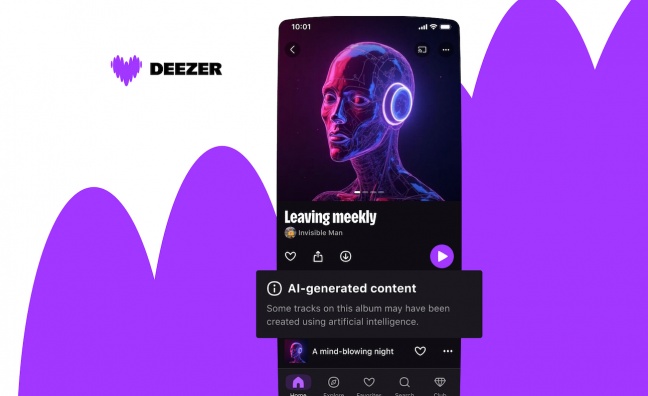
In June 2025, Deezer became the first music streaming platform to explicitly tag AI-generated music. Over 13.4 million AI-tracks were detected and tagged on Deezer in 2025. It also works to safeguard artists’ rights by removing unlicensed music from the platform.
Streaming fraud needs to be addressed at all levels of the music industry and we continue to do our part and collaborate with our partners to stay ahead of the issue
Thibault Roucou
Deezer has the ability to detect AI-generated music from platforms such as Suno and Udio, with the possibility to add detection capabilities for similar services. It has also made “significant progress” in creating a system to detect AI-generated content without a specific dataset to train on.
Thibault Roucou said that streaming fraud across the entire catalogue accounted for 8% of all streams on the platform in 2025.
“Generating fake streams continue to be the main purpose for uploading AI-generated music, and while only a small share of the total streams on Deezer (up to 3%) come from AI-generated tracks, up to 85% of these streams were fraudulent in 2025, depending on the month,” said Roucou. “By comparison, streaming fraud across the entire catalogue accounted for only 8% of all streams in 2025.”
Those fake streams detected were demonetised by Deezer. But that 8% figure signals the possible scale of the problem, which remains unclear across the wider industry.
Deezer launched its AI-music detection tool more than a year ago. The company has since been notably transparent around AI-generated music by regularly revealing updated facts and figures – data welcomed by label executives who have spoken to Music Week.
“Over the past 10 years we have developed multiple algorithms to detect different kinds of fraud, and we currently have a team of 15 people working with fraud detection as part of their job role,” said Roucou. “We are continuously developing our algorithms through cutting edge machine learning and AI, to keep pace with new methods of streaming fraud. When detecting streaming fraud or manipulation of any kind, we exclude the streams from the royalty payments.”
This amount of AI-based tracks uploaded daily to the platform has increased from 10,000 to 75,000 in little over a year.
Songs detected as AI-generated are automatically removed from algorithmic recommendations and are not included in editorial playlists. This prevents these tracks from diluting the royalty pool in any significant way.
Deezer said potential future actions, including updating supplier policy and removing/demonetising content, will be based on careful consideration.
According to a study conducted by CISAC and PMP Strategy, nearly 25% of MUSIC creators’ revenues are at risk by 2028, which could amount to as much as €4 billion by that time.
"AI-generated music is now far from a marginal phenomenon and as daily deliveries keep increasing, we hope the whole music ecosystem will join us in taking action to help safeguard artist’s rights and promote transparency for fans," said Alexis Lanternier, CEO of Deezer. "Thanks to our technology and the proactive measures we put in place more than a year ago, we have shown that it’s possible to reduce AI-related fraud and payment dilution in streaming to a minimum. Since January, we have made our detection technology available for licensing, and we’re looking forward to seeing industry peers of all kinds join us in the fight for fairness in the age of AI.
Deezer also commissioned an international study on attitudes towards AI-music, which revealed that 97% of people couldn’t hear the differences between AI and human made music, and that 80% of people agree that 100% AI-generated music should be clearly labeled to listeners.
Subscribers can read our report on streaming fraud here.
 FOLLOW