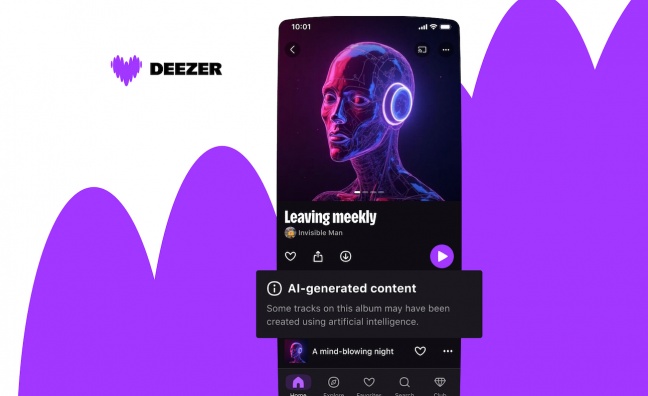
Deezer has introduced the “world’s first AI tagging system for music streaming”, clearly displaying which albums include fully AI generated tracks.
The Paris-based streaming company recently announced the launch of its AI-music detection tool, revealing that 18% of all music uploaded on a daily basis – more than 20,000 tracks – is 100% AI generated.
The AI-music detection tool has the ability to detect 100% AI-generated music from the most prolific generative models, such as Suno and Udio, with the possibility to add detection capabilities for any other similar tool.
“We’ve detected a significant uptick in delivery of AI generated music only in the past few months and we see no sign of it slowing down,” said Alexis Lanternier, CEO, Deezer. “It’s an industry wide issue and we are committed to leading the way in increasing transparency by helping music fans identify which albums include AI music.
“AI is not inherently good or bad, but we believe a responsible and transparent approach is key to building trust with our users and the music industry. We are also clear in our commitment to safeguarding the rights of artists and songwriters at a time where copyright law is being put into question in favor of training AI models."
According to a study conducted by CISAC and PMP Strategy, with participation from key industry players (including Deezer), nearly 25% of creators’ revenues are at risk by 2028, which could amount to as much as €4 billion by that time.
Although fully AI-generated music currently accounts for only a small fraction of streams on Deezer – approximately 0.5% – the company said that the primary purpose of uploading these tracks to streaming platforms is fraudulent.
Deezer has found that up to 70% of the streams generated by fully AI-generated tracks are fraudulent. When detecting stream manipulation of any kind, it excludes the streams from the royalty payments.
Deezer is currently excluding fully AI generated tracks from algorithmic and editorial recommendations, in order to minimise any negative impact on artist remuneration and the user experience.
 FOLLOW