The UK music industry is facing up to the prospect of a rapidly maturing streaming market.
While there remains optimism about further growth in the years ahead, the slowing rate of increases in streaming consumption has become a clear pattern so far in 2025.
The drop-off in streaming’s momentum coincides with an industry debate about the frequency of DSP price rises – after more than a decade when they remained static – and the role of free ad-funded services in expanding the overall market.
Based on exclusive access to market data from the BPI, Music Week can exclusively reveal that the Q3 year-on-year streaming growth rate (SEA – streaming equivalent albums) was just 4.9%. That compares to 11.4% growth in Q3 2024, 12.2% in Q3 2023 and 8.0% in Q3 2022.
The figures, based on Official Charts Company data, show that streaming growth is tracking at 5.9% for the year to date.
It means that the vinyl sales increase – up 7.4% year-on-year so far in 2025 – is currently ahead of streaming growth. The overall recorded music market (AES) across all formats is up 4.8% for the year to date.
Despite the slowing momentum, Kim Bayley, CEO of digital entertainment and retail association ERA, suggested it is “way too early to call the top of the market”.
In 2024 there were just under 200 billion audio streams, accounting for nearly 89% of recorded consumption. Streaming growth (SEA) for that year came in at a healthy 11%, compared to 12% in 2023 and 8.1% in 2022.
At the current trajectory, streaming growth in 2025 could finish up at the lowest level on record. While the market growth did dip below 6% in 2021 (at 5.7%), that was partly blamed on an additional chart week in 2020 affecting the comparison.
BPI CEO Dr Jo Twist acknowledged that the UK streaming market is maturing, noting that “there is a natural point at which growth starts to slow, including in subscriber numbers when it comes to streaming”.
“However, while the idea of double-digit rises and exponential growth may perhaps be behind us, we can remain optimistic for further and solid growth for more years to come,” she added.
Charlie Lexton, COO of the independent sector’s digital licensing agency Merlin, said: “We remain positive about the UK market, which we do not think has yet reached the same levels of penetration as the Nordics. Therefore, while it’s impossible for the UK – or any market – to see double-digit annual growth forever, that doesn’t mean it has stopped growing or that we expect it to stop growing any time soon.”
We remain positive about the UK market, which we do not think has yet reached the same levels of penetration as the Nordics
Charlie Lexton
Following the latest UK Q3 market figures, Spotify has announced an additional UK price increase to £12.99 a month for a Premium individual subscription. It follows a wave of price increases across DSPs in the last few years.
"The price of Premium Individual is increasing so that we can invest in our product, develop new features and continue to bring you the best experience," Spotify informed customers.
With Spotify, for example, having increased premium individual subscriptions by 30% in just over two years, there is now a question of how higher charges might affect net gains in subscribers. For the music industry, price increases have been welcomed as a corrective, following a long period when the £9.99 charge stood still in order to support expansion of the customer base.
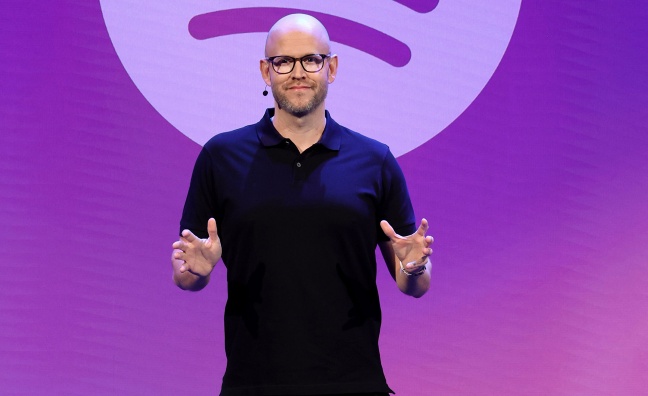
Last month it was announced that Daniel Ek (pictured), co-founder and CEO of Spotify, would be moving to the role of executive chairman, with Spotify’s Alex Norström and Gustav Söderström to be elevated to co-CEOs from January 1, 2026. Prior to this, in a recent FT interview, Norström, currently co-president and chief business officer at Spotify, said, “price increases and price adjustments… that’s part of our business toolbox”.
He added that Spotify would “keep adding value” – such as the introduction last month of Lossless audio at no extra cost.
“We believe in the value we are currently delivering for our users and remain focused on building for the long-term,” a Spotify spokesperson told Music Week ahead of the latest price increase. “We want to be really thoughtful about when we raise prices and will do it when the time is right and it makes sense for the business.”
In the latest Spotify Q3 results, subscriber numbers increased by 12% year-on-year to 281 million.
During the streaming giant's earnings call, Norström said that Spotify had seen "steady retention rates" following the roll-out of recent price increases across more than 150 markets. "These results show the power of the product and the loyalty of our subscribers,” he said.
Spotify does not break down its exact findings on price elasticity for subscriptions, but on the earnings call Norström used that same word, "thoughtful", when it comes to deciding when to increase prices.
"I want to reiterate that price increases are part of our strategy," he said. "You’ve seen this over the last couple of years. And of course, we will continue to do so, but in a thoughtful way. And this is always based on a number of different factors. The important thing is that we’re committed to pricing that reflects the value that we provide."
I want to reiterate that price increases are part of our strategy
Alex Norström
However, some subscriber churn is to be expected from price increases, according to Spotify.
"Our subscriber outlook [for Q4] implies net additions of eight million, which is slightly below prior year net adds due to the expected small amount of churn we see when we raise prices," said CFO Christian Luiga.
"When we adjust prices in markets, we take into consideration a number of different factors," said Norström. "We look at things like household income. We look at things like maturity of the market. We look at things like specific value to price ratio if there’s a specific different offering in that market... And when the timing is right, we do it and we do it in the magnitude that is right for that market."
On the earnings call, Daniel Ek also addressed a question on why price increases are varying by territory. For UK users, the addition of a free audibooks allowance may be contributing to the increase.
"I think implied in the question is that perhaps there’s a comparison of music to music competitors," said Ek. "But in many markets where we act now, Spotify is not just a music service anymore. It is a music podcast and an audiobooks service. In some markets, we haven’t yet gotten to with our audiobooks offering. So as you look at our pricing, we are factoring in the value, not just in music, but in all of the verticals that we act in as well. And I think this is an important addition to add because in a lot of the markets, their perception of what Spotify is, is just very different than what it is in other markets as well."
According to MIDiA research, excluding China and Russia, 45% of people who pay for a music streaming service subscribe to Spotify. Based on Luminate data, 65% of global audio music streams happen on Spotify.
“These outcomes reflect our obsessive focus on delivering value across both our premium subscription and free tiers,” added the Spotify spokesperson. “We are in incredibly strong shape and we have an expanding number of levers to grow the business.”
One of the enormous achievements of streaming services like Spotify, Amazon and YouTube has been to turn music into a must-have monthly service, rather than an occasional buy
Kim Bayley
In an investor presentation in June, Sony Music Group chairman Rob Stringer said price increases will need to continue – perhaps every 18 months – to maintain the value of music.
“Spotify launched over 15 years ago with a £9.99 price point and in real terms, it is much cheaper now,” said Lexton. “Taking that into account, it is obviously positive for the industry that price rises are now ‘part of Spotify’s toolbox’.”
“One of the enormous achievements of streaming services like Spotify, Amazon and YouTube has been to turn music into a must-have monthly service, rather than an occasional buy,” Bayley told Music Week. “Most fans do not regard it as a luxury. Prices have risen, but there has been no drop-off in the number of subscribers.”
Bayley noted that the typical all-you-can-eat streaming music service is “remarkable value” compared to paying for multiple video services.
“Audio streaming represents great value for money in terms of the almost unlimited access and choice it gives consumers, who, let’s not forget, have enjoyed and continue to enjoy a great offering, particularly when compared to other sectors,” added Twist.
There are also expectations of new super-premium tiers.
“That’s a matter for Spotify, but we know that fans are passionate about enjoying an enhanced music experience, and that some will be prepared to invest to access such offerings,” said Twist.
But while the music industry will welcome regular rounds of price rises and new tiers, parts of the sector have long been ambivalent towards the ad-funded model.
Yet Spotify recently improved the free experience, as it aims to provide both a funnel for premium and a safety net.
“Our free service is a key strategy for attracting new users – especially in developing markets, before converting them into paying subscribers,” said Spotify’s spokesperson. “The ad-supported tier introduces users to Spotify and encourages engagement. In fact, 60% of Premium subscribers started as free users.
“The free service also helps to prevent churn – if someone’s circumstances change they can move to the free tier rather than leave Spotify,” added the spokesperson. “By offering a free tier, Spotify not only supports a healthy ecosystem but also fuels a system that has proven to work for artists, consumers, and the music industry alike.”
We know that fans are passionate about enjoying an enhanced music experience, and that some will be prepared to invest to access such offerings
Dr Jo Twist
Lexton said Merlin works collaboratively with DSPs on ad-funded models.
“When it comes to free, our concern has always been the broader ecosystem and the contribution to building long-term subscription businesses,” he said. “There are different approaches to this, but both Spotify and YouTube have been very successful in building subscription [businesses].”
“The funnel effect, upselling fans from free-to-listen accounts to subscription, is a powerful tool,” said Bayley. “If we can find a way to tap into that market, there could yet be growth to come.”
Twist agreed that consumer choice is vital for the ecosystem.
“The more options there are to enable this diversity of choice and to encourage uptake, the better,” she told Music Week.
As the industry awaits the streaming performance in Q4, there could be another factor at play with the release schedule.
Bayley said that streaming has “reduced the seasonality of the music business and its dependence on a handful of current hits”, so Q4 is no longer the blockbuster quarter it once was.
Nevertheless, big new albums from Taylor Swift, Sabrina Carpenter and Olivia Dean, as well as a big comeback for Lily Allen, can only help in the final quarter.
“There are some pretty significant releases that are either recently out, or are due from now through to the end of the year, and one has to be optimistic that these will have a marked positive impact on streaming consumption and on physical sales, too,” said Twist.
PHOTO: Getty
 FOLLOW