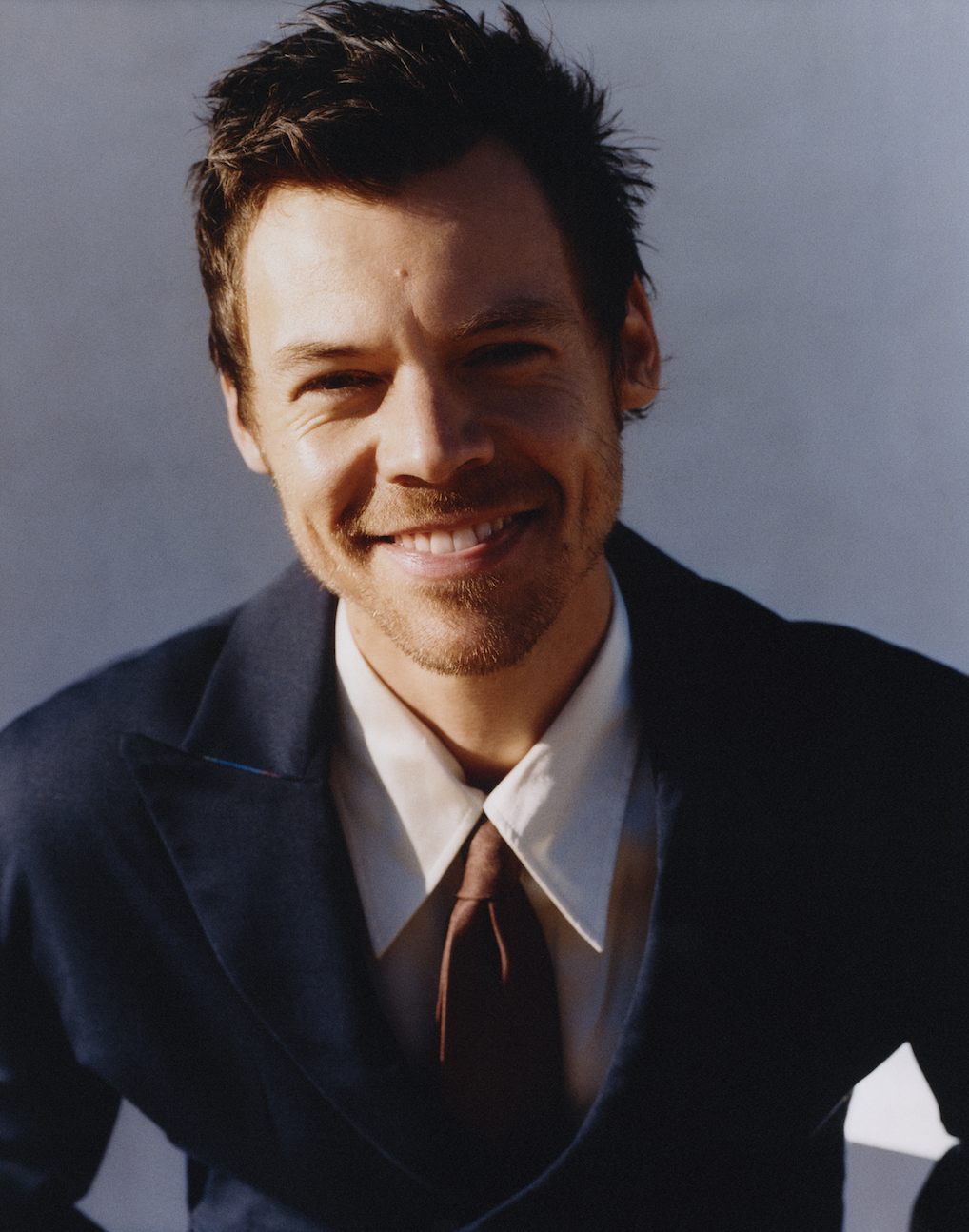
Nestled amidst a record-breaking 12-night run at Wembley Stadium, Harry Styles’ Meltdown performance promises to be one of the most intriguing moments of the Kiss All The Time. Disco, Occasionally campaign.
On June 16, Styles – whose new Together, Together show sees him running laps of the giant staging – will headline the 31st edition of Meltdown in the Royal Festival Hall, performing with Jules Buckley’s Orchestra. Buckley worked on Coming Up Roses from Styles’ chart-topping new record, as well as string arrangements for the current tour.
“Well, it's a piece and a show that he's putting together specifically for Meltdown and he has been working with Jules for a period of time to put that together,” says Jane Beese, head of contemporary music at The Southbank Centre, her words only intensifying the mystery around what this iteration of a Styles live show might look and sound like.
Meltdown has always been about being able to flick through somebody's record collection and find the unexpected
Jane Beese, The Southbank Centre
“Happily we’ve just been able to tell those who were successful in the ballot who actually got tickets for the show,” she adds with a smile. “It's been a really wonderful event to work on, and I think it'll be a really special one-off.”
As far as campaign highlights for stadium-filling megastars go, performing with orchestral backing in the grand confines of a venue such as the Royal Festival Hall is quite the look.
Beese’s message is to expect the unexpected.
“I think all of his tour supports have been very well thought through, but equally quite eclectic as well,” she says, as we begin to discuss Styles’ musical preferences. “I mean, I think he's just got good taste, don't you? It's as simple as that. [Laughs]. Actually, I shouldn't say good taste, I should say great taste!”
“But if you ask people what Meltdown is,” Beese continues, “You know, for me, it's always been about being able to flick through somebody's record collection and find the unexpected, and this is what we’ll get a glimpse of here.”
For his part, Styles’ stated goal as curator is to “share the music and art that I love, and to celebrate the rich history of the venue.”
“We both share a passionate belief that music is a vital part of life,” he has said. “It brings us together and the Southbank Centre has been at the heart of it, providing easy access to great music for the past 75 years.”
As well as the likes of Devonté Hynes, Warpaint, James Murphy, Nilüfer Yanya, Yussef Dayes, Beverly Glenn-Copeland & Elizabeth Copeland, Soulwax and more, Styles’ Meltdown also spotlights unsigned talent and features a day of dance workshops, with a programme of free content alongside many ticketed events.
“We're a little bit of a different proposition, but it does feel like a festival site when it's all running,” Beese says. “The site always feels very energetic…”
With that, we get into a discussion of what’s in store…
First of all, when and how did Harry Styles first come up as a potential curator for Meltdown?
“The process of choosing a Meltdown curator is a constant and ongoing conversation. There’s always a long list, so we've been thinking about Harry for quite a long time, actually. We’ve been in contact with his team on various different projects over the years, and we signed up at the tail end of last summer. We decided we weren't going to announce it until early this year, but the programming, choreography and the conversations with the agents all happened before the announcement. We did it all under NDAs, which was interesting. I fully expected that it wasn't going to be kept a secret, but somehow it was! Putting the beautiful jigsaw puzzle that is Meltdown together has been happening for about nine months now.”
What does it mean to have Harry Styles do it?
“It's the 31st version of Meltdown, it's the 75th birthday of the Royal Festival Hall, so it's 75 years since the Festival Of Britain. It’s interesting, isn't it? Because, if you ask people to define ‘big name’, everybody will have a different opinion. For us, it's not even necessarily about how many records somebody might have sold or how many tickets somebody might be worth, but more about their curiosity and their desire to take on that curatorial mantle. And obviously, for us to celebrate with an artist like Harry, with where he is in his career at the moment feels like a very big moment for the 75th. But it's really about an alignment of values, actually. For the Festival Of Britain in 1951, eight million people came to the site, including my father, my uncle and my grandparents. It was extraordinary. There's a really wonderful black and white documentary that I'd urge anybody to watch called Brief City, which really shows you the range of music, design, technology… Five years after the Second World War, in this part of London that was very grey and run down, they built this magical space. [Back then], I think it was about optimism for the future, and we live in challenging political times now and a lot of the messaging that we want to talk about as an organisation aligns with some of the positivity you would hear from an artist like Harry. We felt there was an alignment there in what we wanted to say about ourselves as an organisation, as an arts centre and what the future of that looks like, and we all need a bit of positivity, don't we?”
Can you give us some insight into the “beautiful jigsaw puzzle” you mentioned and how it actually gets pieced together? Particularly in the midst of a huge album campaign…
“I always say that Meltdown is different every time, and there's a spectrum of curators. Some get very, very involved, and some – very few actually – might present a list and say, ‘here's a list, and let's stick to it.’ There might be some who like or take a lot of guidance from us and then there's a sweet spot in the middle where it's very much a collaboration. Harry and his team came with a very strong list of ideas, and a very good instinct about what they wanted to represent in terms of genre. And that is where a lot of the collaboration comes in, working with the music team and the public programme team. Obviously, we live here, we work here all the time, so we know what works in different spaces, what works in the auditoriums, how we can use the free programme and all of the stuff that we do where you don't need to buy a ticket, whether it's a party on the terrace, or the brilliant photography project that we're putting together. There's a lot of back and forth, because there might be a list, but you probably wouldn't leave it to any curator's team to know which venue you might put certain things in, or what the ticket price might be for that. So there's a lot of very, very, very frequent back and forth, it probably has been daily for the last nine months.”
With Harry, I would just say we have a complete alignment on wanting to support the next generation
Jane Beese, The Southbank Centre
What do you think the line-up represents this year?
“I hope there's something for everybody, and I hope, as all programmers do, that we can attract some audiences who want to be curious about something that they don't know about. That, for me, is always the optimism with Meltdown, the hope that there's something that you haven't heard of, that you want to check out. We've also got a lot of artists who are probably worth more tickets than the size of the space that we've put them in, and a lot of them have graciously agreed to do two shows in a day, especially at the weekends. I think we really wanted to encourage this idea that you could come down, maybe catch two shows in a day, catch some of the free stuff outside and just have an enjoyable Harry Meltdown day, you know?”
You mentioned keeping it a secret, which you successfully navigated. What have been the other challenges of putting it together this year?
“One of the challenges has been the volume of what we're trying to do, but in my experience of being involved in this over 25 years, give or take, it's come together really nicely, actually, and succinctly, and if people haven't been available to join, it's been because of preexisting commitments. Everybody that was able to come to the party was very keen to come to the party.”
Who else are you excited about seeing on the line-up?
“I'm excited about a lot of it! I’m the hugest Mulatu Astatke fan, I am ridiculously excited to see Beverly Glen-Copeland again. Then there’s the show that Keir Stewart is doing, obviously, given that both myself and Harry are huge Durutti Column fans. Keir is doing an evening celebrating Vini Riley, which he's especially putting together for this, I think that's going to be amazing. Kamasi Washington is doing two shows in a day, which is slightly different. The Jon Hopkins audio installation piece that we're putting into the Purcell Room for the last three nights of the festival is going to be really beautiful. Working with Choose Love on that has been a really wonderful thing. We're also doing this incredible thing, a series of dance workshops to celebrate a very special choreographer, Paul Roberts. There are workshops for aspiring, semi professional dancers, and at the same time, for us amateurs, there are similar parallel workshops in a different space, and the plan is that in the early evening, the two groups will come together and do something public and quite special, I hope. So there are nice touches of Harry's interest in choreography, Harry’s interest in art and how he's interested in genres across the board.”
What are your main reflections on collaborating with Harry and his team?
“It is very different every year, depending on the artist, depending on their team, and for me this has been very collaborative, very generous on both sides, not a one sided conversation, but a real conversation. The main words that spring to mind are collaborative, creative and generous on both sides, where we listen to each other and speak to each other. It's a genuine conversation.”
He has mentioned The Durutti Column in interviews around the new record. Have you had conversations about both liking the band?
“Absolutely. We're both from the same part of the world, although I am a very different generation. But I like the fact that there's a nod to the classic North West, in some ways, one of, if not the greatest band on Factory Records ever, but maybe not the most highly sung band on Factory ever. I'm very proud there's that nod to the North West!”
Did the two of you bond over anything else?
“I would just say there's a complete alignment on wanting to support the next generation. [Was I as much of a fan of the clubs as Harry has been talking about being around the new album?] I mean, I spent a lot of time on the dancefloor, but it would have been on a series of very different dancefloors, maybe! [Laughs].
Finally, where does Meltdown sit in the live ecosystem more generally? How are you affected by the challenges the rest of the sector is facing with rising costs, ticket prices and the like?
“I think there are lots of challenges in the live music sector, and there are lots of challenges around creativity and the next generation. We've witnessed decades of the slow extraction and destruction of any sort of solid music, art, culture and design offering, certainly in state schools. Then if you couple that with the closure of youth clubs over decades, and the closure of small venues… I know that the pandemic obviously affected all sorts of industries and all sorts of ways, but it has not been kind to the live sector. In terms of festivals, a lot of independent festivals have closed in the last few years. Obviously, the cost of putting on these events is really challenging. For us, running a 75-year-old venue is challenging. We're in a time where people are really feeling that they need to keep an eye on the bank account, for all sorts of reasons, so yes, there are real challenges. Being part of this sector, we’re all keen to see the proliferation of talent and live events at every scale, from grassroots music venues, through to 100,000 people in a field together. One of the benefits of our venues being the venues that they are, is that there's usually a relatively decent, lower price ticket. Even if it's slightly at the back of the venue, we try to be very open about that. What Meltdown can be is a place where a lot of it is free to come to, and we try to be very careful that there are accessible ticket prices, too.”
PHOTOS: Pete Woodhead/The Southbank Centre/Laura Coulson
 FOLLOW